
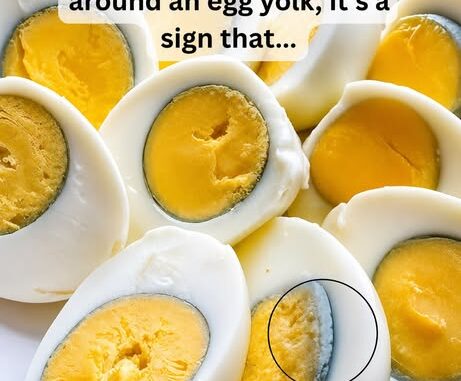
There’s nothing quite as disappointing as peeling a hard-boiled egg expecting a bright, golden-yellow yolk and discovering a strange greenish-gray ring around the outside instead.
It can look alarming enough to make you wonder whether the egg has spoiled.
Fortunately, that unusual color is usually much less dramatic than it appears.
In most cases, the green ring is caused by a chemical reaction that occurs when an egg is exposed to heat for too long. It generally has nothing to do with mold, contamination, or the egg suddenly becoming poisonous.
In fact, if the egg was fresh, handled properly, and stored safely, a green ring around the yolk is usually harmless.
The real problem is often that the egg has simply been overcooked.
Here’s what causes the color, whether you should eat the egg, and how to get smooth, golden yolks the next time you boil a batch.
What Causes the Green Ring?
The strange color comes down to the natural chemistry inside an egg.
Egg whites contain sulfur-containing compounds, while egg yolks contain iron. During cooking, heat changes the proteins in both parts of the egg.
When an egg is cooked for an extended period, sulfur from the white can react with iron from the yolk near the point where the two a ring around the outside of the yolk rather than throughout the entire center meet.
The resulting compound, iron sulfide, can produce the familiar greenish-gray discoloration.
That’s why the color usually appears as a ring around the outside of the yolk rather than throughout the entire center.
The longer the egg remains exposed to high heat, the more noticeable that ring can become.
So if you cut open an egg and discover a narrow green border, you haven’t necessarily discovered a spoiled egg.
You’ve probably discovered an overcooked one.
Is a Green-Yolked Egg Safe to Eat?
In general, the green ring itself isn’t a sign that the egg has spoiled.
If the egg was fresh and was handled and stored appropriately, the discoloration is usually simply the result of cooking.
However, it is important not to use color as the only way to unpleasant rotten odor, an abnormal slim determine whether food is safe.
A questionable egg should be discarded if it has an unpleasant rotten odor, an abnormal slimy texture, or has been stored improperly.
There’s a major difference between an egg that develops firm and rubbery, while the yolk may turn dry, crumbly, and chalky a green ring during cooking and an egg that has actually spoiled.
A properly handled egg with a greenish ring may still be perfectly edible.
An egg with signs of spoilage should not be eaten simply because the yolk happens to look normal.
When it comes to food safety, storage and handling matter just as much as appearance.
Why Does Overcooking Make It Worse?
An egg continues absorbing heat as long as it remains in hot water.
Once the yolk has completely set, additional cooking isn’t necessarily improving the egg.
Instead, the white can become increasingly firm and rubbery, while the yolk may turn dry, crumbly, and chalky.
At the same time, prolonged exposure to heat gives the sulfur and iron compounds more opportunity to react, making the green ring increasingly visible.
That’s why an overcooked egg can have several problems at once.
The yolk may look discolored.
The white may feel rubbery.
The yolk may crumble instead of having a smooth texture.
And the egg can develop a stronger sulfur-like smell.
The green ring is therefore often less of a problem by itself and more of a visual clue that the egg has spent too long cooking.
How to Keep Your Yolks Bright Yellow
Getting attractive hard-boiled eggs doesn’t require complicated equipment.
A few simple habits can make a noticeable difference.
1. Pay Attention to Cooking Time
The most important step is avoiding unnecessary cooking.
Cooking times vary depending on egg size, starting temperature, altitude, and the particular cooking method you’re using, so there isn’t one magic number that works perfectly for every kitchen.
The key is to use a reliable method and remove the eggs when they’re fully cooked rather than allowing them to remain in boiling water indefinitely.
Once the yolk has reached the texture you want, there’s no advantage to continuing to cook it for a long time.
2. Cool the Eggs Quickly
One of the easiest ways to stop carryover cooking is to transfer the eggs into very cold water immediately after cooking.
An ice bath is particularly useful.
The eggs remain extremely hot after they’re removed from the pot, so cooking can continue internally for a while.
Placing them in ice-cold water rapidly lowers their temperature and helps prevent that additional cooking.
This can also make the eggs easier to peel, depending on the freshness of the eggs and the cooking method.
The important thing is not to leave finished eggs sitting in the hot pot while you get distracted with something else.
Once they’re done, cool them.
3. Don’t Treat the Eggs Like They’re in a Race
High heat isn’t automatically better.
A violently boiling pot can cause eggs to bounce against one another or the sides of the pan, increasing the possibility of cracked shells.
More importantly, aggressive cooking followed by excessive cooking time can leave you with tough whites and dry yolks.
A controlled cooking process gives you much more predictable results.
You don’t need to make the water violently boil for the entire cooking period.
Consistency is more useful than maximum heat.
What Should a Properly Cooked Yolk Look Like?
There’s naturally some variation in yolk color.
Depending on the hen’s diet, yolks can range from a relatively pale yellow to a much deeper golden or orange shade.
So there isn’t one exact color that every properly cooked egg should have.
What you’re generally looking for is an evenly cooked yolk without a pronounced gray-green border.
Texture is just as important.
A good hard-boiled yolk should be firm enough to hold together when sliced but still have a pleasant, smooth texture.
It shouldn’t be wet and runny, but neither should it resemble dry powder.
If your yolk crumbles into tiny pieces the moment you touch it with a fork, you’ve probably cooked it longer than necessary.
Does the Green Ring Affect Flavor?
The discoloration itself isn’t necessarily responsible for a bad flavor.
However, eggs that have been significantly overcooked can develop a stronger sulfur-like aroma.
The may feel rubbery, while the yolk becomes dry and texture can also become noticeably less pleasant.
The white may feel rubbery, while the yolk becomes dry and chalky.
That’s probably why people often associate green yolks with unpleasant-tasting eggs.
The important distinction is that the green color isn’t necessarily the cause of the problem.
Both the discoloration and the unpleasant texture can be consequences of excessive cooking.
If you want better-tasting hard-boiled eggs, focus on controlling the cooking process rather than simply trying to eliminate the green ring.
What If Your Eggs Already Have Green Yolks?
Don’t automatically throw them away.
If the eggs were fresh, handled correctly, and otherwise show no signs of spoilage, you can still use them.
One easy solution is to chop them into a dish where the yolk isn’t the main visual feature.
Hard-boiled eggs work beautifully in:
-
Green salads
-
Pasta salads
-
Potato salads
-
Sandwiches
-
Wraps
-
Breakfast bowls
-
Egg salad
Egg salad is especially convenient.
Mash the eggs with mayonnaise, mustard, black pepper, herbs, or your favorite additions.
Once everything is combined, the green ring becomes much less noticeable.
Turn the “Mistake” Into Breakfast
If you’re feeling creative, you can even make the unusual color part of the meal.
For example, mashed egg can be served over avocado toast with black pepper, chili flakes, herbs, or a little salt.
The green tones from the avocado make the unusual yolk less noticeable.
Instead of looking at the egg and thinking you ruined breakfast, you can make it look intentional.
It’s a useful kitchen principle in general: not every imperfect result needs to be thrown away.
Sometimes it simply needs to be used differently.
Green Doesn’t Automatically Mean Spoiled
This is an important lesson when dealing with food in general.
Appearance can sometimes be misleading.
A banana can become darker as it ripens without becoming unsafe.
An apple can develop some browning after being cut.
And a hard-boiled egg can develop a greenish ring because of a completely ordinary cooking reaction.
At the same time, unusual color shouldn’t automatically be treated as proof that something is safe.
When evaluating food, consider the entire situation.
Ask yourself:
-
How was it stored?
-
How long has it been kept?
-
Was it handled properly?
-
Does it have an unusual odor?
-
Is the texture abnormal?
-
Was it cooked properly?
Those factors provide much more useful information than color alone.
What About Gray or Green Eggs Outside of Hard-Boiling?
Similar chemistry can sometimes contribute to unusual coloring in other cooked egg dishes.
Eggs exposed to excessive heat may occasionally develop grayish or greenish tones in scrambled eggs, omelets, or other preparations.
Again, the underlying issue can be related to heat and the natural sulfur and iron compounds present in eggs.
So the phenomenon isn’t exclusive to hard-boiled eggs.
The Best Way to Think About Green Yolks
A green ring isn’t something you need to intentionally create, but it also isn’t usually something worth panicking about.
Think of it as a cooking signal.
If your eggs consistently develop pronounced green rings, become rubbery, or have dry, crumbly yolks, your cooking process probably needs some adjustment.
Try controlling the heat.
Watch the cooking time.
And cool the eggs quickly once they’re finished.
Those small changes can make a substantial difference.
The Bottom Line
That mysterious green ring around a hard-boiled egg yolk is usually the result of chemistry rather than spoilage.
During prolonged cooking, sulfur-containing compounds from the egg white can react with iron in the yolk. This produces iron sulfide, which can create the familiar greenish-gray color around the yolk’s edge.
If the egg was fresh and properly handled, the green ring alone generally doesn’t mean the egg is unsafe.
However, you shouldn’t ignore other warning signs such as an unpleasant rotten smell, abnormal texture, or questionable storage.
If you want attractive golden yolks with a better texture, the solution is straightforward: avoid excessive cooking, control the heat, and cool the eggs promptly after they’re finished.
And if you accidentally end up with green yolks anyway?
Don’t panic.
Slice them into a salad, make egg salad, add them to a sandwich, or turn them into a colorful breakfast.
Your eggs probably aren’t ruined.
They simply spent a little too much time getting acquainted with the hot water.
Leave a Reply