
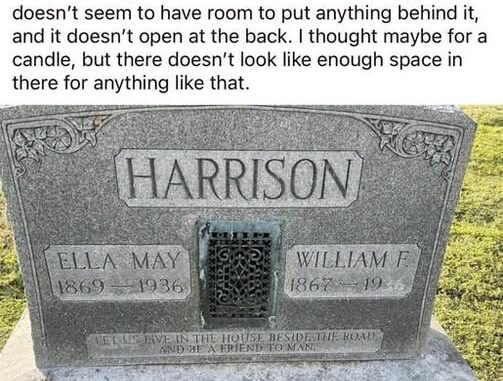
Some memorials tell a story through towering statues, elaborate carvings, or lengthy inscriptions. Others use something much smaller—an ordinary object that might seem completely out of place in a cemetery.
One particularly unusual example features a decorative cast-iron grate built into a grave marker.
At first glance, it looks like a curious architectural detail. Why would anyone place something resembling an old-fashioned heating grate on a gravestone?
The answer may lie in what that object once represented: home, warmth, family, hospitality, and connection.
An Unexpected Detail in a Cemetery
Walk through an older cemetery and you’ll find familiar symbols everywhere.
Crosses can represent faith. Angels may symbolize protection. Flowers can express remembrance. Trees often evoke life, growth, or continuity.
But an old cast-iron floor grate is much less expected.
The design resembles the ornate metal grilles once installed in homes during the late nineteenth and early twentieth centuries. Before modern central-heating systems became commonplace, many houses depended on furnaces, stoves, or other heating sources located on lower floors.
Warm air could then travel upward through openings covered by decorative metal grates.
These objects served a practical purpose, but they were often surprisingly beautiful.
Intricate patterns, floral designs, geometric shapes, and elaborate craftsmanship turned a necessary household feature into something decorative.
That history gives the unusual grave detail a much deeper possibility.
A Piece of the Old Home
For earlier generations, a home represented far more than an address.
It was where families gathered after long days of work. It was where meals were prepared, children grew up, relatives visited, and neighbors sometimes found shelter.
During cold weather, the warmth of the house could become the center of family life.
A heating grate was part of that experience.
Warm air passing through the floor connected different parts of the home. A furnace or stove downstairs could help warm rooms above, creating a physical link between separate floors.
That makes the grate an unexpectedly powerful symbol.
It wasn’t simply a piece of metal.
It was part of the machinery of everyday family life.
From Practical Object to Symbol
Imagine a family remembering someone who was famous for making people feel welcome.
Perhaps their house was always open to relatives and neighbors. Maybe there was always a meal available for an unexpected visitor. Perhaps friends associated that person with laughter, conversation, and the comfort of gathering around a warm home.
In that context, a cast-iron heating grate could become a remarkably personal memorial symbol.
It could represent the warmth that person brought into the lives of others.
The object itself once helped distribute physical warmth through a house.
On a grave, it can evoke another kind of warmth—the emotional comfort created by a loving home.
That transformation is what makes the design so compelling.
The Connection to Hospitality
The symbolism becomes even more interesting when an inscription or quotation on the memorial emphasizes kindness, shelter, or welcoming others.
One poem sometimes associated with this theme is Sam Walter Foss’s “The House by the Side of the Road.”
Its central imagery concerns being a welcoming presence to people passing through life.
When that idea is placed alongside an image reminiscent of a household heating grate, the two symbols naturally complement one another.
The house represents shelter.
The warmth represents comfort.
The grate represents the way that warmth spreads throughout the home.
Together, they can suggest a person whose kindness reached far beyond themselves.
Of course, without historical documentation from the family, we shouldn’t assume that was definitely the original intention of every such memorial. The exact meaning of a particular grave design belongs to the people who created it.
But the symbolism is certainly a fitting interpretation.
Why Cast Iron?
The choice of cast iron may carry another layer of meaning.
Iron is associated with durability.
Unlike many household materials that deteriorate quickly, properly maintained cast iron can survive for generations. Old buildings still contain iron railings, grilles, balconies, registers, and decorative fixtures that were installed more than a century ago.
That longevity makes iron an interesting material for a memorial.
A gravestone is intended to preserve memory.
Cast iron, meanwhile, has a reputation for enduring.
The material therefore naturally lends itself to ideas such as:
-
Strength
-
Permanence
-
Stability
-
Endurance
-
Continuity
If the grate came from an actual family home, the connection would be even more personal.
A piece of the place where someone lived could have been transformed into part of the place where they were remembered.
When Architecture Becomes Memory
Buildings disappear.
Homes are remodeled.
Families move.
Neighborhoods change.
A house that once served as the center of someone’s life may eventually be sold, renovated, or demolished.
But particular details can remain vivid in memory.
Maybe it was the iron railing by the front steps.
Maybe it was a stained-glass window.
Maybe it was the brass doorknob everyone touched.
Or perhaps it was the decorative floor grate that warmed the upstairs rooms.
These seemingly ordinary objects can become powerful reminders of childhood and family.
That’s why architectural details sometimes appear in memorials.
They preserve not only the memory of a person, but also something about the world in which that person lived.
The Grate as a Connection Between Worlds
There’s another poetic interpretation worth considering.
A floor grate occupies a boundary.
It sits between levels of a house while allowing something to pass from one space to another.
Warm air rises through it.
In a memorial context, that physical connection can evoke the relationship between the past and the present.
The person is gone, but their memory continues to move through the lives of those who knew them.
The house may eventually disappear.
The family may scatter.
Yet the stories remain.
In that sense, the small piece of iron becomes a symbol of continuity.
Why Old Objects Feel So Emotional
There is a reason people are often fascinated by ordinary objects from previous generations.
An old object can transport us to another time.
A worn wooden staircase can make us imagine generations walking through a house.
An old stove can evoke family meals.
A cast-iron grate can make us imagine cold mornings when warmth slowly traveled through an older home.
These objects don’t need to be valuable to be meaningful.
Their importance comes from association.
They remind us that ordinary life was once happening around them.
People cooked.
Children played.
Guests arrived.
Families argued and laughed.
Someone waited for a loved one to come home.
The object witnessed all of it.
The Home as Part of a Person’s Identity
For many people, particularly in earlier generations, reputation was closely connected to the home.
A person might be remembered as the neighbor whose door was always open.
The grandmother who fed everyone.
The family member who hosted every holiday.
The person who offered a spare room to someone in need.
The home became an extension of that person’s character.
That’s why a symbol associated with the household can say something about the person buried beneath the memorial.
A cast-iron grate doesn’t depict the individual.
Instead, it can evoke the environment they created.
A warm house.
An open door.
A welcoming table.
A place where people felt safe.
Warmth Means More Than Temperature
We use the language of warmth constantly when describing human relationships.
Someone can be warm-hearted.
A welcome can feel warm.
A childhood home can be remembered as warm and comforting.
A stranger can make us feel welcome.
None of these descriptions are about temperature.
They describe emotional experiences.
That’s what makes a heating grate such an interesting memorial image.
Its original purpose was physical.
Its symbolic meaning can be emotional.
The same object that once helped distribute heat through a building can remind visitors of the emotional warmth created by the person who lived there.
Why the Grave Initially Looks So Strange
Modern memorials often use familiar materials and forms.
Polished granite is common.
Marble appears frequently.
Some markers use religious symbols, portraits, sculptures, or engraved quotations.
A decorative household heating component doesn’t fit that modern visual expectation.
That’s probably part of the reason such a grave catches people’s attention.
It initially looks like an object that somehow wandered into the wrong setting.
But memorials have never been limited to standardized designs.
People have always found personal ways to remember those they loved.
Occupations, hobbies, beliefs, family traditions, favorite objects, and important places
Leave a Reply