
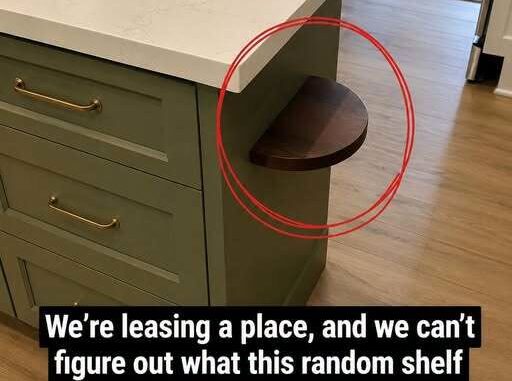
At first glance, a small rounded shelf attached to the side of a kitchen island can seem unnecessary. It may look too narrow to be useful and too small to serve as a traditional countertop. But this little design feature often has a very practical purpose.
Known in some kitchens as a drink ledge, island ledge, or kitchen island shelf, this compact surface is designed to provide an easy landing spot for everyday items while adding a touch of style to the room.
It is a perfect example of how modern kitchen design often focuses on small details that make daily life easier.
A Convenient Place to Put Everyday Items
Think about how often people walk into a kitchen carrying something in their hands.
You might have a cup of coffee, a water bottle, your phone, a set of keys, or a piece of mail. The natural reaction is usually to place everything on the nearest countertop.
Over time, however, those little items can quickly turn into clutter.
A small island ledge provides another option. Instead of filling the main work surface with things that don’t belong there, you can temporarily place them on the smaller shelf.
This allows the primary countertop to remain available for cooking, food preparation, and other kitchen activities.
The shelf isn’t necessarily designed for permanent storage. Its value comes from giving frequently handled objects a temporary home.
Why It Is Sometimes Called a Drink Ledge
One of the most common uses for an island ledge is holding drinks.
Imagine preparing dinner while family members or guests gather around the kitchen island. People naturally want somewhere to place their glasses, mugs, or bottles.
Putting those drinks directly on the food-preparation surface can interfere with cooking. A dedicated ledge separates the social area from the main working area.
This is particularly useful during gatherings. Guests can stand near the island, enjoy a conversation, and keep their drinks nearby without taking over the space where meals are being prepared.
For that reason, some designers refer to this feature as a drink ledge rather than simply a shelf.
It Can Help Reduce Kitchen Clutter
A well-designed kitchen isn’t necessarily one with the most cabinets or the largest countertops. It is one where everything has a logical place.
Small landing areas can make a surprisingly noticeable difference.
Without a designated spot, items such as phones, mail, keys, chargers, and reusable bottles often end up scattered across the main counter. Once several objects accumulate, the kitchen can feel messy even when everything else is clean.
A narrow ledge provides a visual boundary.
Instead of allowing everyday objects to spread across the entire island, the shelf gives them a defined area. When the kitchen needs to be cleared for cooking, those items can then be moved to their proper locations.
It’s a simple organizational idea, but one that can make the room feel more orderly.
The Rounded Shape Isn’t Just for Decoration
Another interesting feature of some kitchen island shelves is their curved or rounded design.
Most kitchens contain plenty of straight lines. Cabinets, drawers, countertops, appliances, and walls naturally create a structured geometric appearance.
Adding a curved edge can soften that look.
A rounded ledge can make the island appear more distinctive and custom-designed. It can also make movement around the island feel more comfortable by reducing the presence of sharp corners.
This can be particularly appealing in busy kitchens where several people regularly move around the island.
Of course, the exact safety benefit depends on the design, materials, and construction, but softer edges can be a thoughtful choice in homes where children are present.
A Small Display Area
The shelf doesn’t have to be purely functional.
Because it is visible and relatively small, it can also become a subtle decorating feature.
A homeowner might place a small plant, decorative object, candle, or seasonal accent on the ledge. Since the available space is limited, it naturally encourages restraint.
Rather than covering the surface with numerous decorations, you can choose one or two items that complement the rest of the kitchen.
This creates a decorative element without making the room feel overcrowded.
The best use often comes from combining function and appearance rather than treating the shelf as either storage or decoration exclusively.
What You Shouldn’t Put on It
Although the shelf can be useful, it shouldn’t be mistaken for a full-size countertop.
Its intended purpose is usually light-duty use.
Large appliances such as stand mixers, air fryers, or other heavy equipment may be inappropriate depending on how the ledge was constructed. Excessive weight could damage the surface or supporting structure.
It should also never be treated as a seat, stool, or step.
A child climbing onto the shelf might seem harmless, but these surfaces generally aren’t designed to support a person’s weight. Using them in this way can create unnecessary safety risks.
Hot cookware also belongs on an appropriate heat-resistant surface. A small decorative ledge may not have the materials or protection necessary for hot pots and pans.
When in doubt, it’s best to think of the ledge as a convenient accessory rather than an additional worktop.
Keeping the Shelf Useful
One of the biggest challenges with small surfaces is that they can become clutter magnets.
A shelf that was originally intended for a coffee mug can eventually become a storage area for receipts, unopened mail, charging cables, toys, and miscellaneous household items.
Once that happens, its original purpose becomes difficult to appreciate.
A simple rule can help: keep the ledge intentionally limited.
Use it for a few everyday objects or a small decorative arrangement, then regularly clear anything that doesn’t belong there.
The less crowded the shelf is, the more useful and attractive it becomes.
Why Small Features Matter in Modern Kitchens
Kitchen design has changed considerably over the years.
Today’s homeowners often want spaces that serve multiple purposes. A kitchen may simultaneously function as a cooking area, dining space, homework station, gathering place, and informal social room.
Because of that, designers increasingly look for ways to make every part of the room useful.
A small shelf may not seem important when compared with cabinets, appliances, or a large island. Yet small conveniences can have an outsized effect because they’re used repeatedly.
A place to put your coffee every morning.
A spot for a guest’s glass during dinner.
A temporary landing area for your phone.
A small surface for a plant or decoration.
None of these functions is dramatic by itself, but together they can make a kitchen more comfortable.
A Simple Idea With a Practical Purpose
The next time you see a narrow shelf attached to the side of a kitchen island, don’t assume it is wasted space.
It may have been deliberately designed to handle the small moments that happen throughout the day.
Its purpose is not to replace the main countertop or provide another heavy-duty work area. Instead, it offers a convenient secondary surface while adding character to the island.
That combination of practicality and simplicity is what makes the feature appealing.
Good interior design isn’t always about adding something large or impressive. Sometimes it is about identifying a small everyday problem and solving it with a simple feature.
A rounded kitchen island ledge does exactly that.
It gives drinks and small belongings a place to rest, keeps the primary workspace clearer, provides an opportunity for subtle decoration, and can soften the overall appearance of the kitchen.
What initially looks like an unusual strip of countertop may actually be one of those thoughtful details that makes a busy kitchen easier to use.
In the end, the value of a kitchen isn’t determined only by how impressive it looks. It is also determined by how naturally the space fits into everyday life.
And sometimes, the smallest shelf can make a surprisingly big difference.
Leave a Reply