
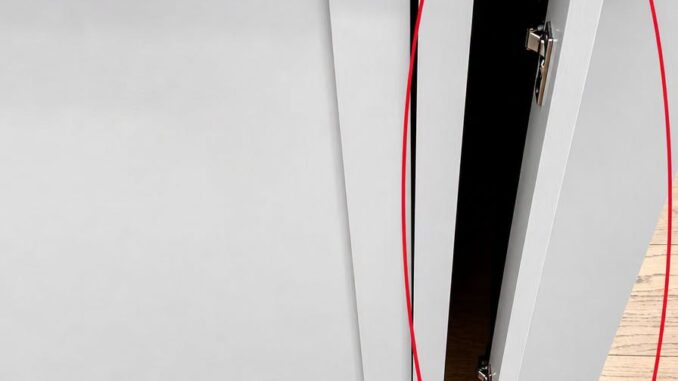
Have you ever noticed a very narrow space between two kitchen cabinets or appliances and wondered why it was there?
At first glance, a gap of only a few inches can seem completely useless. It may look like nothing more than an unavoidable space created by the way kitchen cabinets and appliances are positioned.
And if left empty, it can quickly become a magnet for dust, crumbs, cooking utensils, and all the little things that somehow find their way into the hardest places to clean.
But some kitchens have a surprisingly clever solution for these awkward spaces.
That slim section may actually be a narrow pull-out cabinet, sometimes called a filler pull-out.
What looks like a simple strip of cabinetry can hide a surprisingly practical storage area.
What Is a Narrow Pull-Out Cabinet?
A narrow pull-out cabinet is designed to make use of small spaces that would otherwise be difficult to use.
Depending on the kitchen layout, these units can sometimes fit into spaces only a few inches wide. Instead of opening like a conventional cupboard, the entire narrow cabinet slides outward on rails.
When it is closed, it can look almost like an ordinary cabinet filler.
Pull it toward you, however, and the hidden storage becomes visible.
This design is particularly useful in kitchens where cabinet space is limited and homeowners want to make better use of every available inch.
Why Would Anyone Need Such a Small Cabinet?
The answer is organization.
Kitchen cabinets often contain a surprising amount of wasted space. Large cupboards are useful for pots, pans, appliances, dishes, and other bulky items, but small objects can easily become lost in the back.
Think about bottles of cooking oil, spices, sauces, seasoning containers, kitchen towels, or other narrow items.
When these are placed inside a deep cabinet, they can disappear behind larger objects.
You may know they’re there, but finding them can become an unnecessary chore.
A vertical pull-out changes the arrangement.
Instead of reaching into a deep cupboard, you can simply pull the storage unit toward you and see most of its contents at once.
What Can You Store Inside One?
The exact possibilities depend on the size and design of the cabinet, but narrow pull-outs are particularly well suited to tall or slim kitchen items.
They can be useful for:
- Cooking oils and vinegar
- Spices and seasoning containers
- Sauces and condiments
- Baking ingredients
- Kitchen towels
- Cleaning supplies
- Small bottles and jars
- Utensils
- Food-storage accessories
Some designs use shelves, while others include rails or adjustable dividers that help keep bottles and containers upright.
The important idea is that the storage is designed vertically rather than horizontally.
That makes a surprisingly big difference when floor and cabinet space are limited.
The Hidden Advantage: Everything Is Easier to See
One of the most frustrating things about traditional kitchen cabinets is that objects can disappear into the back.
You might buy another bottle of an ingredient simply because you forgot you already had one.
Then, months later, you discover two or three nearly identical bottles hiding behind everything else.
A pull-out cabinet makes this problem less likely because the contents come toward you.
Instead of searching through layers of objects, you can see the available items much more easily.
That can make everyday cooking and meal preparation feel less chaotic.
Why the Space Is Sometimes Called a “Filler”
The term “filler” can be confusing.
In cabinet design, filler panels are often used to cover small gaps between cabinets, walls, and appliances. They help create a finished appearance and prevent awkward spaces from being left exposed.
A filler pull-out essentially gives that otherwise unused space a second purpose.
Rather than installing a simple stationary panel, a designer can use the space for a narrow storage unit.
From the outside, it can still blend into the rest of the kitchen.
From the inside, however, it becomes functional storage.
Not Every Small Gap Can Become a Cabinet
It’s important to remember that not every narrow opening can simply be converted into a pull-out.
The available space needs to be measured carefully, and the surrounding cabinets and appliances must be considered.
There also needs to be enough clearance for the unit to move without hitting nearby handles, doors, walls, or appliances.
The construction of the cabinet and the strength of its mounting system matter as well.
For that reason, homeowners considering a retrofit should check the dimensions and installation requirements carefully rather than assuming any three-inch or four-inch gap can accommodate a particular system.
Why Modern Kitchens Use More Clever Storage
Kitchen design has changed significantly over the years.
Older kitchens often relied on large cupboards and drawers without much specialized organization.
Modern kitchens increasingly focus on making storage easier to access.
That has led to features such as:
- Deep drawers for cookware
- Corner storage systems
- Pull-out pantry shelves
- Drawer organizers
- Vertical tray storage
- Appliance garages
- Narrow cabinet pull-outs
The goal isn’t necessarily to add more cabinets.
It is to make the existing space work better.
Small Spaces Can Make a Big Difference
A narrow cabinet may not hold as much as a full-size cupboard, but its value isn’t necessarily measured by how many items it can contain.
Its biggest advantage is accessibility.
A small space dedicated to frequently used items can save time every day.
Imagine keeping cooking oils next to the stove, spices near the food-preparation area, or towels close to the sink.
Instead of walking across the kitchen or searching through a large cabinet, the item is immediately available.
Good kitchen design often comes down to reducing these small inconveniences.
What About Older Pull-Out Systems?
Some homeowners may remember older narrow storage units that didn’t operate particularly well.
Earlier hardware could sometimes stick, become misaligned, or struggle under heavier loads.
Modern cabinet hardware has improved considerably, and many current systems use smoother runners, stronger construction, and features such as soft-close mechanisms.
However, quality varies between products.
A narrow cabinet carrying several heavy glass bottles places considerable stress on its hardware, so the weight capacity should always be checked before loading it.
Could You Add One to an Existing Kitchen?
Sometimes.
Retrofitting a narrow pull-out can be possible if an existing filler space has suitable dimensions and the surrounding cabinetry allows the necessary hardware to be installed.
But it isn’t always a simple do-it-yourself project.
Leave a Reply