
I knew something was wrong the moment we arrived at the wedding venue.
The estate was beautiful, with elegant gardens, tall windows, and more decorations than I could count. My husband, Jake, and I had dressed up for what we thought would be a memorable celebration.
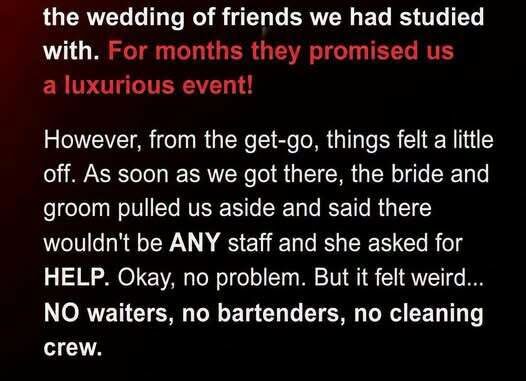
Instead of being welcomed by wedding staff, we were immediately approached by Sarah, the bride.
“Oh, thank goodness you’re here!” she said, pulling me aside. “We really need your help.”
I assumed there had been some last-minute problem.
I had no idea what was coming.
Sarah and Tom gathered several guests in a side room and explained that their planned staff arrangements had fallen through.
“There’s nobody available to handle the reception,” Tom admitted.
Sarah quickly added, “But we have everything organized. We just need our friends to pitch in.”
Then they started handing out lists.
I looked down at mine.
Set up chairs. Serve appetizers. Help with cleanup. Check the bathrooms regularly.
I stared at the page.
“Are we supposed to work the wedding?”
Sarah laughed nervously.
“Not work. Just help us out for a little while.”
Jake looked at me.
Neither of us knew what to say.
We had already traveled to the venue, dressed for the occasion, and brought a wedding gift. Walking away immediately felt awkward, so we reluctantly agreed to help.
That decision would turn out to be a mistake.
From Guests to Workers
The ceremony itself was lovely.
But as soon as it ended, Sarah’s attitude changed.
“Everyone, we need the reception area ready quickly!”
Suddenly, we were moving chairs, arranging tables, carrying decorations, and preparing the dining area.
I was still wearing my formal dress and uncomfortable shoes.
Jake was carrying tables across the lawn.
Other guests were being assigned different tasks.
One person was told to help at the bar. Another was preparing food. Someone else was cleaning.
What bothered me most wasn’t helping.
It was the way we were being treated.
Sarah kept giving instructions as though we had been hired.
Meanwhile, members of the couple’s families were sitting comfortably, chatting and enjoying drinks.
At one point, Sarah reminded me to be careful with an expensive centerpiece.
I almost laughed.
My time mattered too.
Jake eventually came over, looking exhausted.
“Are we having fun yet?” he asked.
I shook my head.
“I thought we came here to celebrate with them.”
Instead, we were spending the afternoon doing jobs nobody had properly arranged for.
Then Sarah asked us to fold the napkins in a particular style.
That was when I realized this wasn’t going to end anytime soon.
The Guests Start Talking
During a short break, several of us gathered in the kitchen.
Everyone had the same complaint.
“We’re guests,” Emily said. “We’re not supposed to be the catering team.”
She had been assigned to the bar and admitted she had spent part of the afternoon searching for drink recipes because she had never worked behind one before.
Another guest asked whether the promised replacement staff had arrived.
Nobody had seen anyone.
That raised an uncomfortable possibility.
Maybe there weren’t any replacement workers coming.
Maybe the couple had simply decided that their friends would handle everything.
Jake looked around the kitchen.
“And we’re still expected to give them expensive wedding gifts?”
That gave us an idea.
Nobody wanted to cause a scene.
Nobody wanted to ruin the celebration.
But we also didn’t think it was fair to spend the entire event working and then pretend nothing had happened.
So we agreed on a simple approach.
The money we had originally planned to give as a generous gift would remain with us.
After all, we’d already contributed our time.
We Finished the Reception
For the rest of the evening, we continued helping.
We served food.
We cleared dishes.
We straightened tables.
We helped keep everything running.
But now, we were doing it with a very different attitude.
Eventually, the gift-opening portion of the evening arrived.
Sarah and Tom sat together while guests gathered around.
I stepped forward as the group’s spokesperson.
“Sarah, Tom, we had originally planned to give you a substantial wedding gift.”
Sarah smiled.
“That’s very generous.”
I continued.
“But after spending most of the reception working instead of attending as guests, we’ve decided that our contribution today was the time we spent helping.”
The room became quiet.
Sarah looked confused.
“What are you saying?”
“We’re keeping the money we planned to give you.”
Her expression changed immediately.
She insisted that we had only been asked to help as friends and that it was supposed to be a small favor.
I calmly explained that nobody had expected to spend the entire celebration performing tasks normally handled by paid event staff.
Jake and the others agreed.
It wasn’t about punishing the couple.
It was about setting a boundary.
An Unexpected Ending
The conversation became increasingly uncomfortable.
Then, in the middle of the commotion, Sarah stepped backward.
Unfortunately, the wedding cake had just been positioned behind her.
She caught her heel on part of her dress and lost her balance.
Before anyone could react, she stumbled directly into the cake display.
The carefully decorated cake collapsed beneath her.
For several seconds, everyone simply stood there in shock.
Sarah was embarrassed and covered in frosting.
Tom rushed over to help her.
The guests tried to compose themselves, but the unexpected scene was difficult to ignore.
Eventually, we decided it was time to leave.
Twenty-five guests who had spent most of the reception helping with the event gathered their belongings and headed toward the parking lot.
Nobody wanted to argue anymore.
We had made our point.
A Lesson About Appreciation
Later that evening, several of us went out for drinks and talked about what had happened.
Looking back, I don’t regret helping.
What I regret is allowing the situation to continue after it became obvious that our generosity was being treated as an obligation.
There is nothing wrong with asking friends for help.
People often pitch in at weddings, parties, family gatherings, and other special occasions.
The difference is whether people are asked respectfully and given a genuine choice.
Friends aren’t automatically free labor simply because they’re invited to celebrate with you.
Sarah and Tom may have wanted to create a beautiful wedding, but somewhere along the way, they forgot something much more important: the people who came to celebrate with them deserved to be treated as guests.
We never received another invitation from them.
Honestly, that was fine.
The experience taught all of us a useful lesson.
A favor should be offered freely—not demanded. And friendship should never be measured by how much unpaid work someone is willing to do.
Leave a Reply