
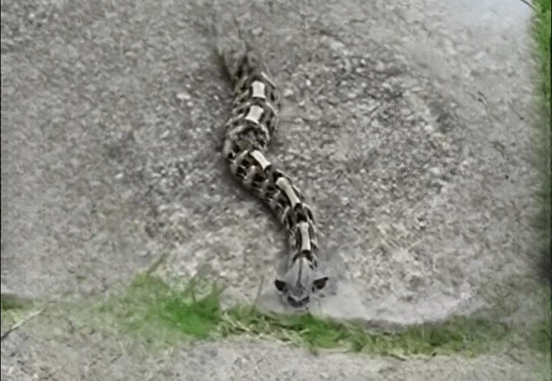
It began as a peaceful morning. I stepped outside to enjoy the fresh air, expecting to see nothing unusual in the garden. The grass was covered with morning dew, and everything seemed perfectly normal.
Then something caught my attention near the shrubs.
At first, I assumed it was a fallen branch or a collection of dry leaves. However, its unusual pattern made me stop and take a closer look. Something about the shape seemed out of place.
As I moved closer, I realized that what I had mistaken for garden debris was actually a snake.
It was a Gaboon viper, one of Africa’s most impressive and potentially dangerous venomous snakes.
I immediately understood why approaching it would have been a serious mistake. Its natural coloring blended almost perfectly with the surrounding leaves, making it extremely difficult to recognize.
A Snake That Disappears Into Its Surroundings
The Gaboon viper (Bitis gabonica) is native to parts of sub-Saharan Africa, where it inhabits forests, woodland areas, and other environments with plenty of vegetation.
Its most remarkable feature is its camouflage. The complex patterns along its body resemble fallen leaves and forest debris, allowing it to remain almost invisible when resting on the ground.
Unlike snakes that actively move around in search of prey, Gaboon vipers often rely on patience. They remain hidden and wait for suitable animals to approach.
This natural ability makes them particularly difficult to notice, even for people who are familiar with wildlife.
Impressive Size and Remarkable Fangs
Gaboon vipers are among the heaviest venomous snakes in the world. Large adults can grow to considerable lengths and develop thick, powerful bodies.
Their appearance is especially distinctive because of their broad heads, intricate markings, and unusually long fangs.
In fact, they possess the longest fangs of any venomous snake species. These specialized teeth allow them to deliver venom effectively when capturing prey or defending themselves.
Their venom contains substances that can interfere with blood clotting and damage tissue. A bite can cause severe medical complications and may become life-threatening without prompt treatment.
Anyone bitten by a suspected venomous snake needs immediate emergency medical attention. Antivenom and professional monitoring may be necessary.
Are Gaboon Vipers Aggressive?
Despite their frightening appearance, Gaboon vipers are generally considered relatively slow-moving and often prefer to remain hidden rather than confront potential threats.
However, their calm behavior should never be mistaken for harmlessness.
They can strike rapidly when threatened, disturbed, or accidentally approached too closely. Their camouflage also increases the possibility of accidental encounters.
The safest approach is always to maintain a considerable distance and never attempt to touch, capture, or move one.
How Does This Snake Hunt?
Gaboon vipers are ambush predators. Instead of chasing animals over long distances, they remain motionless while waiting for suitable prey.
Their diet includes rodents, birds, and other small animals.
Specialized heat-sensitive organs help them detect warm-blooded prey, even when visibility is limited.
Once an opportunity presents itself, they can deliver a rapid strike. Their hunting strategy allows them to conserve energy while remaining effective predators.
What Should You Do If You Find One?
Discovering a potentially venomous snake in a garden can be frightening, but reacting calmly is essential.
Here are some important precautions:
- Keep a safe distance and never approach the snake for a closer photograph.
- Bring children and pets indoors.
- Do not attempt to touch, catch, kill, or relocate it.
- Avoid disturbing nearby vegetation.
- Contact local wildlife authorities or qualified snake-removal professionals.
- Keep others away from the area until trained assistance arrives.
If someone is bitten, seek emergency medical care immediately. Do not attempt to cut the wound, suck out venom, or apply a tight tourniquet.
An Important Part of the Natural Environment
Although Gaboon vipers deserve considerable respect, they also play an important ecological role.
By feeding on rodents and other small animals, they contribute to maintaining balance within their natural habitats.
Like other predators, they are part of a wider ecosystem in which every species has a role.
Their presence is not necessarily a reason for panic, but it is certainly a reason to exercise caution.
Final Thoughts
The Gaboon viper is a remarkable example of how effectively wildlife can adapt to its surroundings. Its impressive camouflage, powerful fangs, and specialized hunting abilities make it one of Africa’s most fascinating venomous snakes.
An encounter with one would be enough to make anyone more careful when walking through gardens, forests, or areas with thick vegetation.
The most important lesson is simple: never assume an unfamiliar shape in the grass is harmless, and never approach a snake you cannot confidently identify.
Sometimes, the safest decision is to admire nature from a distance and leave potentially dangerous wildlife in the hands of trained professionals.
Leave a Reply