
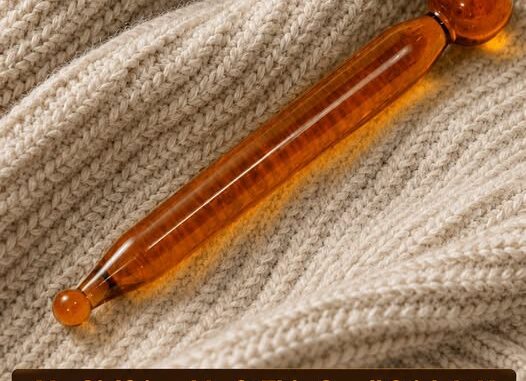
I found it at the back of an old desk drawer.
At first, I had no idea what I was looking at.
It was roughly eight inches long, with a warm golden-brown wooden handle and a narrow metal blade extending from one end. The wood was smooth in places but covered with tiny scratches and darker marks that suggested years of use.
There were no buttons, moving parts, labels, or obvious markings.
It looked completely out of place among the modern office supplies in the drawer.
For a moment, I considered throwing it away.
Then I picked it up.
The weight immediately caught my attention. It wasn’t lightweight plastic. It felt solid and carefully made, as though someone had expected it to remain useful for many years.
That made me curious.
So I started searching for an explanation.
The answer turned out to be surprisingly simple.
It was a letter opener.
But learning what the object was made me much more interested in it.
A Simple Tool From a Different Era
A letter opener is a small desk tool designed to help open envelopes. Traditional paper knives served related purposes and were also used to separate the pages of books that had been printed on folded sheets.
Over time, letter openers became familiar accessories on writing desks and in offices.
They were made from many different materials, including wood, brass, silver, bone, and other decorative materials. Some were extremely simple, while others were designed as elaborate desk accessories.
The one I had found was relatively plain.
Its wooden handle, however, showed something that seemed more interesting than decoration.
It showed years of use.
The surface had clearly been handled repeatedly. The smooth areas looked as though someone’s fingers had rested there hundreds of times.
Suddenly, I started wondering who had used it.
When Opening a Letter Was Part of the Day
Today, most communication arrives instantly.
A message appears on a phone.
An email arrives with a notification.
A photograph can cross the world in seconds.
For previous generations, communication often required considerably more patience.
A person wrote a letter by hand, placed it inside an envelope, addressed it, added postage, and sent it through the mail.
Then the recipient waited.
The envelope might contain family news, a business matter, an invitation, a photograph, or a personal message from someone living far away.
Receiving the mail could be an important moment.
Opening the envelope was the beginning of discovering what someone had taken the time to write.
That made the letter opener more than a simple tool.
It could become part of a daily routine.
Someone might keep it beside a fountain pen, a notebook, or a stack of envelopes on a writing desk.
The tool itself could remain in the same place for years.
Then I Found the Initials
I turned the wooden handle over and noticed something I had missed before.
Near the base were two small initials.
E.H.
I recognized them immediately.
They belonged to my grandfather.
That discovery changed how I looked at the object.
My grandfather had died years earlier, and I had never known that he owned a letter opener.
But then I remembered his old desk.
When I was a child, the desk had seemed enormous.
It was made of dark wood and had heavy brass handles. The drawers were difficult for me to open, and I remember being fascinated by everything inside them.
My grandfather often sat at that desk on Sunday mornings, sorting through envelopes.
I remembered watching him take a long wooden object and slide it beneath the flap of a letter.
At the time, I had never wondered what it was.
Now I realized I had probably seen this exact letter opener decades earlier.
I simply hadn’t understood what I was looking at.
An Ordinary Object With a Personal History
That evening, I placed the letter opener beside my laptop.
The contrast was almost funny.
Next to a smartphone and wireless keyboard, the old wooden tool looked like something from another world.
Yet the object represented a completely different way of communicating.
There was no instant delivery.
No notification.
No typing indicator.
No expectation of an immediate response.
A handwritten letter required time.
Someone had to sit down and write it.
The recipient then had to wait for it to arrive.
That delay may have made the contents feel different.
The words had been chosen before the letter was sent, and there was no opportunity to instantly edit or delete them once the envelope was on its way.
The letter opener was simply the small tool that helped reveal those words.
It Wasn’t Valuable Because It Was Rare
I eventually realized that the letter opener probably wasn’t important because it was expensive or particularly rare.
Its real value was personal.
It had belonged to my grandfather.
It had sat on his desk.
It had been held by his hands.
It may have opened hundreds of envelopes over the years.
Perhaps it had revealed family news, business correspondence, invitations, holiday cards, and countless ordinary pieces of mail.
Those individual moments are impossible to recover.
But the object remained.
That made it feel less like an old office accessory and more like a small connection to someone who was no longer here.
I Put It Somewhere Different
I eventually returned the letter opener to my desk drawer.
But I didn’t hide it at the back this time.
I placed it somewhere I could easily see it.
I don’t use it very often. There simply aren’t enough physical letters arriving these days to make a letter opener necessary.
But occasionally, a real envelope still appears in the mailbox.
When that happens, I take the old wooden tool from the drawer.
I carefully slide it beneath the flap.
For a few seconds, everything feels slower.
There is no buzzing phone.
No screen lighting up.
No notification demanding attention.
Just paper, a quiet room, and a small object that has survived several decades.
And that is what surprised me most.
I thought I had discovered an obsolete tool that had been forgotten in an old desk.
Instead, I discovered a small piece of my grandfather’s everyday life.
Why Old Objects Matter
Old objects don’t always need to be valuable to be meaningful.
Sometimes their importance comes from the people who used them.
A wooden tool, an old watch, a handwritten recipe, or a well-worn piece of furniture can carry memories that aren’t visible at first glance.
The letter opener reminded me that ordinary objects can quietly preserve pieces of family history.
It had spent years sitting unnoticed in a drawer.
All it took was a moment of curiosity to ask a simple question:
What was this made for?
The answer turned out to be much more than the name of a tool.
It opened letters.
It belonged to my grandfather.
And now, every time I see it, it reminds me of a time when communication moved more slowly and ordinary moments could become meaningful rituals.
Sometimes, the most interesting stories aren’t hidden in valuable antiques.
They’re hiding in the ordinary things we almost throw away.
Leave a Reply