
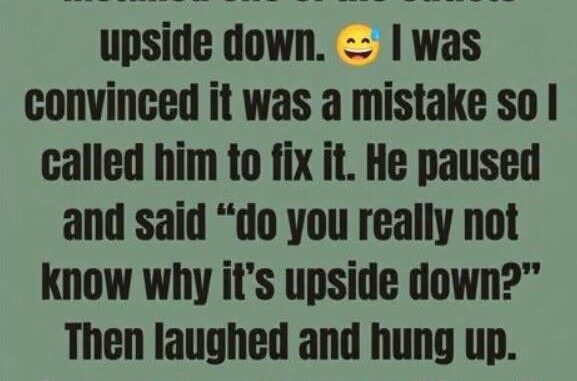
Have you ever noticed an electrical outlet that looks different from the others in your home?
On a typical North American receptacle, the two narrow openings are usually above the round grounding opening. But sometimes you may find one where the round hole is on top and the two vertical openings are underneath.
At first, it may look like an installation mistake.
However, an upside-down receptacle isn’t necessarily a sign that anything was done incorrectly. There are several reasons an electrician or homeowner might choose that orientation, and sometimes there isn’t a special reason at all.
Here’s what that unusual-looking outlet may mean.
What Makes an Outlet Look “Upside Down”?
When people call an outlet upside down, they’re usually talking about the position of a standard three-prong receptacle.
In one orientation, the grounding opening is below the two power slots. Rotate the receptacle 180 degrees, and the grounding opening appears above them.
Simply changing the physical orientation doesn’t normally change the basic function of the receptacle.
So the interesting question isn’t whether it works differently, but why someone decided to position it that way.
A Possible Safety Consideration
One explanation involves the grounding pin found on many three-prong plugs.
If a plug is partially pulled out of a receptacle, some of its metal contacts may remain exposed. Some people prefer the grounding opening to be positioned above the other contacts because of how the plug would interact with the receptacle if it were accidentally struck or contacted by a conductive object.
This is sometimes discussed as an additional safety consideration.
However, outlet orientation should never be treated as a replacement for proper electrical protection. Correct wiring, grounding, circuit protection, and required devices such as GFCI protection are much more important to overall electrical safety.
In other words, turning a receptacle upside down does not automatically make an electrical installation safer.
It Could Be a Visual Identifier
In some installations, an electrician may use the orientation of a receptacle as a visual clue.
For example, an outlet facing the opposite direction from the others might be associated with a particular circuit or function. This can make it easier to identify when several receptacles are installed close together.
An unusual orientation may sometimes be used for a switched receptacle or another circuit that the installer wants to distinguish.
But there is no universal rule that says an upside-down outlet always represents a special circuit.
Different electricians may use different identification methods, including labels, colors, receptacle types, or simply no visual distinction at all.
Therefore, you shouldn’t assume that an upside-down outlet has a special electrical function just because it looks different.
What About Outlets Controlled by a Switch?
Some wall receptacles are connected to a nearby wall switch.
This arrangement is common in rooms where a switched outlet provides convenient control for a lamp or other device. Instead of reaching for the lamp itself, someone can turn it on or off using the wall switch.
In some installations, an electrician may orient a switched receptacle differently from the others as a convenient visual reminder.
Again, though, this isn’t a universal practice.
A switched outlet doesn’t have to be installed upside down, and an upside-down outlet doesn’t automatically mean that a switch controls it.
The only reliable way to determine how a particular receptacle operates is to test it appropriately or have the circuit inspected.
Sometimes There Is No Special Reason
The simplest explanation may be the correct one.
An electrician may have installed the receptacle in that orientation simply because that was their preference or the convention they were following at the time.
A previous homeowner or contractor might also have replaced an old receptacle and installed the new one in a different orientation.
Not every unusual detail in a house has a hidden meaning.
That’s why it’s best not to draw conclusions about an outlet’s wiring based solely on which way it faces.
Why Are Most Outlets Installed the Same Way?
Consistency is one obvious reason.
When several receptacles are installed throughout a room or home, having them all face the same direction creates a cleaner, more uniform appearance.
It also makes unusual outlets easier to notice.
If every outlet has the grounding opening on the bottom except one, that single receptacle naturally attracts attention. But the difference in appearance doesn’t necessarily indicate a defect.
Does Orientation Change How an Outlet Works?
Generally, rotating a standard receptacle doesn’t change its basic purpose.
What matters much more is the condition and configuration of the electrical system behind it.
Proper wiring, grounding, circuit protection, and required safety devices are key factors in determining whether an electrical installation is safe.
Two outlets can look exactly alike while being connected to different circuits. Likewise, two outlets facing opposite directions can perform the same basic function.
The appearance alone doesn’t reveal everything about the wiring.
When Should You Be Concerned?
An upside-down outlet by itself usually isn’t a reason to panic.
However, certain symptoms deserve attention regardless of which way the receptacle is facing.
Watch for signs such as:
-
Burning smells
-
Scorch marks or discoloration
-
Sparks
-
Buzzing or crackling noises
-
A receptacle that feels unusually hot
-
Loose plugs or a loose receptacle
-
Frequently tripped circuit breakers
These issues are far more significant than whether the grounding opening is facing upward or downward.
If you notice any of them, stop using the affected receptacle and consider having a qualified electrician inspect it.
Should You Rotate It Yourself?
If you simply prefer every outlet in your home to face the same direction, you might be tempted to remove the cover and turn the receptacle around.
Be careful.
Electrical receptacles can remain connected to energized wiring, and improper handling can result in electric shock, damaged wiring, or grounding problems.
Unless you’re properly experienced with electrical work, having a qualified electrician inspect or change the receptacle is the safer approach.
What If Only One Outlet Is Upside Down?
If one receptacle in your home is different from all the others, there are several possibilities.
It could have been intentionally oriented differently. It might be associated with a switched or otherwise distinctive circuit. It could reflect an installation preference. Or it could simply be the result of a previous replacement.
You can look for clues, such as whether a nearby wall switch affects the outlet.
But don’t rely on orientation alone to determine what the receptacle does.
If you’re unsure, an electrician can inspect the circuit and explain how it is configured.
Final Thoughts
An upside-down electrical outlet isn’t automatically evidence of bad workmanship.
The orientation may have been chosen for a particular safety consideration, used as a visual identifier, associated with a switched receptacle, or simply selected according to the installer’s preference.
Most importantly, the position of the receptacle isn’t what determines whether an electrical system is safe.
Proper wiring, grounding, circuit protection, and appropriate protective devices matter far more.
So the next time you spot a receptacle with its grounding opening on top, don’t immediately assume someone installed it incorrectly.
It may have a reason behind it—or it may simply be an ordinary outlet facing a different direction.
Leave a Reply