
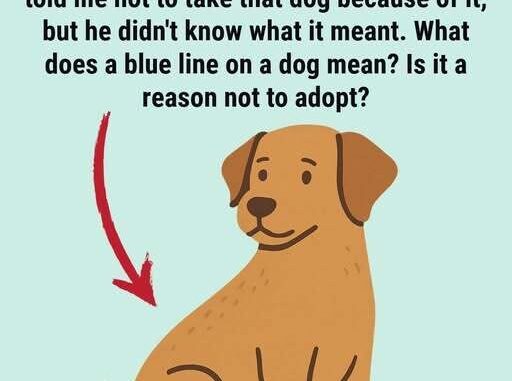
If you’ve ever seen a faint blue or green line on a dog’s belly, you may have stopped for a moment and wondered what it was.
The mark is usually small, subtle, and easy to miss unless you’re specifically looking for it. It often appears near the lower abdomen and may be partially hidden beneath fur.
For many pet owners, the first reaction is confusion.
Some people assume it might be:
- a scar
- an accidental ink mark
- a medical stain
- a tracking identifier
- or even a strange birthmark
But the truth is much simpler—and surprisingly important.
That small blue line is often a veterinary tattoo used to indicate that a dog has already been spayed or neutered.
While tiny and easy to overlook, the mark plays a valuable role in animal care, helping veterinarians, shelters, and rescue organizations avoid unnecessary surgeries and quickly identify sterilized animals.
It’s one of those small details many pet owners never notice until curiosity leads them to ask questions.
And once you understand why the mark exists, it suddenly makes perfect sense.
Why Veterinarians Use Small Tattoos on Dogs
The tattoo is primarily used as a permanent visual indicator that a dog has undergone sterilization surgery.
In female dogs, this usually means the dog has been spayed.
In male dogs, it may indicate neutering, though tattoo placement and appearance can vary depending on veterinary practices or regional standards.
The goal is practical:
to provide quick confirmation that the procedure has already been completed.
This becomes especially important in situations involving:
- rescue animals
- shelter transfers
- stray dogs
- adoption programs
- emergency veterinary care
- incomplete medical records
Without a visible indicator, determining whether a dog has already been spayed or neutered may sometimes require additional testing or exploratory surgery.
The tattoo helps reduce uncertainty.
Why the Mark Is Usually Blue or Green
Many veterinary clinics use blue or green tattoo ink because it remains visible against a wide variety of fur and skin tones.
The mark is intentionally simple.
It may appear as:
- a short line
- a small dash
- a tiny symbol
- a faint green stripe
- or a minimal tattoo near the surgical area
Unlike decorative tattoos for humans, veterinary tattoos are designed purely for identification and practicality.
Their purpose is communication, not appearance.
The Tattoo Helps Prevent Unnecessary Procedures
One of the biggest reasons the tattoo matters is because it helps prevent accidental repeat surgeries.
Imagine a rescue dog arriving at a shelter with no medical history.
If there is no visible evidence of sterilization, veterinarians may face uncertainty about whether surgery has already occurred.
While surgical scars sometimes provide clues, scars can fade over time or become difficult to see beneath fur.
The tattoo offers a clearer visual signal.
This helps:
- avoid unnecessary anesthesia
- reduce surgical risks
- save time and resources
- minimize stress for the animal
For shelters and rescues handling large numbers of animals, these small identification marks can be extremely valuable.
Why Spaying and Neutering Are Important
Spaying and neutering are common veterinary procedures performed for several reasons.
Animal welfare organizations and veterinarians often recommend sterilization to help:
- reduce overpopulation
- lower shelter overcrowding
- prevent unwanted litters
- reduce certain health risks
- influence some behavioral issues
In many communities, controlling pet overpopulation remains a major challenge.
Animal shelters frequently care for large numbers of stray or abandoned animals, and sterilization programs help reduce the long-term strain on shelters and rescue organizations.
The History of Veterinary Identification Tattoos
Veterinary tattoos have existed for decades in various forms.
Before microchips became widespread, tattoos were sometimes used more extensively for identification purposes.
Today, microchips are commonly used for owner identification and recovery of lost pets, while tattoos continue serving more specialized roles.
Sterilization tattoos became especially useful in:
- shelters
- rescue programs
- low-cost spay/neuter clinics
- large adoption organizations
Over time, the small blue or green line became one of the most recognizable indicators of prior surgery.
Why Many Pet Owners Don’t Know About It
Surprisingly, many pet owners are unaware the tattoo exists at all.
That’s because:
- the mark is usually tiny
- fur often covers it
- veterinarians may not always mention it directly
- owners rarely inspect that area closely
In some dogs, the tattoo becomes fainter with age.
In others, it remains visible for life.
The exact appearance depends on:
- tattoo technique
- ink type
- skin pigmentation
- fur thickness
- healing process
Not Every Dog Has One
It’s important to note that not all sterilized dogs receive tattoos.
Practices vary between:
- veterinary clinics
- regions
- countries
- shelters
- animal welfare programs
Some veterinarians rely solely on medical records and surgical scars rather than tattoos.
Others routinely apply tattoos during every sterilization procedure.
As a result, absence of a tattoo does not necessarily mean a dog has not been spayed or neutered.
Leave a Reply