
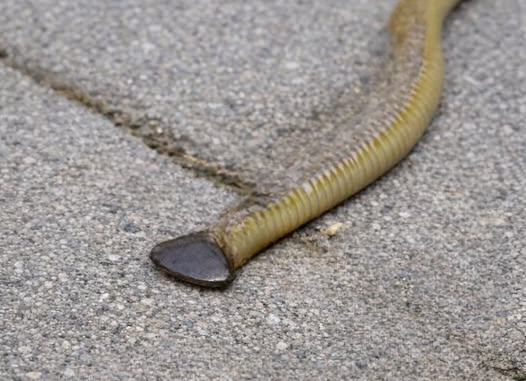
Finding a long, slimy creature stretched across patio stones or garden soil can be unsettling enough on its own. But when that creature has a flat body and a head shaped like a tiny shovel or hammer, the reaction tends to shift from discomfort to confusion. It doesn’t look like any common earthworm or slug, and for many homeowners, the immediate thought is that something unnatural or dangerous has appeared in their yard.
What people are usually seeing is a hammerhead worm, a type of land flatworm that has recently gained more attention due to its spread in residential gardens. Despite its strange appearance, it is a real biological species—not a mutation or a rare one-off—and it is slowly becoming more common in many regions around the world.
A Creature That Looks Like It Doesn’t Belong Outside
Hammerhead worms get their name from the distinctive shape of their head, which is wide and flattened, resembling a spade or hammer. Their bodies are long, soft, and ribbon-like, often in shades of brown, gray, or tan, sometimes with darker stripes running along the length.
Unlike earthworms, which are segmented and cylindrical, hammerhead worms move in a smooth, gliding motion. They can grow quite long—some reaching a foot or more—adding to the surprise when one is spotted crossing a driveway or curled under a plant pot.
They are most commonly seen in damp environments, especially after rainfall, when they come out onto patios, sidewalks, and garden beds. Their appearance in open spaces is often accidental from a human perspective, but for the worm, it is simply part of its natural movement through moist soil environments.
Why Hammerhead Worms Are Spreading
Hammerhead worms are not native to many of the areas where they are now being found. They originally come from parts of Southeast Asia, but have spread globally through human activity. They often travel unnoticed in potted plants, soil, mulch, or nursery materials.
Because they are small, flat, and easily hidden, they can survive long-distance transport without being detected. Once introduced into a new environment with enough moisture and food, they can establish themselves and begin reproducing.
This ability to spread quietly is one of the reasons gardeners and environmental specialists have become more interested in tracking their presence.
The Hidden Role They Play in the Ecosystem
At first glance, hammerhead worms might seem like just another strange garden inhabitant. However, their ecological role is what makes them notable.
They are predators of earthworms.
Earthworms are essential to healthy soil. They break down organic matter, improve aeration, and help distribute nutrients throughout the ground. Without them, soil can become compacted and less fertile over time.
Hammerhead worms hunt earthworms by following chemical trails in the soil. Once they locate prey, they use sticky secretions to immobilize it and begin digesting it externally. This feeding behavior allows them to overpower creatures that are otherwise beneficial to the environment.
While a single worm may not cause noticeable damage, larger populations can reduce earthworm numbers locally, which can have long-term effects on soil quality in gardens and landscaped areas.
Why They Are Hard to Control
One of the most unusual features of hammerhead worms is their ability to reproduce through fragmentation. This means that if the worm is cut into pieces, each piece has the potential to regenerate into a new individual under the right conditions.
This is why common instincts—like chopping or crushing—can actually worsen the problem. Instead of eliminating the worm, improper handling may unintentionally contribute to its spread.
They are also resilient in damp environments and can survive in hidden spaces such as under rocks, mulch, or garden debris, making them difficult to fully remove once established.
Are They Dangerous to Humans or Pets?
Hammerhead worms are not aggressive toward humans or animals. They do not bite, sting, or actively attack. However, they should still not be handled directly.
Their bodies produce mucus that may contain mildly irritating compounds. In some cases, contact can cause skin discomfort or allergic reactions in sensitive individuals. For this reason, experts recommend avoiding bare-hand contact entirely.
Pets are also unlikely to be seriously harmed by them, but ingestion is not advised, and repeated exposure should be prevented where possible.
What to Do If You Find One
If you encounter a hammerhead worm in your yard, the key response is caution and proper handling.
The safest approach is to avoid touching it directly. Using gloves, a stick, or a paper towel, the worm can be placed into a sealed container. Many people choose to dispose of it in a way that ensures it cannot regenerate or return to the soil.
The important rule is to avoid cutting it. Mechanical fragmentation can increase reproduction rather than stop it.
After removal, cleaning tools and washing hands thoroughly is also recommended to avoid accidental transfer of residue.
Why Gardeners Are Paying Attention
The reason hammerhead worms have become a topic of concern is not because they pose a direct threat to people, but because they quietly affect the balance of garden ecosystems.
A healthy garden relies heavily on soil organisms working beneath the surface. When predators like hammerhead worms enter that system, even in small numbers, they can shift that balance over time.
For gardeners, landscapers, and homeowners, awareness is the first line of defense. Recognizing what these creatures are—and what they are not—helps prevent unnecessary panic while still encouraging responsible action.
A Strange Visitor With a Real Impact
The hammerhead worm is a reminder that not everything unusual in nature is immediately harmful, but that doesn’t mean it should be ignored. Its alien appearance often causes alarm, but its ecological role is what makes it important to understand.
Spotting one on a patio or garden path doesn’t mean disaster, but it does signal that the local environment is part of a larger, shifting ecosystem influenced by human movement and climate conditions.
In the end, the strange “shovel-headed” worm is not a myth or a mystery—it is simply a small but fascinating piece of a much bigger natural story unfolding quietly beneath our feet.
Leave a Reply