
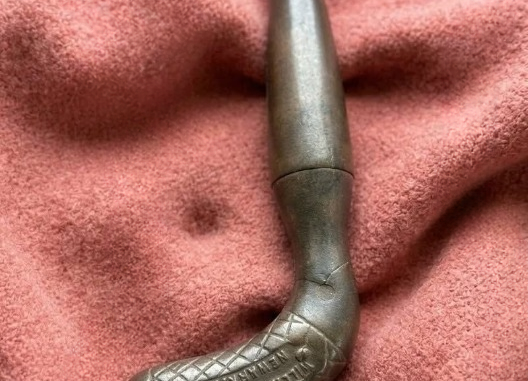
When we began sorting through the belongings of a family friend who had passed away, we expected to find ordinary reminders of a life well lived. There were old photographs, handwritten letters, worn tools, and household items that had been stored away for years.
But among the forgotten belongings, we discovered something unusual.
Hidden beneath dusty papers and miscellaneous objects was a solid, oddly shaped tool. Its surface was smooth in places, and its form suggested that it had once served a specific purpose. Yet none of us could immediately identify it.
We turned it over, studied its shape, and tried to imagine what it might have been used for. Was it an old workshop instrument? A piece of agricultural equipment? Perhaps something from a forgotten household task?
Everyone had a different theory, but no one was certain.
What made the discovery fascinating was the feeling that this object had a story behind it. It didn’t look like something purchased merely for decoration. It appeared to have been designed for practical work, and its unusual shape hinted at a purpose we had yet to uncover.
For a while, the mystery remained unsolved.
An Unexpected Connection to the Sea
Eventually, we began researching old tools and comparing the object with historical examples. After examining similar designs, we discovered a possible explanation that none of us had considered.
It resembled a traditional maritime tool known as a fid, an instrument used by sailors to work with rope.
Suddenly, the strange object took on an entirely different meaning.
Rather than belonging to an ordinary workshop, it was connected to the demanding world of traditional sailing, where ropes played an essential role in keeping ships operational.
A fid was commonly used to separate the strands of tightly twisted rope, making it easier to splice ropes together or create secure connections. Depending on its design and the material from which it was made, it could be used for different kinds of ropework aboard ships.
Although simple in appearance, such tools were important to sailors who maintained the complicated network of ropes used to control sails, secure equipment, and handle heavy loads.
The discovery offered a glimpse into a world that had largely disappeared from everyday life.
Why Sailors Relied on Tools Like This
Before modern synthetic ropes and contemporary marine equipment became widespread, traditional sailing depended heavily on natural-fiber ropes, careful maintenance, and the practical knowledge of experienced crews.
Rope was essential to almost every aspect of a sailing vessel.
It helped control sails, secure cargo, fasten equipment, and perform countless other tasks. A damaged rope or an unreliable connection could create serious problems, particularly when a ship encountered strong winds or rough seas.
Sailors therefore needed to understand how to repair ropes and make durable splices.
A fid helped them accomplish this by opening spaces between tightly twisted strands. Once the strands were separated, they could be woven or interlaced according to the particular splice being made.
The work required patience, practice, and a good understanding of rope construction.
It was not simply a matter of forcing a tool into a bundle of fibers. The sailor needed to know how the strands should be separated and joined so that the finished connection would perform reliably.
In this environment, even a modest hand tool could make an important contribution to a ship’s maintenance.
Imagining the Hands That Once Used It
Once we understood the tool’s possible purpose, it became much easier to imagine the circumstances in which it might have been used.
Perhaps it had once belonged to a sailor who spent long periods aboard a working vessel. Maybe it was kept in a ship’s tool chest, brought out whenever ropes needed attention, and stored away again after the work was finished.
We could picture the sounds of a busy deck, the movement of the ship beneath the crew’s feet, and the constant demands of working with sails and rigging.
Of course, we had no way to know whether this particular object had actually traveled aboard a ship or who might have owned it. Without records or other evidence, its personal history remained a mystery.
Nevertheless, its possible connection to maritime work gave us a new appreciation for its design.
What initially appeared to be an unremarkable object could represent a practical tradition passed between generations of craftspeople and sailors.
How an Important Object Becomes Forgotten
One of the most interesting aspects of the discovery was how easily the tool’s original purpose had been lost.
Objects often remain in families long after the people who used them have passed away. They may be moved between houses, placed in storage boxes, or kept because someone believes they might be useful someday.
Over time, however, the knowledge that once explained their purpose can disappear.
A tool that was once familiar to its owner may become unrecognizable to younger generations. Without the surrounding equipment or the person who understood how to use it, its original function may no longer be obvious.
That is particularly true of specialized tools associated with traditional trades.
Many were designed for one specific task, and their unusual shapes make little sense to someone unfamiliar with the work they were created to perform.
Our discovery reminded us that an object’s importance cannot always be judged by its appearance. Something that seems insignificant today may once have been essential to someone’s livelihood.
A Small Piece of Maritime History
Learning about the fid also encouraged us to think about the broader history of sailing.
For centuries, ships depended on the practical expertise of sailors, carpenters, riggers, and other skilled workers. Their knowledge was often passed along through hands-on experience rather than written instructions.
Tools were designed to solve specific problems, and their usefulness depended on the people who understood them.
Although modern ships use advanced materials and technologies, traditional ropework remains relevant in many maritime activities. Skills such as splicing, securing lines, and maintaining rope are still useful in sailing, boating, and other applications.
A traditional fid therefore represents more than an unusual shape. It reflects a time when practical knowledge and simple equipment were central to working at sea.
The Story Behind the Object
We never expected that sorting through an old house would lead us to explore maritime history. What began as a confusing discovery became an opportunity to learn about a specialized tool and the people who relied on similar instruments.
We also learned an important lesson about historical objects: identification is only the beginning.
To understand an item fully, it helps to consider the work it was designed for, the materials used to make it, and the people whose daily lives depended on it.
Although we could not establish the exact history of the object we found, identifying its resemblance to a traditional fid gave us a much better understanding of its possible purpose.
Perhaps it had belonged to a sailor. Perhaps it had been collected by someone interested in old tools. Its journey to that dusty corner of the house remained unknown.
But its possible maritime connection was enough to change the way we viewed it.
What had seemed like a forgotten piece of clutter became a reminder of the ingenuity and craftsmanship behind traditional sailing.
Sometimes, the most fascinating discoveries aren’t valuable antiques or priceless treasures. They are ordinary objects whose original purposes have been forgotten.
And occasionally, all it takes is a little curiosity to bring their stories back to life.
Leave a Reply