

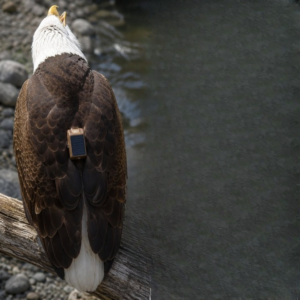
For two decades, researchers followed the movements of a single eagle across vast landscapes, collecting data that would eventually reveal far more than they expected.
At first, the tracking information appeared confusing. The bird’s route stretched across mountains, rivers, forests, and open plains in patterns that seemed unpredictable. Its path rarely followed a straight line, and many of its movements appeared random when viewed on a map.
But as scientists gathered more information and compared the eagle’s travels with weather conditions, seasonal changes, and environmental factors, a fascinating picture began to emerge.
What initially looked like chaos was actually a highly adaptable strategy for navigating a constantly changing world.
A Journey Guided by Nature
The eagle’s movements were closely connected to natural conditions.
Researchers discovered that many sudden changes in direction coincided with shifts in wind patterns, rising warm air currents, and seasonal weather systems. What appeared to be unnecessary detours often helped the bird conserve energy or avoid unfavorable conditions.
By taking advantage of natural air currents, the eagle was able to travel efficiently across long distances while expending less effort.
Each movement reflected a remarkable ability to respond to changing environmental conditions.
Learning Through Experience
One of the most interesting findings was the consistency hidden within the bird’s seemingly irregular routes.
Year after year, the eagle returned to familiar resting areas and seasonal habitats. While the exact path varied depending on weather and environmental conditions, certain destinations remained remarkably consistent.
Researchers observed that the bird adjusted its routes based on:
- Wind conditions
- Seasonal changes
- Food availability
- Weather systems
- Habitat conditions
Rather than following a fixed path, the eagle demonstrated flexibility and responsiveness—qualities that greatly improved its chances of survival.
Challenging Traditional Assumptions
The study also encouraged scientists to rethink some long-held ideas about animal movement.
Earlier models often assumed that migration followed relatively simple and predictable patterns. However, the eagle’s behavior suggested something far more dynamic.
Its decisions appeared to be influenced by multiple factors simultaneously, requiring constant adaptation rather than rigid adherence to a predetermined route.
The research highlighted how animals often respond to environmental conditions in sophisticated ways that are not always obvious through simple observation.
Adaptation in Action
Throughout the twenty-year study, the eagle encountered countless challenges.
Storms altered landscapes.
Weather patterns shifted unexpectedly.
Food sources changed from season to season.
Yet the bird consistently adapted.
When conditions became unfavorable, it adjusted course. When opportunities appeared, it took advantage of them. This flexibility allowed it to thrive across diverse environments and changing circumstances.
The study became a powerful example of resilience and adaptability in the natural world.
What Researchers Learned
Beyond the scientific data, the project offered a deeper appreciation for the complexity of wildlife behavior.
Tracking a single eagle over such a long period revealed how closely animals are connected to their environments. Mountains, forests, rivers, weather systems, and seasonal cycles all influenced the bird’s decisions.
Researchers came to realize that understanding wildlife often requires patience, long-term observation, and a willingness to look beyond simple explanations.
The Value of Long-Term Research
By the end of the project, the eagle had become well known among researchers studying migration and animal behavior.
The study contributed valuable insights into:
- Wildlife navigation
- Migration patterns
- Environmental adaptation
- Conservation planning
- Ecosystem connections
More importantly, it demonstrated how long-term observation can reveal patterns that short studies might miss.
A Reminder About Nature’s Complexity
The story of this eagle serves as a reminder that nature often operates in ways that are more intricate than they first appear.
What looked like random movement eventually revealed a carefully balanced system of decision-making shaped by experience, environmental awareness, and adaptation.
The bird’s journey showed that success in the natural world is not always about following the shortest path. Often, it depends on the ability to adjust, respond, and work with changing conditions.
Final Thoughts
After twenty years of observation, researchers discovered that the eagle’s travels were far from random. Instead, they reflected a remarkable ability to navigate complex environments while adapting to ever-changing conditions.
The study highlights the importance of patience, observation, and curiosity when exploring the natural world.
Sometimes what appears chaotic at first glance turns out to be a sophisticated response to challenges we cannot immediately see.
And occasionally, one animal’s journey can teach us valuable lessons about resilience, flexibility, and the extraordinary ways life adapts to the world around it.
Leave a Reply