
On a quiet evening in rural Tennessee, Sydney Moore and Aramis Youngblood were at home with their young children, doing what any exhausted parents would do after a long day—trying to settle the house, calm the children, and prepare for a peaceful night. Outside, the air felt heavy and still, carrying that uneasy silence that sometimes comes before severe weather, though nothing at that point felt certain enough to demand immediate concern.
Like many nights in rural areas, weather changes can feel distant or manageable, even when conditions are shifting in the background. There were subtle signs that something was off in the atmosphere, but life inside the home continued in its normal rhythm. The family focused on bedtime routines, unaware that the situation outside was about to escalate far beyond what anyone could reasonably prepare for.
That sense of normality collapsed quickly.
Without warning, the wind intensified. What had been a quiet background presence turned into something forceful and active, pressing against the house with growing intensity. The structure began to respond to the pressure almost immediately. Windows trembled, the walls vibrated, and the entire home started to feel as though it was under strain from all directions at once.
Within moments, the sound of the storm changed completely. It became a deep, continuous roar that filled every space inside the house, drowning out speech and thought alike. It no longer sounded like weather in the distance—it sounded like something directly overhead, something massive and uncontrollable moving through the area.
Instinct replaced planning.
Sydney immediately moved to protect their older child, pulling him close and holding him tightly as the environment around them destabilized. At the same time, Aramis reached toward their youngest child, a four-month-old baby resting in a bassinet nearby. In that instant, the bassinet—meant to represent safety and stillness—became the most important object in the room.
But the situation was already beyond control.
The house began to fail under the pressure. The roof gave way rapidly, as if it had been lifted and peeled back by an invisible force. Rain, wind, and debris poured into the home at once, erasing the boundary between inside and outside. Furniture shifted violently, objects were torn loose, and the interior of the house became chaotic and unrecognizable.
Aramis held onto the bassinet with all his strength, trying to keep it anchored in place despite the overwhelming force moving through the structure. But the wind inside the house was no longer predictable. It moved violently and in multiple directions, making it impossible to resist consistently.
Then, in a sudden and devastating moment, the bassinet was torn away.
It was not gently pushed or knocked aside—it was violently pulled upward and outward by the tornado, disappearing into the storm as the house continued to break apart around them. The collapse of the structure continued in waves, leaving the family exposed to wind, rain, and flying debris until the tornado eventually moved on.
When the storm finally passed, the silence that followed felt unnatural. After such extreme noise and destruction, the absence of sound created its own pressure, as if the world had momentarily stopped. Sydney and Aramis slowly realized that what remained of their home was barely recognizable. Walls were gone, belongings were scattered, and everything familiar had been reduced to fragments spread across a damaged landscape.
But the most immediate and painful realization came quickly: their baby was missing.
In the aftermath of a disaster like that, shock and confusion make it difficult to process what has actually happened. There is a state of uncertainty where hope and fear exist at the same time, neither fully taking over. That is where the family found themselves as they tried to understand the extent of the damage and what had been lost.
Despite the devastation, Sydney began moving carefully through the wreckage. The area around the home had been completely transformed—trees uprooted, debris scattered everywhere, and the ground covered in broken materials that made movement difficult and dangerous. She searched through what remained, looking for any sign of life or direction, while still processing the shock of what had just occurred.
Aramis stayed closer to the remains of the house. He could not bring himself to move far from where his child had last been. Instead, he searched nearby areas, calling out repeatedly, hoping for any response. Every sound in the environment felt meaningful, every small noise carrying the possibility of an answer.
Time felt distorted. Minutes seemed much longer than they were, stretched by fear and uncertainty.
Then, in the quiet aftermath, something faint broke through the silence. It was not the wind or debris—it was a small, fragile sound that immediately caught Aramis’s attention. He followed it carefully, moving through broken branches and unstable ground, focusing entirely on the direction it came from.
What he discovered was almost unbelievable.
His infant son was alive.
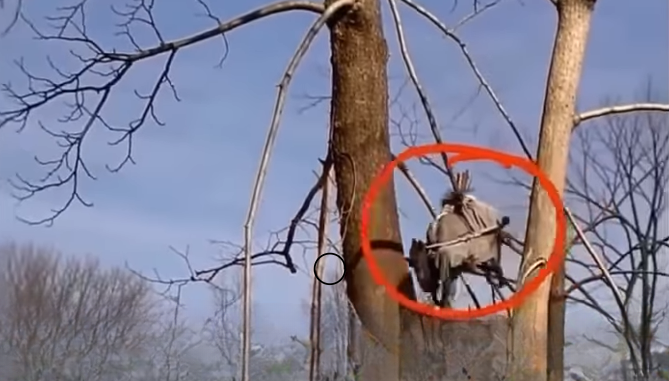
The baby had been carried by the force of the tornado and placed into the fork of a tree, where the branches had formed a natural pocket of protection. Though injured—suffering a mild concussion and ear trauma—the child had survived the violent storm that destroyed everything around him.
The emotional impact of that moment was overwhelming. Relief did not arrive gradually; it hit all at once, breaking through shock and fear in a flood of disbelief and gratitude. Aramis carefully held his child and began the journey back through the destroyed landscape, trying to process how such destruction could still contain survival.
The home they had known was gone. What remained was not something that could be returned to, but only rebuilt from the ground up. Every part of daily life—comfort, structure, possessions, routine—had been erased in minutes.
In the days that followed, word of the incident spread through the community and beyond. People reacted strongly to both the scale of the destruction and the extraordinary survival of the infant. The story quickly drew attention, not only because of what was lost, but because of what had inexplicably remained.
Support began to arrive. A fundraising effort eventually raised over $100,000 to help the family recover and rebuild. Neighbors contributed essential supplies, including clothing, food, and items needed for the baby. Even strangers who had never met the family responded with donations and messages of support, forming a wider network of assistance around them.
What followed was a long process of recovery. Rebuilding after a disaster is never immediate—it happens slowly, in stages, shaped by emotional recovery, financial support, and time. The family had to adjust not only to the loss of their home, but also to the experience of what had almost been lost entirely.
In the end, the story is not just about destruction. It is about how quickly life can be stripped down to its most fragile state, and how, in rare and unpredictable moments, survival can still emerge from within that chaos.
The tornado took nearly everything that night. But somehow, against overwhelming odds, it did not take everything.
Leave a Reply