

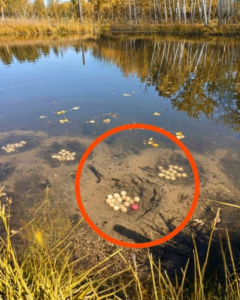
There’s a small artificial lake in our village that most people barely notice.
It sits quietly between homes, trees, and winding roads, blending into the landscape so naturally that it rarely attracts much attention. While it isn’t a natural lake, it has become a familiar part of the area—a calm spot that reflects the sky and surrounding greenery on quiet days.
One afternoon, however, something about it caught my eye.
The weather was unusually calm, and the water looked almost perfectly still. The surface reflected everything around it like a giant mirror. As I stood along the shore, I noticed several unusual shapes scattered across the bottom of the lake.
At first, they appeared random.
But the longer I looked, the more organized they seemed.
The clusters looked intentional, almost as though they had been placed there. From where I stood, it was difficult to tell exactly what I was seeing, and the lack of movement only added to the mystery.
Naturally, my imagination started working overtime.
I wondered whether the shapes were part of some unusual underwater formation. Maybe they were objects that had collected over time, or perhaps something entirely unexpected was hidden beneath the surface.
The stillness of the water made everything seem more mysterious than it really was.
There were no ripples.
No fish breaking the surface.
No movement at all.
I moved closer to the edge, trying to get a better view.
For a few minutes, I became completely absorbed in figuring out what was down there.
Then, as the angle of the sunlight shifted, I finally saw the answer.
One of the shapes revealed a faint logo.
At first, I wasn’t sure what I was looking at. But after focusing more carefully, the mystery disappeared almost instantly.
The strange formations weren’t unusual at all.
They were golf balls.
Dozens of them.
Some were partially buried in the sediment, while others sat clearly visible on the lakebed. Over time, they had collected in clusters after landing in the water from a nearby golf course.
What looked mysterious from a distance turned out to be something completely ordinary.
I couldn’t help but laugh.
In just a few minutes, my mind had transformed a simple collection of lost golf balls into something far more dramatic.
Why Our Minds Fill in the Blanks
The experience reminded me of something interesting about human nature.
When we encounter incomplete information, our brains naturally try to create explanations. We look for patterns, connections, and meaning, even when we don’t have all the facts.
A few unclear shapes beneath still water became a puzzle.
And without an obvious answer, my imagination rushed to fill the gap.
This happens more often than we realize.
A shadow can look like movement.
A reflection can seem unusual.
An unfamiliar shape can feel significant simply because we don’t immediately understand it.
The Value of Looking Closer
What struck me most wasn’t the discovery itself but how quickly my assumptions changed once I had more information.
The lake never changed.
The objects never changed.
Only my understanding changed.
Sometimes things appear mysterious simply because we’re viewing them from the wrong angle or without enough context.
Once the full picture becomes visible, the explanation is often much simpler than we imagined.
A Small Lesson From an Ordinary Afternoon
Looking back, the experience wasn’t really about golf balls or lakes.
It was a reminder that first impressions aren’t always accurate.
We often create stories to explain what we don’t understand, especially when information is limited. Sometimes those stories are fascinating—but they aren’t always true.
In the end, the mystery beneath the lake turned out to be nothing more than years of misplaced golf shots resting quietly at the bottom.
Still, the experience left me with an important reminder:
Not everything unusual hides a secret.
Sometimes the most ordinary explanations are the right ones.
And sometimes all it takes is a closer look to see things clearly.
Leave a Reply