
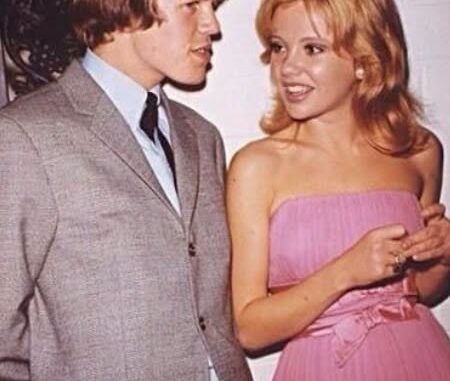
For a young man growing up in the middle of the 1960s rock scene, Peter Noone seemed to have everything.
He was young, famous, surrounded by musicians and celebrities, and living the kind of lifestyle that many people could only dream about.
But behind the fame was a very different story.
Noone has described himself as being immersed in what he calls the “quintessential rocker lifestyle,” yet there was one part of that world he never wanted to make his own.
Drugs were never his territory.
Instead, he preferred to observe.
He described himself as something of a “fly on the wall,” watching the wild scenes around him without becoming deeply involved. While others were drawn toward the excesses of the era, Noone says he tended to gravitate toward the girls who didn’t smoke rather than toward drugs.
Alcohol, however, became a different story.
Trying to Fit Into the Rock ’n’ Roll World
Drinking became Noone’s way of fitting into an environment where excess was almost expected.
He remembers going out with actor Richard Harris and attempting to drink more than him.
He also spent time at London’s famous Ad Lib club, where John Lennon bought drinks.
For someone who was already a young celebrity, these experiences might sound glamorous decades later.
But Noone has suggested that there was something less glamorous underneath it all.
Part of his motivation was simply that he didn’t always feel particularly interesting.
Drinking helped him feel like he belonged.
But eventually, he began to realize that the lifestyle was taking him somewhere he didn’t want to go.
At just 19, Noone attended his first Alcoholics Anonymous meeting with his father.
It became an important turning point.
He decided to cut down because he wanted to remain sensitive to other people’s feelings and, perhaps most importantly, remain capable of doing his job onstage.
Years later, he would say that he had not touched alcohol for approximately 16 years.
His decision was personal rather than a judgment of others. He has continued to make clear that his wife and other people around him should be free to drink if they choose.
For Noone, the important thing was knowing what worked for his own life.
Finding Stability Away From the Stage
His personal life eventually settled into a much more consistent rhythm.
Noone met his future wife, Mireille, when he was just 20.
At the time, he was still dating different women, but meeting Mireille made an immediate impression.
He jokingly described it as “lust at first sight,” followed by the realization that she was genuinely kind and enjoyable to be around.
There was just one problem.
She repeatedly turned him down.
But Noone wasn’t ready to give up.
When Mireille went on holiday to Ibiza with her mother, he rented the apartment next door.
He eventually won over her mother with his respectful behavior and, according to his own telling, eventually “wore Mireille down.”
The couple married in 1968 and later had a daughter, Nicole.
Leaving Herman’s Hermits
By 1971, Noone had made another major decision.
At just 24 years old, he left Herman’s Hermits as the members of the group began moving in different directions.
His solo career never reached the same heights as the band’s earlier success, but his career wasn’t finished.
During the 1980s, he found new opportunities.
He appeared on Broadway in The Pirates of Penzance and became the host of the American television music program My Generation.
Later, he took on another role that connected him with young musical talent, serving as a mentor and voice coach on American Idol.
His career had taken him far beyond the teenage pop-star image that had first made him famous.
A Different Kind of Life in California
Noone had been based in California since the 1970s, and he became attracted to the state’s emphasis on healthy living.
That lifestyle represented quite a contrast to the world he had entered as a teenage rock star.
Now, decades after his rise to fame, he continues to perform.
At 64, he tours with Britain’s Solid Silver 60s Show alongside other familiar names from the era, including Brian Poole and Brian Hyland.
The songs may be old.
The audiences may have changed.
But the memories of the 1960s remain remarkably powerful.
Fans still sing those songs directly to him.
Looking Back at a Dangerous Era
Perhaps the strangest part of Noone’s story is how many people from that generation never made it this far.
He has reflected on the casualties of an era remembered for its music, freedom and rebellion—but also for its heavy drinking, drug culture and excess.
One moment that particularly affected him came at producer Mickie Most’s funeral.
Looking around at the service, Noone was struck by how few familiar faces from his old world he could see.
It made him stop and think.
The people who had once seemed like permanent fixtures in the music industry were no longer all there.
Noone, however, was.
He had survived the era, stepped away from alcohol, built a family life and continued working in music long after many expected the story to end.
His journey is not simply about fame.
It is about what happens when someone surrounded by excess decides that they don’t have to follow everyone else.
The teenage heartthrob who once stood in the middle of rock ‘n’ roll’s wildest years eventually found his own way forward.
And decades later, he’s still standing onstage, still singing the old songs—and still carrying the memories of a generation that changed music forever.
Leave a Reply