
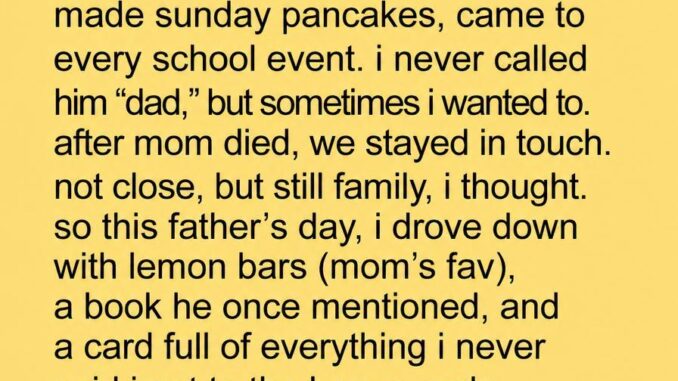
For Jenna, discovering the truth about Gary changed far more than her opinion of the man who had once been part of her family. It forced her to reconsider an entire decade of memories, from childhood weekends and school performances to the quiet moments when she believed someone had chosen to stay.
The most painful revelation was not simply that Gary had been pretending to care. It was learning that her biological father had apparently tried to contact her for years—and that Gary had deliberately destroyed those letters before she ever had the opportunity to read them.
Now Jenna faces a difficult question: should she try to find those lost letters and finally discover what her biological father wanted to say, or would leaving the past untouched give her a better chance at peace?
The Questions That Never Went Away
Growing up, Jenna believed her biological father had simply disappeared from her life.
She had no memories of him being there for her. As far as she knew, he had left and never looked back.
That belief shaped her childhood and, eventually, her understanding of herself.
Then Gary’s confession changed everything.
If his claim was true, Jenna’s father had apparently written letters attempting to reconnect. Gary had intercepted them, discarded them, and allowed Jenna to continue believing that her father had never cared enough to reach out.
That creates an entirely different kind of pain.
There is a difference between knowing someone chose not to contact you and discovering that someone may have tried to contact you—but another person prevented you from ever knowing.
Naturally, Jenna might wonder what those letters contained.
Did her father apologize?
Did he explain why he left?
Did he ask to see her?
Did he talk about the years he missed?
Or were the letters filled with excuses that might only create more questions?
Unfortunately, there may never be complete answers.
Would Reading the Letters Bring Closure?
It could.
For someone who has spent years wondering about an absent parent, even difficult information can sometimes be easier to live with than uncertainty.
Reading the letters might allow Jenna to understand her father’s perspective without necessarily accepting or forgiving his choices.
She could finally learn whether he genuinely wanted a relationship with her.
She might discover that he carried regret.
She might also discover something far less comforting.
Perhaps the letters were poorly written attempts to repair an impossible situation. Perhaps they contained apologies that came too late. Or perhaps they revealed that her father remembered her and wanted to be part of her life more than she ever realized.
Whatever they contain, they could provide information that Jenna was unfairly denied.
But Closure Doesn’t Always Come From the Past
There is another side to the question.
Jenna has already endured an enormous emotional betrayal.
The person she believed had stepped into the role of a father figure admitted that much of his relationship with her was supposedly an act. Then she discovered that he had interfered with her relationship with her biological father.
Opening those old wounds immediately may not be what she needs.
Sometimes people believe that finding every missing piece of their past will finally make everything make sense.
It doesn’t always work that way.
A letter cannot change childhood.
It cannot restore missed birthdays, conversations, holidays, or years of connection.
It cannot transform an absent parent into the father Jenna needed when she was growing up.
And it certainly cannot erase what Gary did.
The Most Important Truth
Perhaps the most important thing for Jenna to remember is that she does not need her biological father’s letters to prove that she mattered.
Her worth was never determined by whether her father stayed.
It was never determined by whether Gary genuinely loved her.
And it certainly isn’t determined by the cruel choices made by the adults around her.
Her mother was the person who actually showed up.
She worked hard, raised Jenna, supported her, and gave her a foundation from which she eventually became strong enough to confront the truth.
That relationship cannot be erased by anything written in an old envelope.
What If She Chooses to Read Them?
If Jenna eventually decides to search for the letters, she should do it because she wants the truth, not because she feels obligated to forgive anyone.
She could read them slowly.
She could stop whenever the experience became overwhelming.
She could choose not to respond to her biological father, even if he is still alive.
Learning someone’s story does not create an obligation to invite that person back into your life.
The letters could become information rather than instructions.
They might explain the past without controlling the future.
What If She Chooses Not to Read Them?
That choice would be just as valid.
Jenna has already reclaimed something more important than an explanation: her independence.
She now knows that Gary’s version of events was built on deception. She knows the house her mother left behind belongs to her. Most importantly, she has learned that she can walk away from people who treat her trust as something disposable.
She doesn’t have to investigate every painful chapter simply because the opportunity exists.
Sometimes peace comes from knowing enough.
A Future That Belongs to Jenna
Ultimately, the letters are not the thing that determines Jenna’s future.
Whether she reads them or leaves them buried, the central truth remains the same: the choices other people made do not define the woman she became.
If she reads them, perhaps she will finally understand a part of her history that was hidden from her.
If she doesn’t, perhaps she will decide that her future deserves more attention than her past.
Either way, she gets to choose.
And that may be the greatest form of closure available to her.
The letters may contain answers about the man who left.
But Jenna’s real story is about the woman who survived the lies, confronted the truth, reclaimed what belonged to her, and finally realized that she never needed anyone else’s permission to decide where her life would go.
Leave a Reply