
When my father passed away, I inherited the family farm. It was a beautiful property that had belonged to our family for many years, filled with memories, traditions, and countless stories from the past.
At first, I thought inheriting the farm was a wonderful gift. But as I began spending more time there, I realized that the property carried more than memories. It also held a family secret that had affected two households for decades.
Our closest neighbors were the Walters. Despite living next to each other for generations, our families had never shared a friendly relationship. There were no visits, no celebrations together, and hardly any conversations.
Growing up, I never questioned this arrangement. My parents simply taught me to stay away from the Walters, and I accepted it as something that had always been part of our lives.
However, everything changed shortly after my father’s funeral.
An Unexpected Discovery in the Old Farmhouse
The day after the funeral, I returned to the farmhouse alone. Walking through its familiar rooms brought back memories of my childhood. Everything seemed exactly as my father had left it.
While looking through the kitchen, I noticed an old envelope hidden behind a jar on a high shelf.
My name was written across the front in my father’s familiar handwriting.
I immediately wondered what he could have wanted to tell me.
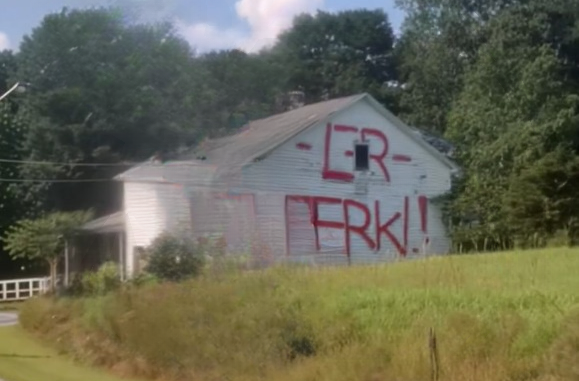
Before opening it, I looked through the window and noticed something unusual on the outside wall of the farmhouse.
Someone had painted two large words in red:
LIAR. THIEF.
I was shocked and immediately wondered who could have done such a thing.
I checked the property’s old security recordings and discovered footage of a young man standing outside the farmhouse during the previous night.
It was Carlos Walter, the son of our neighbors.
His expression suggested years of frustration, and it was clear that the message was directed at my family.
I decided that I needed to speak with the Walters rather than make assumptions.
A Confrontation That Revealed Years of Resentment
When I arrived at their property, Walter, Carlos’s father, answered the door. Carlos was standing nearby, looking upset.
Before I could properly introduce myself, Carlos spoke.
“Your family destroyed ours,” he said.
His words surprised me. I had known about the disagreement between our families, but I had never understood what caused it.
I asked him what he meant.
Walter remained quiet, while Carlos continued expressing his frustration. It became obvious that their family had carried a painful memory for many years.
I returned home with more questions than answers.
That evening, I finally opened the envelope I had discovered in the kitchen.
What I found inside completely changed my understanding of my father and the history of our farm.
The Secret My Father Took to His Grave
In the letter, my father explained that he and Walter had once been very close friends.
They had worked together, shared plans, and dreamed of building a successful farm that would benefit both families.
Their friendship was built on trust, and Walter had invested money into their shared plans.
But everything changed when my mother became pregnant with me.
My father admitted that he had become worried about the future. Instead of discussing his concerns with Walter, he made a decision that would eventually destroy their friendship.
He used the money Walter had invested and arranged for the entire property to be registered under his own name.
Walter was left without the ownership he had expected, while my father continued building a life on the land.
The betrayal created a disagreement that never truly ended.
My father wrote that he regretted his decision and had carried the guilt for the rest of his life.
One sentence particularly stayed with me:
“I took something that was never mine alone, and I allowed that mistake to become a burden for everyone who came after us.”
I read the letter several times.
Suddenly, the family’s long-standing disagreement made sense. Walter’s resentment had not appeared without reason, and Carlos had grown up hearing a story that explained why his family felt wronged.
For the first time, I understood the real history behind the silence between our households.
A Decision That Could Change Everything
The following morning, I took the letter and walked across the field toward the Walters’ home.
The distance between our properties had always seemed ordinary, but that morning it felt different.
When Walter opened the door, I handed him the letter.
“My father left this for me,” I explained. “After reading it, I realized what happened between your families.”
He carefully unfolded the paper and began reading.
I could see the emotions on his face changing as he recognized the details of an event he had remembered for years.
When he finished, he looked at me without saying anything.
“I believe my father made a serious mistake,” I continued. “I don’t want to benefit from something that he admitted was never entirely his.”
I then explained that I wanted to work toward returning the property and correcting the injustice as far as possible.
Walter seemed unable to find the right words.
Carlos, who had been standing behind him, stepped forward.
“I always thought you would defend what your father did,” he said.
“I understand why you thought that,” I replied. “But I don’t believe we should continue something that was wrong simply because it happened before we were born.”
For a moment, nobody spoke.
It was not an instant reconciliation, and years of disappointment could not disappear in a single conversation. But something important had happened.
The truth was finally out in the open.
Slowly Rebuilding a Broken Relationship
Over the next few days, we began discussing what should happen next.
Returning the property was not something that could be settled through a simple exchange of keys. There were ownership records, legal responsibilities, and practical details that needed to be reviewed properly.
However, the most important change was that both families were finally willing to communicate.
Walter began sharing memories of his friendship with my father. He described the early days when they had worked together and talked about their plans for the future.
Carlos also became less confrontational. Instead of repeating the accusations he had grown up hearing, he started asking questions about what had happened.
I listened carefully, realizing that I had inherited a responsibility much greater than maintaining a farm.
I had inherited a complicated family history, including mistakes that I had never personally made.
Over time, conversations became easier. We began greeting each other, discussing practical matters, and slowly rebuilding the trust that had disappeared many years earlier.
The process was not perfect, but it was a beginning.
The Real Meaning of Inheritance
As I reflected on everything, I began to understand that inheritance is about more than receiving property, money, or family possessions.
Sometimes, it also means discovering difficult truths about the people who came before us.
My father had worked hard to build a life for his family, but one decision had created years of disappointment for another household.
I could not change what he had done, and I could not erase the years of resentment that followed.
But I could decide what to do next.
I realized that continuing an old injustice simply because it had become part of the family history would only allow the same problem to survive for another generation.
The letter had given me something I never expected: an opportunity to make a different choice.
It did not immediately restore the friendship between the two families, nor did it erase the past. What it did was create an opportunity for honesty, understanding, and a more peaceful future.
Final Thoughts
The hidden letter changed the way I viewed my father, our family farm, and the neighbors we had avoided for so many years.
It taught me that unresolved mistakes can affect people long after the original events have passed. It also reminded me that honesty and accountability can create opportunities for change.
Family history is important, but it should not force future generations to repeat the same disagreements.
Sometimes, the most valuable thing we inherit is not a house or a piece of land. It is the chance to correct something that was left unfinished.
And sometimes, a single letter can open the door to a conversation that should have happened many years earlier.
Leave a Reply