
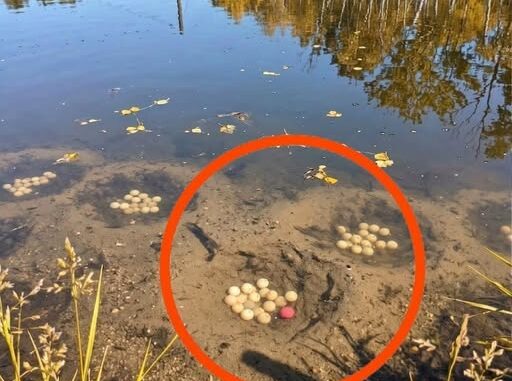
There is a small artificial lake in my village that most people barely notice. It sits quietly among houses, trees, and narrow roads, blending into the familiar landscape. Unlike a natural lake, however, it has always seemed slightly unusual to me. Its shape is orderly, the water can appear remarkably still, and on calm days the surface reflects the sky like a giant mirror.
I had passed the lake countless times without stopping to think about it. Then, one unusually calm day, I noticed something beneath the surface.
The water was clear enough to reveal several strange shapes resting on the lakebed. At first, I could not make out what they were. They appeared to form small clusters, and from a distance, they seemed almost organized.
Naturally, my imagination started working.
I wondered whether the lake might contain some unusual aquatic life. Perhaps an unfamiliar species had adapted to the artificial environment. Maybe the objects were part of a colony of organisms or some other natural formation I had never seen before.
The longer I looked, the more convincing the mystery seemed.
The quiet surroundings made everything feel even more unusual. There was barely any movement on the water, and nothing immediately explained the shapes below. I moved closer to the edge and tried to get a clearer view.
Then I finally recognized one of the objects.
It had a familiar logo.
The mystery disappeared almost instantly.
The strange shapes were golf balls.
There were dozens of them scattered across the bottom of the lake. Some were partly covered by sediment, while others were still visible beneath the water. Their presence suddenly made perfect sense because a golf course was located nearby.
Those mysterious clusters were simply the result of golf balls repeatedly ending up in the water.
For a moment, I felt both amused and slightly disappointed. I had imagined hidden creatures and unusual ecosystems, only to discover something completely ordinary. Once I knew what I was looking at, however, the entire scene made sense.
I laughed at how quickly my imagination had transformed a few blurry objects into an elaborate mystery.
Why Our Minds Create Stories
What stayed with me was not really the golf balls. It was the way my mind had interpreted them.
When people encounter incomplete information, the brain naturally tries to make sense of it. We look for patterns, connect details, and create explanations based on what we already know.
That process can be useful. Recognizing patterns helps us understand unfamiliar situations and make decisions quickly. However, it can also lead us to conclusions that are more imaginative than accurate.
That is exactly what happened beside the lake.
I had very little information. I could see shapes, but I could not identify them. Instead of waiting for more evidence, my imagination filled the gaps.
And, as often happens, the most interesting explanation seemed more appealing than the simplest one.
The Simple Explanation Was the Right One
When I discovered that the objects were golf balls, I expected to feel disappointed. Instead, I found the explanation strangely satisfying.
There was no unexplained species or hidden phenomenon. Nothing unusual had been discovered. The objects had simply accumulated there over time.
Sometimes an ordinary explanation can be more interesting than a complicated one because it reminds us how easily everyday events can create unusual scenes.
A single golf ball in a lake would not have attracted much attention. Dozens of them gathered together beneath still water were a different story. Without context, the collection looked mysterious.
With context, it was perfectly ordinary.
When Familiar Things Look Strange
The experience also reminded me that what we see depends heavily on circumstances.
Water can distort objects beneath its surface. Reflections can change their appearance, while shadows and sediment can make familiar objects difficult to identify. Distance and lighting can make the problem even greater.
When those visual details are combined with an active imagination, it becomes surprisingly easy to mistake something ordinary for something extraordinary.
This happens in everyday situations as well. A vague sound can seem threatening until its source is identified. A shadow can resemble an object that is not actually there. A small misunderstanding can become a much larger story when important information is missing.
The lake gave me a simple example of that process.
A Lesson From an Ordinary Lake
Looking back, the experience was never really about the golf balls. It was about perception and the assumptions we make when we do not have the full picture.
The lake itself had not changed. The objects beneath the water had not changed either. What changed was my understanding of what I was seeing.
At first, the scene appeared mysterious. A few minutes later, it was completely ordinary.
That small experience reminded me that an unexplained detail does not necessarily point to something extraordinary. Sometimes the answer is much simpler than the story our minds create.
The quiet lake, the scattered golf balls, and a moment of mistaken interpretation turned an ordinary afternoon into a memorable reminder: before believing the story our imagination creates, it is often worth taking another look at the facts.
Leave a Reply