
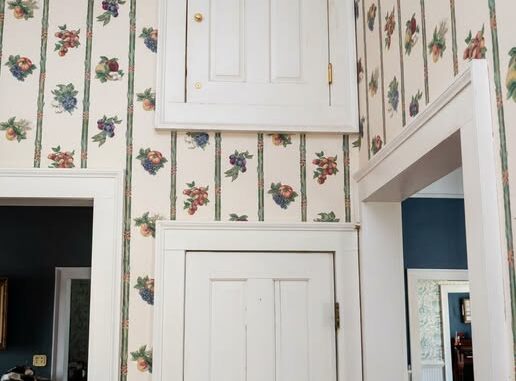
If you’ve ever explored an older house, you may have noticed something unusual: a small cabinet or open shelf positioned high above a doorway or tucked into an otherwise unused section of wall.
At first, it can look almost pointless.
Why would anyone put storage somewhere so difficult to reach?
The answer is more interesting than it appears.
These elevated cabinets were often clever solutions to a very ordinary problem: how to make every inch of a home useful without sacrificing valuable floor space.
And in some historical settings, there was another reason for designing storage this way—local tax rules and the way certain types of household space were classified.
When Every Inch of a Home Mattered
Older houses often had far less built-in storage than modern homes.
There were no enormous walk-in closets, expansive kitchen cabinets, or dedicated storage rooms in many properties. Families therefore had to become creative.
Unused wall space became valuable.
The area above a doorway was particularly useful because it normally served no practical purpose. Rather than leaving it empty, homeowners could install a shallow shelf or cabinet and turn dead space into storage.
It was a simple idea:
If you couldn’t expand outward, build upward.
What Did People Store Up There?
Because these cabinets could be inconvenient to reach, they were best suited to belongings that weren’t needed every day.
Depending on the home, they could hold things such as:
- Extra blankets and quilts
- Seasonal clothing
- Luggage
- Holiday decorations
- Spare linens
- Serving dishes
- Household supplies
- Keepsakes and other rarely used possessions
Instead of allowing these objects to occupy valuable closets or living areas, homeowners could move them overhead.
A small cabinet might not have offered much space individually, but several strategically placed storage areas could make a meaningful difference.
The Clever Use of Vertical Space
The real genius of these cabinets was their location.
Modern homes frequently leave substantial amounts of vertical space unused. We tend to think horizontally—adding another dresser, shelf, closet, or storage box.
Earlier homeowners often had a different approach.
They looked upward.
The space above doors, beneath ceilings, and inside awkward wall recesses could all become useful. High cabinets allowed families to add storage without making rooms feel smaller or filling the floor with furniture.
That principle remains useful today, especially in apartments and smaller homes.
Did High Cabinets Really Help Avoid Taxes?
This is where the history becomes particularly intriguing.
Stories about older homes sometimes connect unusual storage arrangements with historical taxes on household features such as rooms, windows, or closets. In certain places and periods, governments did impose taxes or assessments based on particular characteristics of a property.
However, the idea that all high cabinets were specifically invented to avoid a universal “closet tax” is too broad.
The exact rules varied considerably by location and period. Some historical tax systems did target particular forms of housing or luxury, but there isn’t one single explanation that accounts for every elevated cabinet found in older buildings.
So while clever homeowners certainly adapted their homes to local regulations, the practical explanation is often simpler:
High storage was an efficient way to gain useful space without expanding the room itself.
Why Some Were Left Open
Another feature that makes these cabinets look strange today is the lack of doors.
An open shelf above a doorway might seem unfinished by modern standards, but it could be perfectly practical.
Open shelving was inexpensive to build and made it easy to see or retrieve stored items.
In some cases, the contents were covered with fabric, baskets, or other simple methods of keeping them tidy.
The goal wasn’t necessarily to create elegant cabinetry.
It was to create useful storage.
A Clever Solution for Seasonal Belongings
One of the best uses for elevated storage was keeping seasonal items out of the way.
Think about a family preparing for winter.
Heavy blankets and quilts might be needed for several months but become unnecessary once the weather warmed. Rather than allowing them to occupy everyday storage, they could be moved into a high cabinet.
The same principle worked for holiday decorations, summer clothing, travel bags, and other belongings that spent most of the year untouched.
The cabinet didn’t need to be convenient every day.
It only needed to be available when necessary.
Why the Idea Still Works Today
Although these cabinets belong to a different era, the underlying design principle hasn’t disappeared.
In fact, it’s arguably more relevant in smaller modern homes.
Apartments, studios, tiny houses, and compact urban properties all face the same basic challenge:
There is only so much floor space available.
Using vertical space can dramatically increase storage capacity without making a room feel crowded.
Modern versions of the idea might include:
- Cabinets above doorways
- Full-height kitchen storage
- Shelving near the ceiling
- Built-in wardrobes extending upward
- Overhead storage in small bedrooms
- Recessed shelves in unused wall spaces
The technology has changed.
The problem hasn’t.
A Forgotten Example of Practical Design
These strange little cabinets tell us something interesting about how people used to think about their homes.
A house wasn’t simply a collection of rooms.
Every corner had potential.
A narrow wall could become a shelf. The space beneath stairs could become a cupboard. The area above a door could become storage.
What might look peculiar to us today was often the result of careful problem-solving.
Why We Still Find Them Fascinating
Part of the appeal of these high cabinets comes from their mystery.
When you encounter one in an old house, it’s natural to wonder why anyone would build storage somewhere so inconvenient.
But once you understand the logic, the feature becomes much more interesting.
It represents a time when homeowners had to be resourceful with limited space and limited resources.
There was little reason to waste an empty corner simply because it wasn’t convenient.
The Lesson Hidden Above the Door
The next time you see a small cabinet sitting high above a doorway, don’t dismiss it as an outdated architectural oddity.
It may represent something much more practical.
It could have been used for seasonal belongings, household storage, or simply to take advantage of otherwise wasted vertical space. And depending on the building’s location and age, its design may also reflect historical approaches to taxation and property classification.
Either way, the idea reveals an enduring truth about good design:
The best storage solution isn’t always the biggest one. Sometimes it’s simply the space everyone else overlooked.
What once seemed like an awkward little cabinet was actually a clever reminder that when space is limited, creativity can be just as valuable as square footage.
Leave a Reply