
For several weeks, my husband and I noticed unusual sounds coming from the wall beside our bedroom. At first, they were so faint that we barely paid attention. A little scratching in the early morning, followed by an occasional soft buzzing, seemed easy enough to explain.
We assumed the house was settling or that the sounds were coming from the plumbing. Like many homeowners, we had grown accustomed to the ordinary noises a house makes.
But gradually, the sounds became more noticeable.
When the Noises Became Hard to Ignore
The scratching seemed to follow a pattern. Sometimes we heard it just before sunrise, while at other times it appeared late in the evening.
My husband thought there might be a small animal inside the wall. I wondered whether a loose component or an issue with the wiring could explain the buzzing.
We discussed several possibilities, but neither of us knew for certain what was happening.
One evening, the noise became loud enough to interrupt our conversation. My husband stood near the wall and listened carefully.
“Something is definitely going on in there,” he said.
For the first time, we realized that guessing would not solve the problem. We needed to find out what was causing the sounds.
Deciding to Investigate
Our first instinct was to inspect the area ourselves. However, we knew that opening a wall without understanding what was behind it could create additional problems.
The combination of scratching and buzzing made us consider the possibility of an insect nest or another hidden pest issue. We decided that professional advice would be the safest next step.
When a qualified specialist examined the area, the explanation was far more surprising than we had expected.
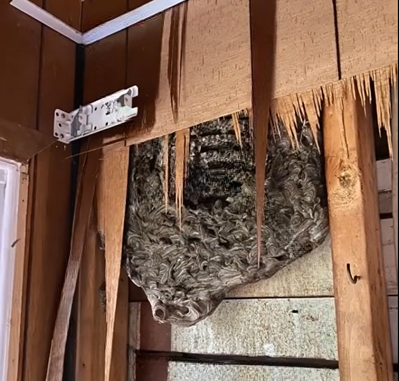
Behind the drywall was a large wasp nest.
The nest occupied part of the wall cavity, hidden from view by the interior surface. What had sounded like mysterious activity inside the house was connected to a colony of insects living just beyond the room where we slept.
We had never imagined that something like this could develop so close to our everyday living space.
How Could a Nest Develop Inside a Wall?
Wasps sometimes build nests in sheltered locations, including wall cavities, roof spaces, sheds, and other protected areas.
A small opening in the exterior of a building can provide access to a space that is rarely inspected. If conditions are suitable, a colony may grow over time without being immediately noticed by the people living inside.
The sounds we had heard were consistent with activity inside the wall, although the precise cause of each noise could not be established simply by listening.
Discovering the nest helped explain why the sounds had become more noticeable as the weeks passed.
It also reminded us that hidden areas of a home can occasionally develop problems that are not obvious during ordinary cleaning or maintenance.
Why Professional Help Was Important
Once the nest was identified, we left the work to trained professionals.
Disturbing a wasp nest can cause defensive behavior, and some people may experience serious allergic reactions to stings. For that reason, attempting to remove a nest from an enclosed wall without appropriate knowledge and equipment can be dangerous.
The specialists assessed the situation and arranged for the nest to be handled appropriately.
They also considered the surrounding area to determine how the insects had gained access and whether further inspection or repairs were necessary.
Watching the process made us appreciate the value of professional experience. What initially seemed like a simple household mystery required careful assessment and a suitable plan.
Getting Our Peaceful Home Back
After the nest was addressed, the bedroom gradually returned to normal.
The quiet felt especially welcome. For weeks, we had been listening for every little sound, wondering whether the next scratch or buzz would reveal another problem.
Now we could relax without constantly trying to identify noises behind the wall.
The experience had changed our perspective, though. We became more attentive to unusual sounds and more willing to investigate problems instead of dismissing them.
We also learned that paying attention does not mean assuming the worst. It means recognizing when something is unusual and taking sensible steps to understand it.
Small Signs Can Deserve Attention
Looking back, we realized how easily we had explained away the early noises.
A house can creak as temperatures change. Pipes can make sounds, and outdoor activity can sometimes be heard indoors. Not every unusual noise indicates a serious problem.
However, persistent scratching, unexplained buzzing, or repeated sounds coming from the same enclosed area deserve closer attention, particularly when they become more frequent.
Depending on the circumstances, a qualified pest-control professional, electrician, or building specialist may be able to identify the source.
If insects are suspected inside a wall, avoid striking or opening the area yourself. Keep a safe distance and seek appropriate professional assistance.
What Our Experience Taught Us
The discovery was unexpected, but it left us with a practical lesson about home maintenance.
We cannot see every part of a house, and we cannot prevent every problem. What we can do is pay attention to changes, investigate persistent concerns, and seek help when a situation is beyond our expertise.
We also learned that familiar surroundings should not prevent us from taking reasonable precautions. A home can feel perfectly ordinary while an issue develops somewhere out of sight.
Today, our bedroom is quiet again. Occasionally, I still notice a small sound and pause for a moment, but I no longer feel the same uncertainty.
Instead, I remind myself that unusual problems are often easier to address when they are recognized early and handled appropriately.
Our experience began with a faint scratching sound and ended with an unexpected discovery behind an ordinary wall.
It taught us that good home care is not about worrying over every noise. It is about knowing when to pay attention, making informed decisions, and protecting the place where we live.
Leave a Reply