
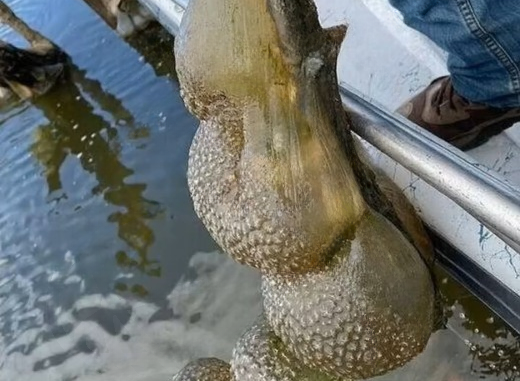
In March 2024, visitors exploring McGee Creek Reservoir in Atoka County, Oklahoma, noticed unusual jelly-like formations attached to branches beneath the water. The transparent, irregularly shaped clusters looked unfamiliar, leaving boaters wondering what kind of organism could create such strange structures.
Images of the formations sparked curiosity online, with some people questioning whether they were insect eggs or a potentially harmful aquatic species. However, the mystery had a natural explanation. According to the Oklahoma Department of Wildlife Conservation, the unusual growths were colonies of bryozoans, tiny aquatic animals that are common in freshwater environments.
Although their appearance might seem alarming, these organisms are harmless to people and play a useful role in aquatic ecosystems.
What Are Bryozoans?
Bryozoans are small aquatic animals that often live together in colonies. Rather than being one large organism, each colony consists of hundreds or thousands of microscopic individuals known as zooids.
These tiny animals work collectively, forming a structure that can resemble a soft, gelatinous blob. Depending on the species and environmental conditions, colonies may appear transparent, whitish, or light brown.
Each zooid performs essential functions that help the colony survive. Many freshwater bryozoans feed by filtering water and collecting microscopic food particles, including algae and other organic material.
To capture food, they use specialized structures called lophophores. These contain delicate tentacles that create water currents and trap tiny particles, allowing the animals to obtain nutrients from their surroundings.
Why Do They Look Like Jelly?
The unusual texture of bryozoan colonies comes from a soft, gelatinous material that surrounds and protects the individual animals. This outer layer gives the colony its distinctive appearance and helps provide a suitable environment for the zooids.
Underwater, the formations may look soft, slippery, and almost transparent. When removed from the water, however, they can lose moisture, shrink, and become much less flexible.
At McGee Creek Reservoir, submerged branches and other underwater surfaces offered convenient places for the colonies to attach themselves. Suitable water conditions and available food allowed them to grow into structures large enough for visitors to notice.
Although these formations can look strange to someone seeing them for the first time, they are a natural part of freshwater life.
Are These Aquatic Colonies Dangerous?
The good news is that freshwater bryozoans do not pose a known direct threat to swimmers, anglers, or boaters. They are not known to bite or sting people, and the colonies are not considered poisonous.
Their unusual appearance can understandably cause concern, especially when they are discovered unexpectedly. However, there is generally no reason to panic when these organisms are spotted attached to submerged branches.
As with any unfamiliar material found in a lake, it is sensible to avoid unnecessary handling and wash your hands after contact. Visitors should also follow local guidance if they encounter a substance they cannot confidently identify.
How Bryozoans Support Freshwater Ecosystems
Despite their small size, bryozoans contribute to the natural processes that keep lakes and reservoirs functioning.
Their filter-feeding activity helps remove suspended particles from the water. Depending on local conditions, this can influence water clarity and the movement of organic material through the ecosystem.
Bryozoan colonies may also provide surfaces and hiding places for small aquatic organisms. Some animals feed on them, while tiny invertebrates can use their complex structures as shelter.
These interactions make the colonies more than just unusual underwater formations. They are part of a larger food web in which many different species depend on one another.
However, finding bryozoans alone does not prove that a lake is pollution-free or completely healthy. Their presence is one biological observation that must be considered alongside other environmental evidence.
Their Remarkable Survival Strategy
One of the most interesting features of certain freshwater bryozoans is their ability to survive when conditions become unfavorable.
Many species produce specialized structures called statoblasts. These durable reproductive bodies can remain dormant through difficult periods, including cold weather or drying conditions.
When the environment becomes suitable again, statoblasts can develop into new colonies. This survival strategy allows bryozoans to persist across changing seasons and helps explain why they can reappear in lakes and reservoirs.
Some statoblasts can also be transported to new locations through water movement, animals, and other natural processes, helping these organisms reach additional suitable habitats.
An Ancient Group of Aquatic Animals
Bryozoans have a remarkably long evolutionary history. Fossils indicate that the group dates back hundreds of millions of years, with early representatives appearing during the Ordovician Period, approximately 470 million years ago.
Today, bryozoans include thousands of known species, most of which live in marine environments. Others inhabit freshwater habitats, including ponds, rivers, lakes, and reservoirs.
Because they often remain underwater and attach themselves to submerged surfaces, people may never notice them until a colony becomes large enough to attract attention.
Their discovery in Oklahoma therefore offers a reminder that familiar waterways contain a surprising variety of organisms that usually remain hidden from view.
What the Oklahoma Discovery Teaches Us
The jelly-like formations at McGee Creek Reservoir demonstrate how easily an unfamiliar natural feature can be mistaken for something dangerous. Without scientific information, their unusual shape and texture can make them seem mysterious.
In reality, bryozoans are small colonial animals that have survived through enormous periods of environmental change. Their feeding habits, reproduction, and interactions with other aquatic species make them valuable members of freshwater ecosystems.
The next time a strange cluster appears beneath the surface of a lake, the explanation may be far more interesting than it first seems. Rather than representing a mysterious threat, these formations can reveal the hidden diversity of life living just below the waterline.
The Oklahoma discovery is a useful reminder that understanding nature often begins with curiosity. By learning more about unfamiliar organisms, we can better appreciate the complex ecosystems that surround us and the many small creatures that help sustain them.
Leave a Reply