
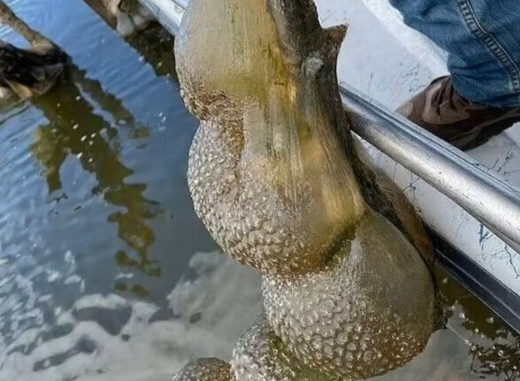
At first glance, the strange, jelly-like blobs hanging beneath the water in an Oklahoma lake looked like something straight out of a science-fiction movie. Their translucent appearance and unusual shapes left boaters wondering what they had discovered. Were they mysterious eggs, an invasive species, or something potentially dangerous?
The surprising answer was far more fascinating than many people expected.
In March 2024, visitors to McGee Creek Reservoir in Atoka County, Oklahoma, spotted unusual gelatinous clusters attached to submerged tree branches. The discovery attracted attention because the formations looked so different from the plants and animals people normally encounter in freshwater lakes.
But scientists had a reassuring explanation. According to the Oklahoma Department of Wildlife Conservation, the mysterious blobs were colonies of bryozoans—tiny aquatic animals that have existed for hundreds of millions of years.
Although their appearance may seem alarming, these remarkable organisms are harmless to humans and play an important role in freshwater ecosystems.
What Are These Strange Jelly-Like Blobs?
Bryozoans are small aquatic animals that often live together in colonies. Rather than being a single large creature, each gelatinous mass consists of hundreds or even thousands of tiny individual animals called zooids.
Working together, these zooids form a colony that can grow on submerged branches, rocks, aquatic plants, and other underwater surfaces.
The colony’s unusual appearance comes from its soft, jelly-like outer structure, which provides support and protection for the tiny animals living within it.
Depending on the species and environmental conditions, bryozoan colonies can appear translucent, whitish, yellowish, or light brown. Some remain relatively small, while others grow into conspicuous masses that are easy to spot beneath the water.
Because most people rarely see these organisms up close, their unusual appearance can easily lead to confusion.
However, bryozoans are a natural part of many freshwater environments, including lakes, ponds, and reservoirs throughout North America.
How Do These Tiny Animals Survive?
One of the most interesting things about bryozoans is how they feed.
Individual zooids use specialized structures called lophophores, which consist of delicate, tentacle-like projections arranged around the mouth. These structures help them capture tiny food particles suspended in the surrounding water.
Their diet can include microscopic algae, bacteria, and other small organic particles.
As the zooids feed, the colony collectively filters material from the water. This contributes to the movement and processing of organic matter within the ecosystem.
Bryozoans are not a replacement for natural water-treatment processes, and their presence alone does not prove that a lake is clean. Nevertheless, they perform an important ecological function as filter-feeding animals.
Their colonies can also provide surfaces and hiding places for tiny aquatic organisms, creating miniature habitats within the larger freshwater environment.
In this way, these strange-looking blobs contribute to the complex web of life beneath the water’s surface.
Are Bryozoans Dangerous to Humans?
The good news is that freshwater bryozoans are considered harmless to people.
They do not bite or sting, and the colonies are not known for producing toxins that threaten swimmers or boaters. Their unusual appearance is not a reason to panic.
However, people should still practice ordinary water safety. Avoid drinking untreated lake water, and wash your hands after handling unfamiliar aquatic material.
It is also wise to avoid moving water plants, animals, or attached organisms between lakes, since doing so can unintentionally spread unwanted aquatic species.
If you encounter a strange underwater growth, observing it without disturbing it is usually the best approach.
Why Were They Growing in McGee Creek Reservoir?
Bryozoans need suitable surfaces on which to establish their colonies. Submerged tree limbs and other solid objects can provide excellent attachment points.
At McGee Creek Reservoir, the branches beneath the water offered places where colonies could develop and expand.
When conditions are favorable, a colony can become large enough to attract attention from people passing overhead in boats.
Water temperature, food availability, and other environmental factors influence when and how these organisms grow. Some colonies become especially noticeable during warmer months, although their activity varies by species and location.
Their presence is not necessarily unusual or evidence of a sudden environmental problem. It is often simply a reminder that freshwater habitats contain far more life than is immediately visible.
The Remarkable Survival Strategy Behind Their Ancient History
Bryozoans have a fascinating way of surviving unfavorable conditions.
Many freshwater species produce specialized dormant structures called statoblasts. These tough structures contain developing cells that can survive periods when conditions are unsuitable for active growth.
Depending on the species, statoblasts can help bryozoans withstand cold temperatures, drying conditions, or other environmental challenges.
When conditions improve, they can develop into new colonies.
This survival strategy helps freshwater bryozoans persist through changing seasons and allows them to colonize suitable habitats. Some statoblasts can also be transported by water movement, animals, or other natural processes.
Their resilience is one reason these organisms can appear in lakes and reservoirs year after year.
Bryozoans also have an exceptionally long evolutionary history. Fossils show that the group existed hundreds of millions of years ago, with a fossil record extending back to the Ordovician Period, roughly 470 million years ago.
Modern freshwater species are part of this much larger animal group, which includes numerous marine species as well.
Although today’s gelatinous colonies may look unfamiliar, their distant relatives were already living in ancient oceans long before humans appeared.
What Their Presence Tells Us About the Environment
Bryozoans are one part of a much larger freshwater ecosystem.
They interact with microorganisms, aquatic plants, fish, and other invertebrates. Their colonies may provide shelter for small organisms, while some aquatic animals can feed on bryozoans or associated material.
Their abundance can also respond to environmental conditions, making them potentially useful subjects for ecological research.
However, seeing a colony should not automatically be interpreted as proof of excellent water quality. Environmental health depends on many factors, including dissolved oxygen, nutrient levels, pollution, habitat conditions, and the diversity of organisms present.
Scientists consider multiple lines of evidence when evaluating an aquatic ecosystem.
The Oklahoma discovery nevertheless offered a valuable opportunity to remind the public that unusual-looking organisms are often ordinary residents of natural habitats.
What Should You Do If You Find Similar Blobs?
If you discover jelly-like clusters attached to branches or rocks in a lake, there is no need to assume that they are dangerous.
A few simple steps can help you learn more about what you are seeing:
- Observe from a safe distance. Notice the color, shape, location, and whether the growth is attached to an underwater surface.
- Take photographs. Pictures from several angles can help wildlife experts identify the organism.
- Avoid unnecessary handling. Leaving aquatic organisms undisturbed protects both the wildlife and the surrounding habitat.
- Ask a local expert. Your state wildlife agency, natural resources department, or a university extension service may be able to help identify an unfamiliar organism.
A photograph and the location where the organism was found can often provide useful clues.
A Small Discovery With a Big Lesson
The strange jelly-like formations at McGee Creek Reservoir remind us that nature is full of organisms that can seem mysterious when we encounter them for the first time.
What looked like a collection of bizarre underwater blobs turned out to be colonies of tiny animals with a long evolutionary history and an important ecological role.
Bryozoans filter microscopic food particles, provide habitat for small organisms, and use remarkable survival structures to endure changing conditions. They are not monsters lurking beneath the water, but fascinating members of the freshwater world.
Their discovery also highlights an important lesson: something that looks unusual is not necessarily dangerous.
Lakes and reservoirs are living ecosystems filled with organisms that most visitors never notice. Sometimes, a closer look at an unfamiliar sight reveals not a threat, but a remarkable piece of the natural world.
The next time you see something strange beneath the surface of a lake, remember that the explanation may be more interesting than the mystery itself.
Leave a Reply