
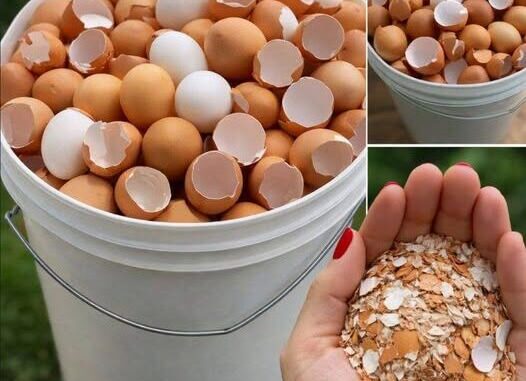
Eggshells are one of the most common items thrown away in kitchens, yet they still have several practical uses around the home and garden. Instead of sending every shell straight to the garbage bin, you can reuse them in compost, gardening projects, crafts, and simple household experiments.
Most eggshells consist primarily of calcium carbonate, a mineral that can be useful in certain gardening applications. Although they are not a miracle fertilizer or a solution to every household problem, reusing them can help reduce waste and make better use of everyday resources.
Here are 12 practical ways to give eggshells a second life.
1. Add Crushed Eggshells to Your Garden Soil
Eggshells contain calcium, which is an essential nutrient for healthy plant development. Before using them in the garden, rinse away any remaining egg residue, allow them to dry, and crush them into small pieces.
Keep in mind that eggshells break down slowly. Grinding them into a fine powder can help them decompose more quickly, although the calcium may still become available gradually depending on soil conditions.
For the best results, check your soil’s needs before adding large quantities. Not every plant or garden benefits from additional calcium.
2. Enrich Your Compost
Adding eggshells to a compost pile is a straightforward way to reduce kitchen waste. They contribute minerals to the finished compost and can eventually return nutrients to the soil.
Crushing the shells before adding them helps speed up their breakdown. Mix them with other compostable materials, such as vegetable scraps, fruit peels, dry leaves, and suitable garden waste.
Remember that eggshells alone do not create balanced compost. A mixture of different organic materials is important for producing a useful soil amendment.
3. Give Seedlings a Natural Starting Container
Eggshell halves can serve as small biodegradable containers for starting seeds indoors.
Carefully open an egg near the top, empty it, rinse the shell, and make a small drainage hole in the bottom. Fill it with seed-starting mix and plant your seeds according to their growing requirements.
Once the seedlings are ready for transplanting, gently crack the shell or remove the bottom portion before planting. This helps roots grow into the surrounding soil rather than remaining restricted by the shell.
Because eggshell containers are small, they work best for seedlings that will be transplanted relatively quickly.
4. Reduce Kitchen Waste
One of the simplest uses for eggshells is to keep them out of the household garbage when a suitable reuse option is available.
If you maintain a garden, composting is often the most practical choice. If you do not have outdoor space, check whether a local composting service accepts eggshells.
Even small changes can reduce the amount of waste a household sends to landfill over time.
5. Try a Simple Science Experiment
Eggshells provide an excellent opportunity to demonstrate basic chemistry.
Place a raw egg in a clear glass and carefully cover it with vinegar. Over time, bubbles will appear as the vinegar reacts with the calcium carbonate in the shell.
After approximately one to several days, depending on the conditions, much of the shell will dissolve, leaving the egg enclosed in its flexible membrane.
This experiment helps demonstrate how acidic liquids react with calcium carbonate. Adult supervision is recommended, and the experimental egg should never be eaten.
6. Make an Educational Craft Project
Clean eggshells can be used for creative projects with children and adults.
After drying the shells, crush them into small pieces and use them to create mosaics, textured artwork, decorative patterns, or handmade greeting cards.
The pieces can be arranged with craft glue to create different colors and textures. Avoid making the fragments too sharp, and supervise younger children to prevent accidental ingestion.
7. Use Eggshells in Suitable Composting Systems
If you have a worm-composting system, finely crushed eggshells may be useful as a source of calcium-rich grit, depending on the system and its management.
Introduce small quantities rather than adding large piles of shells. Excess material can accumulate when decomposition is slow.
For ordinary household composting, finely crushed shells are generally easier to incorporate than large, intact pieces.
8. Clean Certain Kitchen Items With Caution
Crushed eggshells have a rough texture, which may seem useful for scrubbing stubborn residue from cookware.
However, their abrasiveness can scratch delicate finishes, nonstick coatings, and some plastics. They may also leave particles behind.
For most kitchen cleaning tasks, warm water, dish soap, and a suitable nonabrasive sponge are safer options. Avoid using eggshells on surfaces unless the manufacturer confirms that abrasive cleaning is appropriate.
9. Avoid Using Eggshells to Sharpen Blender Blades
A popular household tip suggests freezing eggshells and blending them with water to sharpen blender blades. However, this method is not a reliable way to restore a blade’s sharpness.
Eggshell fragments may create additional cleanup problems, and blending hard materials can place unnecessary stress on some appliances.
If your blender is performing poorly, consult its manual, check for worn or damaged components, and replace the blade assembly if recommended by the manufacturer.
10. Be Careful With Homemade Toothpaste
Eggshells contain calcium carbonate, but that does not automatically make homemade eggshell toothpaste safe or effective.
Improperly prepared shell powder may contain contaminants, and particles that are too coarse can potentially damage tooth enamel. Homemade mixtures also lack the carefully tested formulations of commercial dental products.
For everyday oral hygiene, choose toothpaste containing fluoride and follow your dentist’s recommendations rather than experimenting with eggshell powder.
11. Skip Unverified Eggshell Beauty Treatments
Some homemade beauty recipes recommend mixing ground eggshells with egg whites to create facial masks or exfoliating treatments.
There is limited evidence that these mixtures provide meaningful skincare benefits. Coarse particles can irritate sensitive skin, while raw egg products may introduce unwanted bacteria.
A gentle, commercially formulated skincare product is generally a more predictable choice. If you enjoy DIY skincare, avoid applying abrasive eggshell powder to your face.
12. Do Not Rely on Eggshells to Repel Slugs and Snails
Scattering crushed eggshells around plants is often promoted as a natural way to keep slugs and snails away.
Unfortunately, this method is not consistently effective. Slugs and snails may cross eggshell barriers, particularly when the material becomes wet or shifts around the garden.
More dependable options include removing hiding places, inspecting plants regularly, protecting vulnerable seedlings, and using locally appropriate slug-control methods.
Why Reusing Eggshells Matters
Eggshells may be small, but finding appropriate ways to reuse them can help households reduce unnecessary waste.
Composting, seed-starting projects, and educational experiments are among the most practical ways to make use of discarded shells. Other popular suggestions, including homemade toothpaste and blender sharpening, are less advisable because their benefits are uncertain or their risks may outweigh the advantages.
The most useful approach is to focus on methods that are simple, safe, and suited to your needs.
Instead of viewing eggshells as something that must always be thrown away, consider whether they can serve a second purpose. Small, sensible habits can help reduce household waste while encouraging a more thoughtful approach to everyday resources.
Leave a Reply