
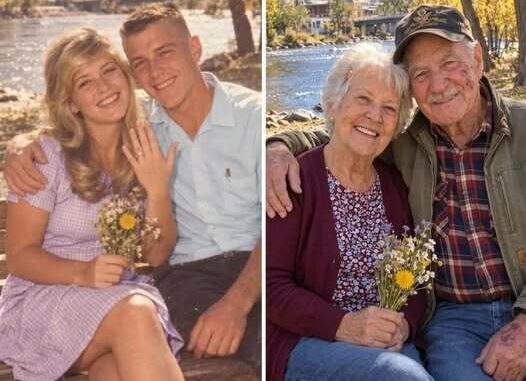
Nine days after my fiancé slipped a ring onto my finger, he left for Vietnam. I was eighteen years old, standing at the beginning of a future we had planned together. I believed he would return, marry me, and build the life we had dreamed about.
But the war changed everything.
For fifty-eight years, I believed Danny was dead. I eventually married another man, raised a family, and learned to live with the memories of my first love. Then, at seventy-seven, I received an unexpected delivery of wildflowers that changed everything I thought I knew about the past.
The message came from Danny himself.
He was alive.
When I finally stood before him, I could hardly recognize the frail, elderly man sitting in the chair. His face carried the scars of war, his hands trembled, and his breathing was shallow. Yet his eyes were unmistakably familiar.
“I’m sorry,” he whispered.
“You let me believe you were dead for fifty-eight years,” I replied, struggling to control my tears.
He lowered his head. “I know.”
“No, Danny. You don’t know what that did to me.”
He explained that he had been severely injured during the war and transferred between hospitals before eventually recovering in San Antonio. For months, he had struggled to remember his own name. Yet even through the confusion, he remembered me and the nickname he had given me: Dandylion.
His mother had visited him in the hospital. Believing I deserved a husband who could offer me a normal life, she convinced him that I would be better off thinking he had died.
Danny admitted that he had agreed.
He was ashamed of his injuries, frightened of the future, and convinced that I would no longer love him if I saw what the war had done to him.
“I thought I was protecting you,” he said.
“You took away my choice,” I answered.
His mother had also destroyed a letter he wrote after leaving the hospital. In it, he had explained that he was alive and hoped to return home. When the letter never reached me, Danny assumed I had moved on. I continued mourning him, believing there was no future left for us.
Both of us had spent decades living with a lie.
Danny eventually rebuilt his life in Ohio, found work, and married a kind woman named Elaine. They shared forty-one years together and raised a daughter, Selena. I also married, finding genuine happiness with my husband, Ted, who understood that loving someone new did not require erasing an earlier love.
When Danny told me about Elaine, I felt a mixture of sadness and relief. His life had not stopped when mine continued. He had experienced love, family, loss, and happiness, just as I had.
“I loved Ted,” I told him. “He gave me a beautiful life.”
Danny nodded. “I hoped you were happy.”
For the first time, I understood that we did not have to diminish the people we had loved afterward to acknowledge what we had once meant to each other.
I began visiting Danny every Sunday. Sometimes I brought food or flowers; other times, we simply sat together and shared stories about the lives we had lived apart.
I brought the old engagement ring, too. Its shine had faded, but I had kept it for decades.
Danny looked at it with disbelief.
“You kept it.”
“Of course I did.”
He told me I owed him nothing—not my memories, my forgiveness, or another Sunday. I realized then that our reunion was not about reclaiming the life we had lost. It was about finally being honest with each other.
Months later, Danny confessed that his mother had even arranged an empty grave bearing his name in Ohio. He wanted to return there and correct the records, so his family would no longer remember him as a man who had died in 1969.
Despite his declining health, we made the journey with Selena’s help.
Standing before the empty grave, I felt anger rise within me. For decades, people had mourned a death that had never happened, while Danny remained alive but hidden from the world.
He did not ask me to forgive him.
Instead, he admitted that fear and shame had prevented him from coming home.
I took his hand.
“You came home now,” I told him.
Together, we began putting the truth in its proper place.
Our final journey together took us to the river in Reno, where Danny had given me the ring so many years earlier. The city had changed, but the water continued flowing beneath the bridge.
We sat beside it, remembering the young couple who had once believed their future was certain.
“I thought I would marry you, build a house, and grow old beside you,” Danny said.
“I wanted a white house with a porch swing,” I reminded him.
We laughed, though the memories hurt.
I told him that I had loved Ted deeply and that my life had been meaningful despite losing Danny. I had raised children, welcomed grandchildren, and experienced happiness I could never have imagined at eighteen.
“You were part of my life, even when you weren’t in it,” I told him.
He squeezed my hand.
“And you were part of mine.”
Before we left, Danny asked whether I could forgive him.
I looked at the man beside me and saw the frightened soldier, the devoted husband, the loving father, and the elderly man who had finally found the courage to face his past.
“I forgave the boy a long time ago,” I whispered. “I’ve been angry with the man. But I think I’m ready to forgive him, too.”
Danny died peacefully the following June, with Selena and me beside his bed. His final words were filled with tenderness, and I held his hand until the end.
We buried him in Ohio beside the empty grave that had carried his name for so long. His new headstone told the truth about his life, and beneath his name, Selena chose a simple inscription:
He came home.
After his funeral, I returned to my own life with a different understanding of love and grief. I still missed Danny, just as I missed Ted, but I no longer felt compelled to carry sadness as proof that either man had mattered.
I was seventy-eight years old, surrounded by family, with letters, photographs, and memories that belonged to every chapter of my life.
One morning, I looked outside and discovered three small lemons growing on my tree. I laughed, remembering Danny’s final request that I keep tending my garden and enjoying the life I still had.
For years, I had believed that waiting faithfully meant refusing to move forward. Now I understood that life could hold sorrow and happiness at the same time.
Danny had returned too late for us to live the future we once imagined, but not too late for us to tell the truth, make peace, and say goodbye.
Sometimes, love does not return to give us back what we lost. Sometimes, it returns to help us understand that our lives were never defined by one broken promise.
And sometimes, after a lifetime of waiting, the greatest gift is discovering that we can finally let go.
Leave a Reply