

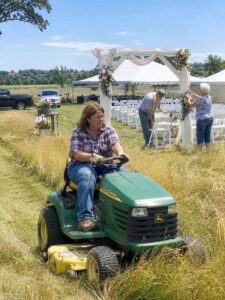
At four o’clock on the morning of my sister’s wedding, I climbed onto my grandfather’s old tractor and started cutting letters into the hayfield.
By the time the sun came up, four enormous letters stretched across the hillside behind her wedding altar.
Two hundred guests would be able to see them.
And my sister, Megan, had no idea.
I wasn’t trying to destroy her wedding. I had spent months preparing the farm so she could have the ceremony she’d always dreamed of.
But after everything I’d sacrificed, she’d told our mother I was charging family for dirt.
Those words stayed with me.
So I decided to let the field speak for itself.
The Farm Grandpa Left Behind
My name is Laney Tidwell. I’m thirty-four, and I own eighty acres of farmland outside Shelbyville, Tennessee.
I grow timothy, orchardgrass, fescue, and clover. I sell hay to horse owners and cattle farmers, and I teach agriculture at Cascade High School to help cover the bills.
Fourteen months earlier, the farm had belonged to my grandfather, Earl Tidwell.
Grandpa bought that land in 1972 with money he’d saved driving a milk truck.
Back then, the fields were overgrown with blackberries and weeds.
He cleared the ground, built fences, planted grass, and constructed the barn using oak from the property.
He spent fifty-one years caring for those eighty acres.
And he never stopped loving them.
After supper, he’d walk through the fields with his hands in his pockets, quietly studying the land.
When my father abandoned our family, Grandpa took us in.
I was nine. Megan was six.
Our mother worked at Walmart and couldn’t afford rent or childcare on her own.
Grandpa gave us bedrooms in his farmhouse and moved himself into a tiny room beside the kitchen.
He never complained.
I followed him everywhere.
By eleven, I could drive his old Ford tractor.
By twelve, I was learning to rake hay.
By fourteen, I could operate the baler.
Grandpa taught me how to read the weather, when to cut grass, and how to tell whether hay was dry enough to bale.
Megan rarely came outside.
She preferred staying indoors with Mom.
I assumed she didn’t like farming.
I thought we were simply different.
I had no idea how wrong I was.
The Will That Divided Us
Grandpa died in April at eighty-seven.
His heart had been weakening for years.
Toward the end, he couldn’t climb onto the tractor anymore.
But every evening, he’d sit in a lawn chair beside the field and watch me work.
One evening, he didn’t come out.
I found him sitting peacefully on the porch, facing the sunset.
His will was straightforward.
He left the farmhouse to our mother.
He left Megan $11,000 and his gold Hamilton watch, which he’d worn for sixty years.
And he left me the eighty acres.
He’d even written an explanation.
He wanted me to keep the land in hay, rather than sell it to developers.
Megan said nothing when the lawyer read the will.
She accepted her inheritance and avoided looking at me.
On the way home, Mom said Grandpa had always loved us equally.
I believed that.
I also believed Megan had never wanted the farm.
After all, she’d never shown any interest in working it.
But that assumption would come back to haunt me.
The Wedding Request
In October, Megan got engaged to Scott Hendricks.
Scott was a pharmacist in Murfreesboro, a kind man with a quiet sense of humor.
I liked him immediately.
A month later, Megan called.
“Laney, can I ask you something?”
“Of course.”
“Scott and I want to get married at the farm. In June. In the hayfield behind the house.”
I didn’t hesitate.
“Absolutely.”
“Really?”
“Really. Grandpa would’ve loved it.”
She thanked me softly.
I thought that was the end of the discussion.
But preparing a working farm for a two-hundred-person wedding wasn’t simple.
That spring, I cleared the ceremony area twice.
I removed a dead cedar tree, filled a groundhog hole, and mowed a path from the parking area to the altar.
I prepared space for the reception tents and made sure the ground was safe for guests.
Then I made the biggest sacrifice.
I postponed my first hay cutting.
For people who don’t farm, that might sound insignificant.
It wasn’t.
The first cutting is usually the most valuable hay of the season.
My bottom forty acres could produce approximately two thousand square bales, often selling for around twelve dollars each.
But Megan wanted tall, golden hay behind her wedding altar.
If I cut it on schedule, she’d have stubble and drying grass in her photographs.
So I left the field standing.
By waiting until after the wedding, I expected to lose roughly eleven or twelve thousand dollars in value.
I never mentioned that to Megan.
I didn’t want her to feel guilty.
She was my sister.
I wanted her day to be beautiful.
The $1,400 Argument
The only major expense I asked Megan to cover was the rental tents.
She wanted two large white tents, each forty by sixty feet, complete with sidewalls and lights.
The rental company quoted $1,400.
Because the tents would be installed on my property, the company contacted me about the agreement.
I signed the paperwork and called Megan.
“Hey, the rental company needs the deposit. Can you and Scott take care of the tents?”
She paused.
“Since we’re having the wedding at your place, I figured you’d pay for those.”
I sat quietly at my kitchen table.
I thought about the lost hay income.
The clearing.
The hours I’d spent preparing everything.
But I didn’t bring any of it up.
“Meg, I’m giving you the venue for free. The tents are part of your wedding expenses.”
Another silence.
“Fine.”
Then she hung up.
Two days later, Mom called while I was working in the barn.
“Laney, are you charging your sister to get married on the farm?”
I stopped what I was doing.
“No, Mom. I’m asking her to pay the company renting her two tents.”
“She called me crying. She says you’re charging family to use the property.”
“That’s not true.”
Then Mom repeated the words that hurt more than anything else.
“She says you’re charging family for dirt.”
Dirt.
I sat down on the barn steps.
That dirt had fed our family after Dad disappeared.
It had paid for our clothes, school supplies, and electricity.
It had helped buy Megan’s first car and her prom dress.
Grandpa had poured fifty-one years of work into that land.
And now my sister was calling it dirt.
Mom sighed.
“Can’t you be the bigger person? You’re the one who inherited it.”
There it was.
The resentment neither of them had ever fully admitted.
I wanted to explain how much money I was already losing.
I wanted to remind Mom that Megan had received Grandpa’s savings and watch.
But I didn’t.
“Okay, Mom. I’ll handle it.”
That night, I paid the $1,400 myself.
Grandpa’s Favorite Saying
After paying the bill, I sat at the kitchen table for a long time.
I remembered Megan as a little girl.
After Dad left, she’d climb into my bed at night, press her cold feet against my legs, and ask whether he was coming home.
I’d tell her stories until she fell asleep.
She was my only sister.
I wasn’t going to ruin her wedding over two tents.
But I couldn’t forget what she’d said.
Grandpa had a saying for moments like this.
“Being decent is one thing. Being a doormat is another.”
He usually said it when somebody borrowed equipment and refused to return it, or when a buyer tried to cheat him.
He never raised his voice.
He simply stood his ground.
That evening, I looked through my kitchen window toward the field behind the farmhouse.
The hay was tall and golden.
The wedding altar would stand at the bottom of the slope.
And suddenly, an idea came to me.
I could make the field say something.
Something Megan couldn’t dismiss as dirt.
Four Letters, Forty Feet Tall
I knew exactly where the wedding photographer planned to stand.
Megan had shown me the ceremony layout months earlier.
The guests would face a white arbor.
Behind it, the hayfield rose toward the tree line.
Every wedding photograph would capture that hillside.
So I started planning.
I took a measuring tape, orange survey flags, graph paper, and a carpenter’s pencil.
I measured the slope.
I calculated the viewing angle.
Then I sketched four letters.
Each would be forty feet tall, with wide strokes visible from the ceremony area.
I marked their corners with small flags hidden in the grass.
Nobody noticed.
On Friday evening, I attended the rehearsal dinner.
I ate fried chicken beneath the tents I’d paid for.
I smiled at Megan.
And I didn’t say a word.
At four the next morning, I went to the barn.
The sky was still dark.
Dew covered the hay, and the June air was cool enough that I wore Grandpa’s old brown work coat.
It still smelled faintly of diesel, grass, and the peppermints he always carried.
There were two peppermints left in the pocket.
I climbed onto his 1968 Ford 3000 tractor.
The blue-and-gray paint was worn where his hands used to rest.
I attached the old sickle mower and started cutting.
Slowly.
Carefully.
First gear.
The headlights illuminated the survey flags as I guided the mower up and down the hillside.
I made the long strokes first.
Then the shorter ones.
When the outlines were complete, I switched to Grandpa’s John Deere riding mower to sharpen the edges.
The wet grass kept clogging the deck.
I had to stop repeatedly, climb down, and pull it free.
My fingers turned green.
My jeans were soaked.
But I kept working.
At 5:40, the sun rose over the eastern ridge.
Golden light spread across the field.
I stopped for a moment.
Two letters were finished.
E.
A.
I thought about Grandpa sitting on the porch, watching this same hillside.
Then I started the tractor again.
By 7:45, all four letters were complete.
I switched off the engine.
The sudden silence felt enormous.
I walked into the middle of the word.
The letters were cut dark green against the standing golden hay.
I reached into Grandpa’s coat, unwrapped one of his peppermints, and put it in my mouth.
For a moment, I felt nine years old again.
Two Hundred Guests Saw It First
By one o’clock, the wedding guests began arriving.
I had showered and changed into a navy dress, although the green stains were still visible in the creases of my fingers.
I stood behind the reception tent.
Cars lined the driveway.
Families walked along the path I’d cleared.
They passed the farmhouse, rounded the corner, and reached the slope overlooking the ceremony.
Then they stopped.
A woman in a blue dress was first.
She raised her hand to her mouth.
Her husband followed her gaze.
Then the people behind them stopped too.
Soon, the entire crowd was staring toward the hillside.
Phones came out.
People began whispering.
There, behind the white arbor, cut into the golden hay in enormous dark-green letters, was one word.
EARL.
My grandfather’s name.
An older farmer named Harlan Pruitt stood near the front.
He’d worked alongside Grandpa for decades.
He removed his cap.
“That’s Earl Tidwell,” he whispered.
Other guests recognized the name.
Someone explained to a little girl that Earl had owned the farm and raised the bride.
The little girl looked at the hillside.
“Is he watching us?”
Her mother hesitated.
“Maybe he is.”
Scott stood beside the preacher at the altar.
He stared at the letters for a long time.
Then he found me behind the tent.
He gave me a small nod.
My mother stepped out of the farmhouse.
When she saw the hillside, she stopped.
Her hand went to her chest.
Tears began running down her face.
Then Megan appeared.
The Bride’s Reaction
My sister looked beautiful.
Her ivory lace gown had long sleeves and a flowing train.
Her dark hair was pinned up with tiny white flowers from Mom’s garden.
Our uncle Jeff was escorting her because our father wasn’t there.
Megan was watching her feet as she walked, trying not to step on her dress.
She didn’t notice the crowd staring toward the field.
But Uncle Jeff did.
He stopped.
Megan looked up at him.
“Uncle Jeff? What’s wrong?”
He didn’t answer.
His eyes were fixed on the hillside.
Megan turned.
She saw the guests.
The altar.
Scott.
And then the four enormous letters behind him.
EARL.
She stood completely still.
Her bouquet hung loosely at her side.
Then she reached beneath the lace sleeve of her wedding dress.
She pulled it back.
And there, around her wrist, was Grandpa’s gold Hamilton watch.
The watch he’d worn for sixty years.
The watch he’d left her in his will.
She pressed it against her chest.
Then she began crying.
Not quietly.
Her shoulders shook.
Her bouquet fell into the grass.
Uncle Jeff caught her before she lost her balance.
I watched from behind the tent, stunned.
I’d expected anger.
I’d expected her to accuse me of stealing attention from her wedding.
I hadn’t expected her to break down.
Then she looked around the crowd.
She spotted me.
And started walking.
People stepped aside as she crossed the grass.
She stopped directly in front of me.
“You did this.”
It wasn’t a question.
“I did.”
“When?”
“This morning. From four until almost eight.”
She looked down at my hands.
The green stains.
The scratches.
“Why?” she whispered.
I’d rehearsed an entire speech.
About the lost hay.
The rental tents.
The word dirt.
But looking at her face, I couldn’t deliver it.
“Because you called it dirt,” I said quietly. “And I wanted everyone to remember whose dirt it was.”
Megan closed her eyes.
“I didn’t mean it.”
“You told Mom.”
“I know. I was angry.”
“About fourteen hundred dollars?”
She shook her head.
“No, Laney.”
Her voice cracked.
“About everything.”
The Secret I Never Knew
Megan looked toward the hayfield.
“Do you know why I never worked outside with Grandpa when we were kids?”
I shrugged.
“I thought you didn’t like farming.”
She stared at me.
“I wasn’t allowed.”
I frowned.
“What?”
“I was allergic to timothy grass. I had terrible asthma when I was little. Remember?”
I remembered the inhaler.
The closed windows during summer.
Megan staying indoors.
But I had never connected those things to Grandpa’s fields.
“Grandpa was terrified I’d have an asthma attack,” she explained. “He wouldn’t let me go out there.”
Her eyes filled again.
“I used to stand at the kitchen window and watch you ride the tractor with him.”
I said nothing.
“I watched him teach you everything. I watched him put his hand on your shoulder. And I kept thinking that you were the granddaughter who belonged out there with him.”
My throat tightened.
All those years, I’d believed Megan simply didn’t care about the farm.
But she had wanted to be there.
She just couldn’t.
“Then Grandpa left you the land,” she continued. “And I understood why. You’re the farmer. You know how to care for it.”
She swallowed.
“But it felt like he was telling me I didn’t belong here.”
“Meg, he left you his savings. And his watch.”
“I know.”
She held out her wrist.
“I’ve worn this every day since he died. Every single day.”
Then I asked the question that had been bothering me.
“If the hay makes you sick, why did you want to get married here?”
She looked at me for a long moment.
Then she reached into a small hidden pocket inside her dress.
She pulled out a folded piece of paper.
“Because of this.”
Grandpa’s Last Letter
The paper was yellowed and soft from being unfolded so many times.
I recognized Grandpa’s handwriting immediately.
It was dated March, one month before he died.
The letter was addressed to Megan.
He wrote that he knew she’d always believed he loved me more because I spent so much time beside him in the fields.
He told her that wasn’t true.
He explained how frightened he’d been when her asthma attacks became severe.
He’d kept her indoors because he couldn’t bear the thought of losing her.
Then came the words that made my eyes fill with tears.
He admitted that he’d watched her standing at the kitchen window for years.
He knew she wanted to join us.
And he was sorry he’d never found a safe way to include her.
He explained that he was leaving me the farm because I could continue working it.
But he wanted Megan to know she’d always belonged there too.
She’d grown up on that land, even if she’d spent much of her childhood looking at it through a window.
Then he wrote that he hoped she’d someday get married in the hayfield.
He wanted to imagine himself watching from somewhere.
At the bottom, he’d added one last piece of grandfatherly advice.
Take something for the pollen first.
Then he’d signed it:
Love, Granddaddy.
I read the letter twice.
By the second time, I could barely see through my tears.
“Mom gave it to me after the funeral,” Megan explained. “Grandpa told her to give it to me when I got engaged.”
“Why didn’t you show me?”
“I was going to. When I called to ask about the wedding.”
She smiled sadly.
“But you said yes before I even finished asking.”
I looked toward the tents.
“And then we argued about the rental.”
She nodded.
“I know I was wrong. But when you asked me to pay, I felt like a visitor on land Grandpa had told me was mine too.”
Her voice trembled.
“I know it wasn’t fair to you. I know you weren’t charging me for the land.”
She looked down.
“But in that moment, it felt like I was being asked to pay just to come home.”
Suddenly, the argument made sense in a way it hadn’t before.
She wasn’t angry about a tent.
She was grieving a childhood she believed she’d missed.
And I’d been so sure she didn’t care about the farm that I’d never asked her why.
Walking Into the Field Together
For a while, neither of us spoke.
The guests were still waiting.
Scott stood at the altar.
Uncle Jeff held Megan’s bouquet.
Finally, I folded Grandpa’s letter and handed it back.
“Meg?”
She looked up.
“Did you take your allergy medicine?”
She blinked.
Then she laughed through her tears.
“Yes. And I used my inhaler. I’ve also been getting allergy shots since January.”
“Since January?”
“Since you said I could have the wedding here.”
She looked toward the field.
“I wanted to be able to stand out there.”
I held out my hand.
“Come on.”
“Where?”
“Into the hayfield.”
She stared at me.
Then she took my hand.
We walked past the tents.
Past the chairs.
Past the guests.
Past Scott and the preacher.
And up the hillside toward the enormous letters.
We stepped into the cut grass forming the E.
Her wedding dress dragged across the green stubble.
She didn’t seem to care.
We walked all the way to the top of the letter.
Then we stopped.
For the first time in her life, Megan stood in the middle of Grandpa’s hayfield.
She looked across the farm.
The barn.
The pond.
The farmhouse.
The tree line.
“I’ve never been out here before,” she whispered.
She reached toward the standing timothy and gently brushed the seed heads.
A small cloud of pollen rose into the air.
She sneezed.
We both burst out laughing.
We laughed until we had to hold on to each other.
Two grown sisters, one in a wedding gown and the other in a navy dress, standing in the middle of their grandfather’s name.
“He feels close, doesn’t he?” Megan whispered.
I looked toward the old barn.
“He’s always been close.”
The Walk Down the Aisle
When we returned to the ceremony, Uncle Jeff was waiting with Megan’s bouquet.
He offered her his arm.
But Megan looked at me.
“Uncle Jeff, would you mind if Laney walked with us?”
His face softened.
“I’d be honored.”
So we walked together.
Uncle Jeff on her left.
Me on her right.
Past two hundred guests.
Past our mother, crying in the front row.
Toward Scott and the white arbor.
Behind us, Grandpa’s name stretched across the hillside.
When we reached the altar, the preacher asked who was giving Megan away.
Uncle Jeff looked at me.
I looked at my sister.
Then I answered.
“Her family. All of us.”
I glanced toward the hillside.
“Especially Grandpa.”
The ceremony continued.
And for the first time since his death, the farm felt complete again.
The Photograph Everyone Remembered
The photographer captured Megan and Scott kissing beneath the arbor.
Behind them, the guests were standing and applauding.
And rising above the ceremony, cut into the golden hay, were the four letters:
EARL.
That photograph now hangs above Megan and Scott’s fireplace.
Someone posted another picture on Facebook that evening.
The caption explained that the bride’s sister had mowed their late grandfather’s name into the hayfield before sunrise.
It was shared thousands of times.
For weeks afterward, people called asking whether I’d do something similar for them.
A local television station wanted an interview.
A woman from Ohio even asked whether I could mow her late husband’s name into an alfalfa field.
I declined.
That wasn’t something I wanted to turn into a business.
I’d done it for Grandpa.
And for Megan.
The Check She Brought Me
The Monday after the wedding, I finally cut the bottom forty.
Just as I’d expected, the hay was past its best.
Instead of producing about two thousand premium bales, the field yielded roughly seventeen hundred lower-quality bales.
I’d lost a significant amount of money.
But I didn’t regret the wedding.
That Wednesday, while I was raking hay, Megan drove down the lane.
She stepped out wearing jeans, an old T-shirt, and a dust mask.
Her inhaler was tucked into her back pocket.
“What are you doing here?” I asked.
“Helping.”
I raised an eyebrow.
“You’re allergic.”
“I’ve got my mask, my inhaler, and my shots. Show me what to do.”
I stared at her.
Then I smiled.
I helped her onto Grandpa’s old Ford tractor.
I showed her the clutch, throttle, and controls.
She drove slowly down the first row.
Crookedly.
She missed half the hay.
But when she stopped and turned toward me, she was grinning.
“I did it!”
“You did.”
I couldn’t stop smiling.
Before she left, she handed me an envelope.
Inside was a check for $1,400.
“For the tents,” she said. “You were right. They were my responsibility.”
I looked at the check.
Then I handed it back.
“Meg, I don’t want your money.”
“I know. But I want to make it right.”
I thought about Grandpa’s lawn chair at the edge of the field.
Then an idea came to me.
“Use it for a bench.”
“A bench?”
“At the cemetery. Beside Grandpa’s grave. Somewhere we can sit when we visit.”
She looked down at the check.
Then she nodded.
The Words on the Bench
In September, a gray granite bench was installed beside Grandpa’s headstone at Shelbyville Cemetery.
It stood beneath a cedar tree, facing west.
On the front, Megan had engraved:
EARL TIDWELL
1937–2025
HE KEPT IT HAY.
But she added something on the back without telling me.
When I walked around and read it, I started crying.
It said:
From the girl in the field
and the girl at the window.
We both belonged.
One Year Later
Another June has arrived.
The bottom forty is growing tall again.
I’ll cut it next week, when the timothy is at its best.
And this year, I won’t be working alone.
Megan has been coming to the farm every Saturday.
She still wears a mask when we’re cutting hay.
She still keeps her inhaler nearby.
But she knows how to operate the rake now.
She’s learning to use the baler, although she manages to jam it more often than I’d like.
Grandpa would’ve laughed himself breathless watching us.
Last Saturday, the morning air was chilly.
Megan took Grandpa’s old work coat from the nail in the barn and slipped it on.
Then she reached into the pocket.
She found the last peppermint.
The one I hadn’t eaten on her wedding morning.
She stood holding it for a long time.
Then she unwrapped it, broke it in half, and handed me a piece.
We stood together in the barn doorway, sharing Grandpa’s last peppermint.
“It tastes like being nine,” she said.
“Six,” I corrected her. “You were six.”
She laughed.
And then she rested a hand on her stomach.
Megan and Scott are expecting a daughter in August.
They’re naming her Earlene.
After Grandpa.
Megan says that when Earlene is old enough, she’ll bring her to the farm and teach her to drive the little Ford.
Just like Grandpa taught me.
“And if she’s allergic like you?” I asked.
Megan thought for a moment.
“Then we’ll figure out how to keep her safe.”
She looked toward the field.
“But she’ll never have to spend her childhood feeling like she doesn’t belong.”
The Field Still Has a Voice
Last evening, I walked to the edge of the bottom forty.
The sun was setting behind the ridge.
The hay glowed gold and pink.
Barn swallows flew low over the grass.
I stood with my hands in my pockets, just looking.
Exactly the way Grandpa used to.
I don’t know whether he could see us on Megan’s wedding day.
I don’t know whether he watched as the sun rose over the letters I’d cut into his field.
Or whether he saw two sisters walk into the hay together, holding hands after years of misunderstanding.
But I know what I’m going to do next week.
When I cut the bottom forty, I’ll start behind the farmhouse.
Right where Megan’s wedding altar stood.
I’ll take the tractor slowly up the slope.
And I’ll cut one letter.
Just one.
An E.
Not the whole name.
Just enough that when Megan comes down the lane on Saturday morning, she’ll look toward the hillside and recognize it.
She’ll know I’m thinking of Grandpa.
She’ll know that the farm still belongs to our family’s story.
And she’ll know something we both took too long to understand.
Grandpa never had a favorite granddaughter.
He simply loved us in different ways.
The field had always been big enough for both of us.
We just needed to find our way into it together.
THE END.
Leave a Reply