
The camera was Katie’s idea, but the fear was all mine.
I sat at my kitchen table at four in the morning, staring at a grainy video on my phone.
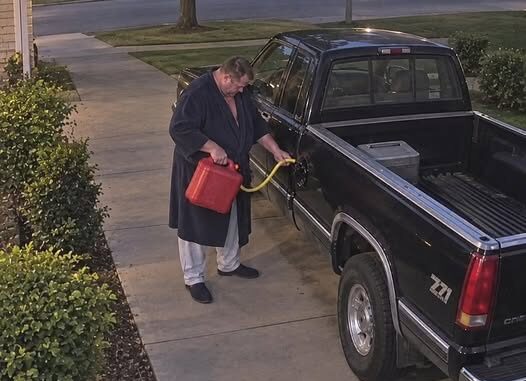
A man was walking quietly up my driveway.
He looked around, approached my old pickup, and began taking fuel from the tank.
I watched the entire thing without moving.
Then I recognized him.
It was my neighbor, Clark.
My name is Frank. I’m seventy years old, retired, and I live alone in the little house my late wife, Ellen, and I bought more than forty years ago.
The house is quieter now.
Ellen passed away three years ago, and some days the silence still feels heavier than it should.
The old pickup in my driveway means a lot to me. Ellen and I bought it years ago, and we used it for everything—family trips, home projects, visits to friends, and countless ordinary drives that became precious memories.
So when I noticed the fuel disappearing, I was more worried than angry at first.
I thought maybe I had forgotten where I had driven.
I started writing down every trip.
The pharmacy.
The grocery store.
A visit to my friend Walt.
That was about it.
Still, the fuel kept disappearing.
I took the truck to my mechanic, Dave.
He checked the tank, the lines, and everything else he could think of.
“There’s nothing wrong with the truck,” he told me.
I drove home with one uncomfortable thought in my mind.
Someone was taking my fuel.
That’s when I remembered something my granddaughter Katie had told me months earlier.
“Grandpa, you should put a camera near the driveway.”
I called her.
Within a few days, she helped me set one up.
The first couple of nights showed nothing unusual.
Then, on the third night, we found the answer.
Clark.
My neighbor.
I had known him for years.
He had borrowed my ladder, my pressure washer, and other tools more than once. I had always tried to be understanding. Ellen had been the kind of person who believed keeping peace was often more important than winning an argument.
But this was different.
Clark wasn’t borrowing anything.
He was taking it without asking.
The next morning, I walked over and confronted him.
“Have you been taking fuel from my truck?”
For a moment, he looked uncomfortable.
Then he shrugged.
“It’s only a little,” he said. “You barely drive anymore.”
I couldn’t believe what I was hearing.
“It doesn’t matter how much I drive,” I told him. “It’s my truck and my fuel.”
He tried to make it sound harmless.
He said fuel was expensive and that he had a family to support.
But none of that changed the basic fact.
If he needed help, he could have asked.
Instead, he had decided that because I was retired and lived alone, my property mattered less.
I walked home angry.
My first thought was to call the police.
I had video evidence, and I knew I had every right to report the theft.
But after thinking about it, I decided I wanted something else first.
I wanted Clark to understand that I wasn’t invisible.
Katie came to visit that weekend.
We watched the footage together and talked for hours.
She reminded me of something I had forgotten.
“Grandpa, being quiet doesn’t mean you’re weak.”
Those words stayed with me.
We decided that the safest and most sensible thing was to make sure Clark understood he had been caught.
The next morning, I left a simple envelope on his porch.
Inside were printed photographs from the camera footage, along with a note explaining that I knew what had been happening.
There was nothing threatening in it.
Just the truth.
By the time Clark came outside, several neighbors were already beginning their morning routines.
He picked up the envelope.
He looked at the photographs.
Then he looked across the street at me.
For once, he didn’t have an excuse.
Later that week, Clark came to my door.
He looked uncomfortable.
“Frank, I’m sorry,” he said.
I waited.
“I kept telling myself it wasn’t a big deal. You weren’t driving much, and I thought you wouldn’t notice.”
“That was the problem,” I said. “You decided I wouldn’t notice.”
He nodded.
“I was wrong.”
Then he offered to repay everything he had taken.
I told him that was all I wanted.
A few days later, he returned the fuel and left an envelope containing the money for what he had taken.
It wasn’t a dramatic ending.
There was no shouting match.
No police cars.
No grand victory.
Just a man admitting he had crossed a line.
Things between us didn’t become perfect overnight.
But they changed.
The next time he needed something, he asked first.
Eventually, he even started helping with small things around the neighborhood.
And I started noticing something else.
I was spending less time worrying about whether I was becoming invisible.
For a long time after Ellen died, I had quietly wondered whether my life had become smaller.
Maybe I had started believing that being old meant becoming less important.
But that experience reminded me of something.
Age doesn’t erase your boundaries.
Living alone doesn’t mean people can take advantage of you.
And being quiet doesn’t mean you don’t have a voice.
I still drive that old pickup.
Every Tuesday, I fill the tank.
The truck is still scratched, faded, and far from perfect.
But every time I see it sitting in the driveway, I remember Ellen.
And I remember that I still have plenty of life left.
Sometimes, when Clark is outside, he waves.
I wave back.
We’re neighbors.
And these days, we both understand something that should have been obvious from the beginning:
Being a good neighbor means helping when you’re asked—not taking what isn’t yours.
Leave a Reply