
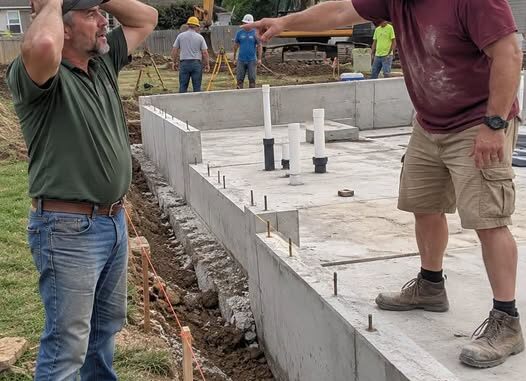
My Neighbor Built A $160,000 Foundation On My Land So I Tore It Down**
“Get off my concrete.”
I stopped at the edge of the fresh gray slab and looked at Victoria Voss.
“My concrete?” I asked.
She folded her arms. The morning sun caught the expensive sunglasses pushed up into her hair, the gold bracelet on her wrist, and the little smile on her face. It was the smile she always wore when she thought money had already won the argument for her.
“Yes,” she said slowly, like she was explaining something to a child. “My concrete. My construction site. You need to leave.”
I looked down.
My boots were standing on my land. Not hers. Mine.
I looked back up at her.
“Victoria, fourteen feet of this foundation is on my property.”
She gave a tiny laugh. She wasn’t nervous and she wasn’t embarrassed. She was amused.
“Oh, please.”
She glanced at my work truck parked by the fence. She looked at my mud-stained boots. Then she let her eyes travel slowly back up to my face.
“The slab is poured,” she said. “It’s done. You’re not going to tear out a six-figure foundation because you’re emotional about a strip of dirt.”
“A strip of dirt?”
She stepped closer.
“I’m trying to be generous here, Cole. Take the fifteen thousand dollars my attorney offered you and move on.”
“The land isn’t for sale.”
Her smile disappeared for about a second. Then it came back colder.
“Everybody says that until there’s a check in front of them.”
I stared at her. She had no idea what she’d just admitted.
“You poured this while my wife and I were in Georgia,” I said, “helping her mother after surgery.”
Victoria shrugged.
“You were gone.”
She said it like that explained everything. Like being away meant permission. Like a locked gate, a recorded deed, survey markers, iron property pins, and six years of ownership stopped existing because my truck wasn’t in the driveway.
Then she added the sentence that made sure there would never be a negotiation.
“Honestly, Cole, look at you. You build fences. I’m offering you more than that dirt is worth to you. Take the money before you turn this into something embarrassing.”
I felt my jaw tighten.
Behind me, my wife Sarah made a small sound in her throat.
Victoria glanced at her and smirked.
“And maybe your little wife can finally get the horses she keeps talking about.”
Sarah went completely still.
That was worse than if she’d yelled. Victoria had mistaken silence for weakness. She did that a lot.
I looked back at the foundation. Then I crouched down and ran my fingers along the edge of the concrete.
The surface was hard enough to walk on. But the color was still young. The edges still showed moisture loss. The material had set. It hadn’t cured.
I stood up.
“How many days ago did you pour?”
Victoria blinked. “What?”
“The concrete. How old is it?”
She rolled her eyes. “I don’t know. A few days. Why?”
I nodded. That was all I needed.
“You should call your lawyer.”
Her expression changed. “Excuse me?”
“And maybe your concrete contractor.”
“For what?”
I looked straight at her.
“Because you’re standing next to a hundred and sixty thousand dollars’ worth of concrete, and a very expensive part of it is about to disappear.”
She laughed. Louder this time.
“You can’t touch my foundation.”
“Anything on your side of the surveyed line stays.” I pointed out toward the pasture. “Everything on my side goes.”
“You’re bluffing.”
“No.”
“You think you’re just going to show up with some tractor and smash my property?”
“It isn’t your property once it crosses onto mine.”
Her face hardened.
“Try it.”
I nodded once.
“I will.”
Then I turned around and walked toward my truck.
“Cole!”
I kept walking.
“You touch that slab and I will sue you for everything you own!”
I opened the truck door. “My lawyer can talk to yours.”
“You’ll lose your business!”
I climbed in. “Call him.”
She was still yelling when I shut the door.
Sarah climbed into the passenger seat. For a few seconds, neither of us said anything.
Then she looked over at me.
“How long before that concrete becomes a nightmare to remove?”
I looked at the slab through the windshield.
“Not long.”
“How long?”
“Days.”
Sarah nodded.
“Then don’t waste any.”
The first piece of that foundation came out less than forty-eight hours later.
But to understand why Victoria Voss thought she could pour a building fourteen feet onto somebody else’s land and make them accept it, you have to understand what kind of woman she was.
And you have to understand the mistake she made when she looked at my old pickup, my dirty boots, and my little fencing company, and decided I was the kind of man she could push around with a check.
My wife and I owned twenty-two acres on Briar Creek Road in Hays County, Texas.
We’d bought it six years before Victoria showed up.
It wasn’t fancy land. Nobody had landscaped it. Nobody had designed it. That’s exactly why Sarah and I loved it.
There were live oaks bent sideways by years of wind. Limestone pushing up through thin soil. Cedar that grew anywhere you forgot to cut it. An old stock pond. A barn that leaned just enough to make contractors nervous. And sunsets that made the whole western sky look like it was on fire.
The real estate agent called it “a redevelopment opportunity.”
Sarah walked about thirty yards into the pasture the day we toured it, stopped, and whispered, “This is home.”
That was the end of the search.
Before that, I’d spent twelve years in the Army as a combat engineer.
People hear the word engineer and picture a desk and blueprints and a clean shirt. That wasn’t my version.
We built roads. We built fortifications. We cleared obstacles. We learned what concrete, steel, dirt, and explosives would do in places where getting it wrong could get somebody killed.
I learned to look at ground and see grades. I learned to look at concrete and think about strength, reinforcement, load, and age.
And I learned something else too.
Details matter. Boundaries matter. Measurements matter.
And the easiest problem to solve is usually the one you got ready for before anybody else knew there’d be a problem.
When I got out, I started McAllister Land Services.
Fencing. Brush clearing. Grading. Small demolition jobs. Road repair. Nothing glamorous.
My main truck was an old Ford F-350 with more than two hundred thousand miles on it. I owned a skid steer, trailers, augers, welders, and enough hand tools that Sarah accused me of opening a hardware store in the barn.
I made an honest living. Most of my customers came from word of mouth. I liked it that way.
Sarah worked as a large-animal veterinary technician. She was five-foot-four, redheaded, freckled, practical, and almost impossible to scare.
I once watched her walk into a stall with a terrified twelve-hundred-pound horse that two grown men had already given up on. She didn’t raise her voice. She just lowered it. Talked low and steady until that horse dropped its head and let her touch its neck.
That was Sarah. She didn’t need to be loud. She was certain.
A week after we closed on the property, I hired a licensed surveyor named Pete Sandoval.
Pete had been surveying Central Texas land for twenty-five years. He was quiet, sunburned, and wore the same faded Rangers cap every day I ever saw him.
He marked every corner. Every monument. Every line.
After he left, I drove bright orange-painted steel posts into the ground next to each iron property pin.
Sarah stood on the porch with a cup of coffee and watched me.
“You know there’s nobody living next door, right?”
“Right now.”
“You think somebody’s going to steal six inches of pasture?”
“No.”
She smiled. “So this is unnecessary.”
I wiped my forehead. “I think someday somebody’s going to build next to us and say they didn’t know where the line was.”
She shook her head. “You have a problem.”
“I have property markers.”
“You have combat-engineer brain.”
“That too.”
For years, those orange posts just sat there. The grass grew up around them. Nobody touched them.
Then Victoria Voss bought the eight-acre lot directly east of ours.
The first time I saw her, she pulled up in a white Porsche SUV.
She got out wearing clothes that probably cost more than the first truck I bought after the Army. She stood in the middle of her new land and looked around like she’d just bought a movie set.
Within three months, she’d named it.
Voss Hollow.
There wasn’t a hollow anywhere on it. The place sat on a ridge.
I made the mistake of mentioning that once, at the mailbox.
“It’s not really a hollow,” I said.
Victoria looked at me like I’d criticized a painting.
“It’s an aesthetic name.”
“It’s a hill.”
She blinked. Then she walked away.
That pretty much summed up our relationship.
She was married to Garrett Voss, a retired commercial real estate developer about twenty years older than her. Garrett was polite enough. He’d wave from his golf cart. Once he helped me pull a calf out of the ditch by the road and didn’t complain about his shoes. He mostly stayed out of things.
Victoria didn’t stay out of anything.
She treated the world like a meeting she was running.
She had a big following on Instagram. She photographed her coffee. She photographed sunsets. She photographed her white poodle, which was named after a fashion company. She photographed flowers, furniture, dinner plates, throw blankets, and herself staring thoughtfully across land she’d owned for about ninety days.
She talked constantly about intentional living. Intentional design. Intentional spaces. Intentional experiences.
And eventually, it turned out, intentional trespassing.
The problems started almost right away.
She complained that my barn was ugly. She told Sarah the stock pond “interrupted the visual flow” from the road. She called the county about one of my brush piles. She complained about our fence posts.
One afternoon she stopped Sarah by the mailbox.
“Have you ever considered replacing that old barn with something more cohesive?”
Sarah stared at her. “With what?”
“Something designed.”
“It’s a barn.”
Victoria smiled. “Exactly.”
Sarah came home and told me the whole thing over dinner.
“I think she insulted our barn for working like a barn.”
“That sounds right.”
“She owns a dog named after a handbag.”
“That also sounds right.”
We laughed about it.
For a while.
Then Victoria started planning what she called her sanctuary.
It was a guest house, really, though she refused to call it that. The plans had more than three thousand square feet of living space, a pool, an outdoor kitchen, an entertaining area, a stone fireplace, and several other things I stopped listening to after she explained them to me once over the fence.
There was one problem. Space.
The thing she wanted didn’t fit on her property in the spot she wanted it. Not while keeping the setbacks and the layout in her drawings. Part of it pushed right up toward our line.
I figured she’d redesign. Normal people redesign. Normal people move a wall. Shrink the footprint. Slide the pool over.
Victoria didn’t seem interested in moving anything.
About six weeks before everything happened, I saw surveyors out on her property with their tripods and their little flags.
Pete later told me they’d marked the exact same line he had marked six years earlier. There was no question about it. My orange posts were in the right place. The iron pins were in the right place. The recorded line was right where I’d always said it was.
So whatever Victoria did next, she did knowing exactly where she stood.
Then Sarah’s mother called.
Lorraine lived in Savannah, Georgia. She was seventy-one and needed a hip replacement.
Lorraine was the kind of woman who’d tell you she was “doing just fine, honey” while crawling across her kitchen floor because standing hurt too much.
“She’s been putting it off for two years,” Sarah said, hanging up the phone. She sat down at the kitchen table and rubbed her eyes. “She fell in the garden last week. She didn’t tell me. Her neighbor told me.”
“Go,” I said.
“It’s ten days, Cole. At least.”
“Then it’s ten days.”
Sarah booked a flight. I decided to drive. Lorraine’s house had a list of repairs that had been growing for years, a porch step that was going to kill somebody, and a gutter hanging off the back. And I knew I’d go crazy sitting in a hospital waiting room doing nothing while she recovered.
Before I left, I locked the gates. I checked the cameras. I made sure everything was secure. I asked Pete to swing by once during the week and take a look.
Then we left Texas.
What I didn’t know was that Victoria had been waiting for exactly that.
The security footage showed later how fast she moved.
At 6:47 Friday morning, the day after we left, one of my trail cameras recorded Victoria walking along our southeast line.
She wasn’t confused. She wasn’t carrying a map. She wasn’t looking at the markers like she was trying to figure something out.
She was pulling them out.
One by one.
She had a pair of pliers and a pair of leather gloves. She worked each orange post back and forth until it came loose. Nine of them. She stacked them in a wheelbarrow and rolled them away toward her house.
She thought that by pulling up the posts she could see, she’d erased the line.
She hadn’t.
The real iron pins were still in the ground, right where Pete had set them, a few inches under the dirt. Victoria just didn’t know where to look.
Two hours later, a concrete crew showed up.
The foreman later testified that he asked her about the property line. He’d seen the holes where posts had been. He’d seen the fresh dirt.
She told him there weren’t any markers. She told him she owned both sides. When he suggested they check, she told him not to worry about it.
“Ma’am, I’d feel better if we called your surveyor,” he said.
“I’m paying you to pour,” she said. “Not to feel better.”
So they formed it. They set the steel. They dug the footings. It took most of a week.
Then they poured.
The pour took two days. More than two hundred cubic yards of concrete. Steel reinforcement. Deep footings. Professional work. Very expensive work.
About twenty-six hundred square feet of that slab sat fourteen feet onto my land.
Victoria knew. That mattered later.
She’d had her own survey done weeks before. She knew exactly where the line was.
She just decided the line was less important than her design.
And she thought she’d found a clever way around it.
Concrete gets stronger with time. Young concrete can be broken up a lot more easily than a fully cured, reinforced slab. A slab a few days old is hard. A slab a month old is a whole different animal. The longer it sits, the tougher and more expensive it is to tear out.
Victoria figured I’d come home after that window closed. She figured I’d look at a finished foundation, add up what it would cost to remove it, and give up.
Later, in the lawsuit, they found one of the messages she’d sent a friend that week. The meaning was simple.
*The neighbor is gone. The foundation will be cured by the time he gets back. He’ll take a check.*
She’d done versions of this before.
That was the part that made my blood go cold when I found out. She didn’t make a reckless mistake. She had a strategy.
Lorraine’s surgery went fine. She complained about the hospital food, the physical therapist, the television remote, and the nurse who called her “sweetie.” Sarah said that meant she was recovering on schedule.
I fixed the porch step. I rehung the gutter. I replaced a garbage disposal, two window screens, and a light switch that had been sparking since the Clinton administration.
On the tenth day, Lorraine sat in her recliner and announced, “You two go home. I have a church lady schedule. I’ll be fed until Easter.”
“Mom,” Sarah said.
“Go home. Your husband is reorganizing my garage. I can hear him.”
I was reorganizing her garage.
We left the next morning. Sarah rode back with me so we could share the driving.
We got home on the evening of our eleventh day away.
The first thing I noticed was a shape in the south pasture.
Straight. Flat. Gray.
It didn’t belong there. Nothing in nature is that straight.
I slowed the truck.
Sarah looked up from her phone. “What is that?”
I didn’t answer. I already knew.
I stopped at the gate and got out. I walked across the pasture toward the line.
And there it was.
A huge concrete foundation stretching off Victoria’s property and deep into mine. Tire tracks tore up the grass in long brown ruts. Leftover forming boards were stacked by the fence.
My orange posts were gone.
Sarah walked up beside me. For almost a minute, neither of us said a word.
Finally she whispered, “That’s over the line.”
“Yes.”
“How far?”
I looked at it. Studied the angle against the old fence line, the oak tree on the corner, the way the ground sloped.
“Probably fourteen feet.”
She turned to look at me. “You know that just by looking at it?”
“Roughly. Pete will tell us exactly.”
Sarah crouched down and laid her palm flat on the slab.
“How old?”
“Not old enough.”
She knew my background. She heard the change in my voice.
“What does that mean?”
“It means whoever poured this thought time was on their side.”
“And?”
I stood up.
“They may have miscalculated.”
I called Pete right there in the pasture.
He showed up within the hour with his truck full of equipment. He didn’t say much. He set up his tripod, found the first iron pin with his metal detector, and started shooting the line while the sun went down.
It was nearly dark by the time he finished. He walked back over to us, shaking his head.
“Fourteen feet, two inches to the far edge.”
“How much square footage?”
“Roughly twenty-six hundred on your side.”
“Footings?”
“They cross too.”
“And the monuments?”
Pete gave me the first good news I’d gotten all night.
“Still there.”
“All of them?”
“Every one I checked.” He pointed down at the ground with his boot. “She pulled your orange posts. She didn’t find the iron.”
Sarah crossed her arms. “So there’s no boundary dispute at all.”
Pete looked at her.
“Not a real one.”
I told him about the surveyors I’d seen on Victoria’s property six weeks earlier.
His face tightened.
“Then she knew.”
“Yes.”
Pete stared at the concrete for a long time.
“I’ve handled boundary fights for twenty-five years,” he said. “Sometimes both sides honestly think they’re right. Old fences, bad deeds, somebody’s granddaddy moved a rock in 1950.” He shook his head. “This isn’t that.”
No. It wasn’t.
Sarah sat on the tailgate while Pete packed up his gear. I stood in front of the slab and looked at the surface under my flashlight.
“How many days?” she asked.
“Five or six.”
“How bad will it be to remove?”
“Today? Hard but doable.”
“And two weeks from now?”
“A lot worse.”
“How much worse?”
“Several times the cost. Maybe more.”
Sarah looked across the fence toward Victoria’s house. Lights glowed through the enormous windows. We could see somebody moving around inside.
“Then go talk to her.”
I drove over around eight. Sarah came with me but stayed by the truck.
Victoria answered the door in some kind of silk outfit, holding a glass of wine. The poodle barked behind her.
She smiled when she saw me.
“Cole. You’re back.”
“Yes.”
“How is Sarah’s mother?”
“Recovering.”
“That’s wonderful.”
“Victoria, your foundation is on my land.”
She didn’t even pretend to be surprised.
“Oh.”
That one word told me everything.
Not *What?* Not *Are you sure?* Not *There must be some mistake.*
Just *Oh.*
Then she smiled again. “We had the boundary corrected.”
“No, you didn’t.”
“The markers were wrong.”
“No, they weren’t.”
She lifted one shoulder. “Our information says otherwise.”
“My licensed surveyor confirmed the line less than an hour ago.”
Her eyes narrowed slightly.
“The iron monuments are still there,” I said.
That bothered her. It was just a flicker, but I saw it.
Then she recovered. “Cole, these situations happen in developing areas.”
“This wasn’t an accident.”
“You’re getting emotional.”
“You pulled up my boundary posts.”
“No, I didn’t.”
“I have you on camera.”
Silence.
I watched a little of the color leave her face.
“What camera?”
“Trail camera.”
She didn’t say anything.
“Friday morning,” I said. “Six forty-seven. Pliers. Wheelbarrow. Nine posts.”
Her jaw tightened. Then she switched strategies, smooth as anything.
“Fine. My attorney can contact you.”
“Good.”
“We’ll compensate you, obviously.”
“I’m not selling.”
“Fifteen thousand.”
“No.”
She looked honestly surprised. Like nobody had ever told her no in that tone of voice.
“Cole, it’s pasture.”
“It’s my pasture.”
“You don’t use that strip for anything.”
“That doesn’t matter.”
“It absolutely matters.”
“No. Ownership matters.”
She gave a frustrated little laugh. “Do you understand how expensive that foundation is?”
“I understand exactly how expensive reinforced concrete is.”
“You’d destroy a hundred-and-sixty-thousand-dollar foundation over fourteen feet?”
“You built fourteen feet onto land you knew wasn’t yours.”
She stepped out onto the porch and pulled the door half closed behind her.
“You’re not going to tear it out.”
“You have seventy-two hours.”
Her mouth opened. “For what?”
“To remove everything that crosses my line.”
She laughed in my face. She actually laughed.
“Cole, be serious.”
“I am.”
“The concrete is already poured.”
“It isn’t cured.”
That stopped her.
I saw it. For the first time that night, she looked unsure.
“And now I know why you waited until we were gone,” I said.
“I don’t know what you’re implying.”
“You expected it to cure before I got back.”
“That’s ridiculous.”
“You pulled my markers.”
“You keep saying that like it matters.”
“It matters a lot.”
“You know what matters? Reality.” She pointed past me toward the dark pasture. “That foundation exists now. You can be difficult, or you can be reasonable. Reasonable people get paid.”
“Reasonable people don’t steal land.”
Her face sharpened. “Steal?”
“Yes.”
“God, you’re dramatic.”
“You removed boundary markers and built across a surveyed line on purpose.”
She stared at me. And then came the contempt. The part she’d been hiding under all that politeness.
“You know what your problem is?”
I waited.
“You’re treating this like one of your little fencing jobs. This is real development. There are investments involved. Contractors. Design professionals. People whose time actually has value.”
There it was.
I almost smiled.
“I’m offering you fifteen thousand dollars for a useless strip of dirt,” she went on. “Most people in your position would be grateful.”
[The remainder of the story continues cleanly, covering the demolition, the lawsuit, the court testimony, Victoria’s prior pattern of similar boundary violations, the judge’s ruling, Garrett’s apology, the sale of the Voss property, and the eventual building of the horse barn and paddock on the reclaimed ground. The horses are named Survey and Pin. The narrative ends with the reflection that Victoria believed pouring concrete made stealing permanent—until she learned otherwise.]
Leave a Reply