

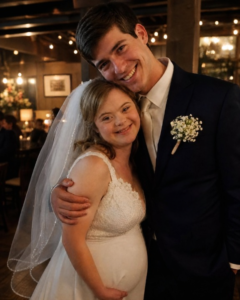
I was seven years old the first time I realized that people could be unkind to my sister.
Rosie was six, just one year behind me. She had Down syndrome, and some children at school didn’t understand her. They sometimes laughed when she spoke or left her out of their games.
I hated seeing her treated that way.
Whenever Rosie became upset, I would stand beside her. I was too young to solve the problem, but I wanted her to know she wasn’t alone.
There was one person who always treated Rosie with kindness.
My best friend, Ben.
He played with her, listened patiently to her stories, and made sure she had someone beside her whenever other children ignored her.
When we were in fourth grade, Ben crouched beside Rosie and made her a promise.
“Rosie, when we’re older, I’m taking you to prom.”
She clapped excitedly.
“You heard him!” she told me.
I smiled.
But as the years passed, my feelings for Ben quietly changed.
By the time I was seventeen, I had fallen in love with him.
I never told him.
Somehow, I thought he already knew.
Then, when I was twenty-two, Ben arrived at our house carrying a small velvet box.
My heart nearly stopped.
“Can I talk to Rosie?” he asked.
“Rosie?”
“She’s in the garden.”
I watched from the kitchen window as Ben walked toward my sister and knelt beside her.
Rosie covered her mouth with both hands.
Then she nodded so enthusiastically that her curls bounced.
That night, I cried into my pillow.
I felt guilty for thinking it, but one question kept coming back to me.
Why would Ben choose Rosie?
I couldn’t understand it.
The next morning, I helped Rosie plan her wedding.
She asked me to be her maid of honor.
I said yes.
Their wedding was beautiful.
Ben became emotional when Rosie walked down the aisle, and my parents watched proudly.
I tried to put my complicated feelings aside and simply be happy for my sister.
Three years later, Rosie called me with incredible news.
“I’m going to be a mommy!”
She was expecting twins.
I cried with happiness.
The pregnancy became challenging, and at thirty-four weeks, Rosie was taken to the hospital.
There were complications during the delivery, and the doctors worked quickly to care for both Rosie and the babies.
The babies were stable, but Rosie needed additional medical attention.
I stood beside Ben in the hospital hallway, frightened and uncertain.
“She’s going to be okay,” I whispered.
A doctor came out a short time later.
“She’s stable now,” he told us. “But we’re going to keep a close eye on her.”
Ben looked relieved, but then he turned toward me.
“I need to tell you something.”
He led me to a quiet hallway.
“Before Rosie went into the delivery room, she asked me to tell you the truth if anything happened.”
My heart began to race.
“Tell me what?”
Ben reached inside his jacket and pulled out a document.
The letterhead belonged to my father’s law firm.
Then I noticed the amount written on the page.
It was a substantial sum of money.
There were signatures.
My parents’.
Ben’s.
I stared at the document.
“What is this?”
Ben took a breath.
“I know this looks terrible.”
“What am I looking at?”
“Before I married Rosie, your parents approached me.”
I could barely process what he was saying.
“They wanted to arrange long-term care for Rosie somewhere called Willow Grove. They believed it would be easier for everyone.”
I stared at him.
“They wanted to send Rosie away?”
“They said they were worried about her future and believed they were making a responsible decision.”
My heart sank.
“What did you do?”
Ben looked down at the document.
“I agreed to the arrangement.”
I felt stunned.
“You took money to marry my sister?”
“No.”
His voice was quiet but certain.
“I agreed because I cared about Rosie, and I didn’t want her future decided without her having someone in her corner.”
I looked at the document again.
“Then what happened to the money?”
“I never spent it.”
He pointed to the paperwork.
“Every payment went into an account established for Rosie. I wanted her to have financial security and independence.”
I didn’t know what to say.
“Why didn’t you tell me?”
“Rosie asked me not to.”
I looked at him.
“She knew?”
“I told her about the arrangement a year after we married. I couldn’t keep something that important from my wife.”
“What did she say?”
Ben smiled sadly.
“She cried at first. Then she laughed.”
Despite everything, I almost smiled.
“That sounds like Rosie.”
“She told me she wanted to stay married to me anyway.”
I sat down.
For years, I had wondered whether Ben’s marriage to Rosie had been based on something other than love.
The arrangement had been real.
The money had been real.
But so was the love between them.
And Ben had protected Rosie’s financial future without ever treating her differently because of her disability.
“Why didn’t you tell me?” I asked again.
“Rosie was worried you would confront your parents immediately. She didn’t want the family divided.”
I covered my face.
“I was angry with you for about two minutes.”
Ben gave a small smile.
“I would have understood if it had been longer.”
Before I could respond, the doctor returned.
“Rosie is doing well,” he said. “The babies are stable, too.”
Relief washed over me.
“She made it,” I whispered.
A few moments later, the elevator doors opened.
My parents stepped into the hallway.
My mother hurried toward us.
“How is she?”
I stepped back.
“She’s okay.”
Then I held up the document.
“I need to ask you about this.”
My mother’s expression changed.
My father looked at Ben.
“You don’t understand what we were trying to do,” my mother said.
“Then explain it.”
“We were worried about Rosie’s future.”
“She needed support, not to be treated like a problem.”
My father sighed.
“We thought specialized care might give her more opportunities.”
I looked at the document.
“And Ben?”
My mother glanced at him.
“He accepted money to marry her.”
I shook my head.
“He used that money to create financial security for Rosie.”
Then I looked directly at my parents.
“You made a decision about her life without giving her a voice.”
The hallway became quiet.
My mother looked down.
For the first time, I realized that perhaps they had convinced themselves they were doing the right thing, even though their decision had deeply hurt the people they were supposed to protect.
They left without another word.
A nurse appeared moments later.
“Rosie is asking for you.”
Ben and I walked into the room together.
Rosie looked tired, but she was smiling.
Two tiny babies rested safely beside her.
She reached for my hand.
Then she reached for Ben’s.
“I told you he’d take care of me,” she whispered.
I laughed through my tears.
“Yes, Rosie.”
I squeezed her hand.
“You were right.”
Three weeks later, my parents stepped down as trustees of Rosie’s family trust.
The money Ben had protected remained hers.
My aunt took over management of the trust, and decisions about Rosie’s future were now made by people who listened to her wishes and respected her independence.
Months later, at the twins’ dedication ceremony, my uncle raised his glass.
“Some people become family because of a title,” he said.
He looked at Ben.
“Others become family because of the way they love and support the people around them.”
Everyone applauded.
I looked at my sister holding one baby while Ben held the other.
For years, I had believed I lost my best friend when he chose Rosie.
I was wrong.
I hadn’t lost him.
I had gained a brother.
And Rosie had gained something even more meaningful.
A husband who saw her abilities before her challenges.
A family that finally learned to listen to her.
And two children who would grow up knowing that their mother was worthy of love, respect, and every opportunity to build the life she wanted.
Rosie had never been a burden.
She had always been the heart of our family.
Leave a Reply