
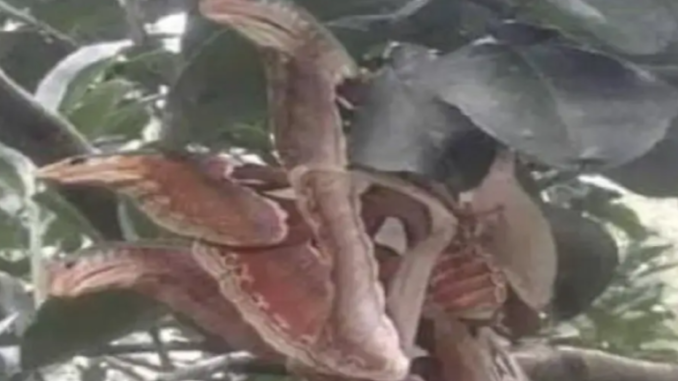
At first glance, the scene looked terrifying.
A tree appeared to be covered with snakes, their heads seemingly raised and watching from among the branches. Images of the strange sight quickly caught people’s attention online, with many viewers convinced they were looking at several dangerous reptiles.
But the truth was completely different.
The creatures weren’t snakes at all.
They were atlas moths.
A Frightening Illusion
The images are a perfect example of how nature can create an incredibly convincing disguise.
Atlas moths are among the world’s larger moth species, but their appearance is anything but ordinary.
When their wings are positioned in a certain way, the patterns near the tips can resemble the heads of snakes.
From a distance, that resemblance can be surprisingly convincing.
Why Would a Moth Look Like a Snake?
The unusual appearance serves an important purpose.
Atlas moths are vulnerable to predators, and looking like something dangerous can provide an important defensive advantage.
The snake-like patterns may make a predator hesitate before getting too close.
In other words, what looks like a frightening creature at first may actually be a remarkable example of natural defense.
Nature’s Incredible Disguise
This kind of visual deception is one of the reasons insects can be so fascinating.
Instead of fighting predators directly, some species rely on camouflage or mimicry to make themselves appear dangerous, difficult to see, or simply not worth attacking.
The atlas moth’s wing patterns create exactly that kind of visual confusion.
A predator doesn’t necessarily need to know what it is looking at.
If the image makes the animal hesitate, the disguise may already have done its job.
The “Snake Tree” Wasn’t What It Seemed
For people seeing the viral photographs without context, the reaction is understandable.
Several snake-like shapes appearing among tree branches would be enough to make almost anyone look twice.
But once the creatures are identified as atlas moths, the entire scene takes on a completely different meaning.
What initially looked like a dangerous encounter becomes an extraordinary example of how appearance can be used for survival.
One Photograph, Two Completely Different Stories
The scene is a reminder that photographs can sometimes be misleading without context.
Something that appears frightening from one angle can turn out to be completely harmless once you understand what you’re actually seeing.
In this case, the illusion comes from the moth’s natural wing patterns rather than a group of snakes hiding in a tree.
And that may be the most fascinating part of all.
What looked like a tree full of snakes was actually nature putting on one of its strangest disguises—and the truth was far more fascinating than the first impression.
Leave a Reply