
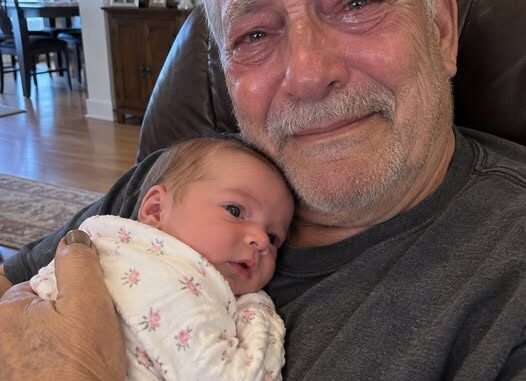
After thirteen long days in the hospital, I was finally driving home with my newborn daughter, Nora, safely asleep in her car seat.
She was tiny—just four pounds and eleven ounces—but she was healthy enough to leave the hospital. For the first time in nearly two weeks, I felt like I could finally relax.
I couldn’t wait to introduce her to my grandfather, Walter.
He had been there for me through everything. After losing my parents when I was young, he had raised me and become the person I trusted most. During my pregnancy, he came to appointments, helped prepare the baby’s room, and spent hours sanding a crib for Nora by hand.
He had been waiting patiently for the day he could finally hold her.
There was just one thing about Nora that immediately caught people’s attention.
She had two different-colored eyes.
The doctors explained that this was called heterochromia and that, in her case, there was no reason for concern. Her dark curls and little cleft chin also reminded me strongly of her father, Caleb.
Caleb, however, had been absent since shortly after I told him I was pregnant.
He had disappeared without explanation, leaving me to face the pregnancy and birth without him. I eventually stopped expecting him to return.
So when I pulled into my grandfather’s driveway that afternoon, I was thinking only about introducing him to his great-granddaughter.
Grandpa was sitting on the porch when he saw my car. He immediately stood up and hurried toward me.
“There are my girls,” he said with a smile.
I carefully lifted Nora from her car seat and placed her in his arms.
At first, his expression was exactly what I’d imagined. He looked completely overwhelmed with happiness.
Then he noticed her eyes.
His smile disappeared.
He looked at one eye, then the other. His expression changed so quickly that I became worried.
“Grandpa?” I asked.
He looked at me.
“Who is her father?”
I reminded him that her father was Caleb.
The moment I said the name, he became even more serious.
Then he asked me another question.
“What was Caleb’s father’s name?”
I told him William.
Grandpa sat down slowly, still holding Nora.
There was something about the way he looked at her that told me this wasn’t simply surprise.
Finally, he told me something I had never heard before.
My mother had once worked as a nanny for Caleb’s family.
I was very young at the time, so I had almost no memory of that period. According to Grandpa, my mother had left the family after a serious disagreement with William, and she had wanted to keep me far away from them.
Grandpa believed he was protecting me by keeping the entire story hidden.
But now, seeing Nora’s unusual eyes and recognizing the connection to Caleb, he realized that the past had unexpectedly returned.
As he spoke, fragments of my childhood began coming back.
I remembered a large house.
A garden.
A red bicycle.
And a young boy who used to run behind me while I learned to ride.
That boy was Caleb.
I couldn’t believe it.
The man I had fallen in love with as an adult had actually been part of my earliest memories.
That night, I opened an old cedar box containing some of my mother’s belongings. Inside, beneath photographs and scarves, I found something I had never seen before: letters.
They had been written by Caleb when he was a child and teenager.
The earliest letter was simple. He wanted to know where the little girl he remembered had gone.
Other letters showed that he had continued asking about me as he grew older.
One even contained money he had saved from his allowance, asking my mother to use it for me.
Then I found a note written by my mother.
It contained only a few words:
“He isn’t like his father.”
That sentence changed the way I viewed everything.
My mother had apparently seen something in Caleb that Grandpa had never been willing to consider.
I began remembering other moments from my relationship with Caleb.
Questions he had asked about my childhood.
The way he reacted when I mentioned the red bicycle.
The strange familiarity I had felt when we first met.
It became clear that Caleb had recognized me long before I realized who he was.
Eventually, I went to his family’s old home looking for answers.
William confirmed that Caleb knew about our connection.
But Caleb himself soon appeared.
He admitted that he had recognized me from the beginning.
He also explained why he had disappeared after learning about my pregnancy.
His father had been controlling access to a family trust that Caleb was eventually supposed to receive. According to Caleb, William had used that financial arrangement to pressure him into staying away from me until the situation was resolved.
Caleb admitted that agreeing to those terms had been a serious mistake.
He believed he was protecting our future, but he had made an important decision without allowing me to have any say.
For me, that was the real issue.
It wasn’t simply about the money or the family history.
It was about trust.
I told Caleb that if he wanted to be part of Nora’s life, he needed to prove it through his actions rather than promises.
I wasn’t ready to rebuild our relationship immediately, but I believed Nora deserved the opportunity to know her father if he was willing to be responsible and present.
Over time, things began to change.
Caleb moved away from his father’s control and started building an independent life. He became consistent with Nora and respected the boundaries we established as parents.
I also talked honestly with Grandpa about everything I had discovered.
He eventually admitted that he had kept the past hidden because he believed he was protecting me.
I understood his reasons, even though I wished he had trusted me enough to let me make my own decisions.
That experience taught me something important.
Sometimes people hide painful truths because they believe secrecy is a form of protection. But even loving intentions can create problems when important decisions are made for someone else.
Today, Nora is growing up surrounded by people who love her.
Her unusual eyes still attract attention, but to me, they’re more than a physical feature. They became the reason an old family story finally came to light.
Most importantly, I learned that understanding the past doesn’t mean allowing it to control the future.
Some family stories take years to uncover.
And sometimes, the smallest detail—a photograph, an old letter, or even a child’s eyes—can lead to answers that change everything.
Leave a Reply