
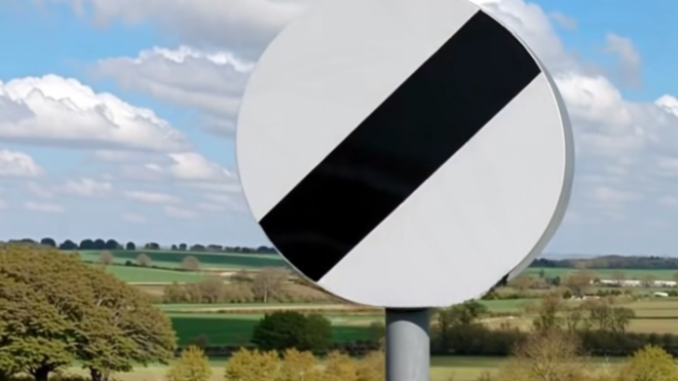
A simple road sign in the UK has been quietly confusing drivers for years, sparking debates online and even catching out experienced motorists during theory test revisions. At first glance, it looks almost too plain to be important: a circular white sign with a thick black diagonal stripe running through it.
No numbers. No arrows. No obvious instructions.
And yet, this sign carries one of the most important meanings on the road.
It represents the national speed limit.
A Sign That Looks Simple—but Isn’t Always Understood
Despite its simplicity, many drivers admit they forget exactly what the sign means once they pass their driving test. Online forums are filled with jokes and guesses, with some users joking that it means “go as fast as you want” or “end of all restrictions.” While humorous, these interpretations highlight a real issue: the sign is widely recognized visually, but not always fully understood in practice.
In reality, the sign does not give permission to speed freely. Instead, it signals that default UK speed limits now apply, depending on the type of road and vehicle being driven.
From this point onward, drivers are expected to know the legal limits without needing repeated signage.
What the National Speed Limit Actually Means
When a driver passes this sign, it means they are entering a stretch of road where the national speed rules apply rather than a specifically posted limit.
For most standard passenger cars, the rules are:
- 60 mph on single carriageways
- 70 mph on dual carriageways and motorways
However, these are maximum limits—not targets. Drivers are still required to adjust their speed based on conditions such as traffic, weather, visibility, and road surface.
A dry, empty motorway might safely allow 70 mph. But in heavy rain, fog, or congestion, driving at that speed could be dangerous or even illegal under careless or dangerous driving laws.
The sign therefore acts less like an instruction to accelerate and more like a reminder that no additional local speed sign is in force.
It Affects Different Vehicles Differently
One of the most commonly overlooked aspects of the national speed limit sign is that it does not apply equally to all vehicles.
Larger or more complex vehicles are subject to lower maximum speeds. For example:
- Vehicles towing trailers
- Vans and heavier goods vehicles
- Certain buses and coaches
For these road users, the limits are typically:
- 50 mph on single carriageways
- 60 mph on dual carriageways and motorways
This difference is crucial because many drivers assume the sign applies universally. In reality, the law adjusts based on vehicle type for safety reasons, particularly due to longer braking distances and reduced stability in heavier or loaded vehicles.
Urban Roads Still Follow Their Own Rules
Another important point is that the national speed limit sign does not override built-up area rules.
In the UK, roads with street lighting generally default to 30 mph, unless otherwise signed. This rule applies regardless of whether drivers have seen the national speed limit sign earlier on another road.
This creates one of the most common sources of confusion: drivers assume the absence of a speed number means higher limits apply everywhere. In fact, lighting, signage, and road classification all interact to determine legal speeds.
Other common urban limits include:
- 20 mph zones, often near schools or residential areas
- Variable limits in construction zones
- Locally enforced reductions in high-risk areas
Understanding where the national speed limit sign fits into this system is key to avoiding unintended speeding violations.
Leave a Reply