

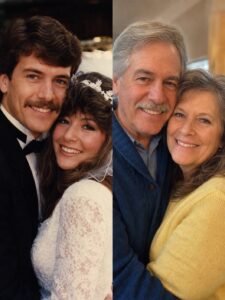
I first noticed her during the second hymn.
She was sitting alone near the back of the church, dressed in gray, quiet and still. She was not crying, not speaking, and not looking around like the other guests.
She was watching.
My husband Richard’s funeral was supposed to feel like an ending. Instead, it felt like something unfinished.
Our children sat beside me in the front row. Gina held my hand tightly. Alex stared ahead in silence, his jaw tense in a way that reminded me of his father.
But the woman in the back kept drawing my attention.
After the service, I found myself walking toward her before I even fully understood why.
“Julia?” she said softly.
The way she said my name felt too familiar.
My daughter noticed immediately.
“How does she know your name?” Gina asked.
The woman looked nervous. “I’m sorry,” she said. “My name is Charlotte. I worked with hospice.”
That word changed everything.
Hospice.
I froze.
Richard had left our marriage five years earlier after telling me he had been unfaithful. After 38 years together, he had looked me in the eyes and said something that broke everything we had built.
I believed him.
I had no reason not to.
But now Charlotte was standing in front of me, telling me something completely different.
“Richard was sick,” she said gently. “He had pancreatic cancer.”
I shook my head.
“No,” I said. “That can’t be true. He told me he cheated.”
Charlotte lowered her eyes.
“I know what he told you,” she said. “He asked us to let you believe it.”
For a moment, I could not make sense of her words.
Then she said, “He didn’t want you to stay.”
Richard had not left because he stopped loving me.
He had pushed me away because he knew I would stay beside him through everything.
Charlotte handed me a letter.
“He wanted you to have this after the funeral,” she said.
That night, I sat alone in the house we had once shared. I made tea but never drank it. I walked from room to room, feeling like every memory had suddenly become uncertain.
Finally, I opened the letter.
His handwriting was the same.
“Julia,” it began.
“I never cheated on you.
I was sick.
And I knew you would stay. You would have given up your own life to care for me and called it love. I could not let you disappear inside my illness.
So I became someone you could leave.”
I had to stop reading.
For five years, I had carried anger toward him. I had believed he had destroyed our marriage with one careless confession.
But now the story was changing.
Not becoming easier.
Just different.
He continued:
“I needed you to live beyond me. Not just survive me.”
There was no perfect explanation. No way to undo the hurt. What he had done still caused pain. But now I understood that his choice had come from fear, love, and control all tangled together.
He had chosen to let me hate him because he believed it would free me.
That did not make it right.
But it made it harder to hate him.
The next morning, I called Gina and Alex. I let them read the letter themselves.
For a long time, neither of them spoke.
“He let us think he ruined the family,” Alex said finally.
“He did hurt us,” I said softly. “Just not in the way we thought.”
Gina wiped her eyes. “He thought he was protecting you.”
“Maybe,” I said. “Or maybe he was trying to control how we lost him.”
Both answers felt true.
Grief does not become simpler when the truth changes. It only changes shape.
A week later, Alex brought me another envelope.
Inside were documents for the lake cabin Richard and I had once dreamed about retiring to together.
It was mine now.
There was a small note attached.
“Keep the porch light on.
In case you come back to yourself.”
I sat with those words for a long time.
Maybe Richard had not been trying to give me closure. Maybe he was trying to give me permission.
Permission to keep living.
Permission to build a life he would no longer be part of.
Permission to stop feeling guilty for surviving him.
If this story taught me anything, it is this:
Be careful with the stories you accept too quickly. Sometimes the truth is not easier than the lie. Sometimes it is heavier.
And sometimes people hurt us not because they stopped loving us, but because they did not know how to love us the right way.
Leave a Reply