

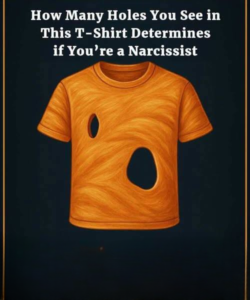
At first glance, the question seems almost too easy.
You’re shown a picture of a T-shirt with two noticeable tears and asked a simple question:
“How many holes are in the shirt?”
Many people answer immediately.
“Two.”
After all, the two tears are the first things most people notice. It feels like an obvious answer.
But then someone gives a completely different response.
“Six.”
Suddenly, what looked like a straightforward puzzle turns into an interesting discussion.
The First Impression
When most people see the image, their attention goes directly to the torn areas in the fabric.
Since the question asks about holes, it’s natural to count the two visible tears and move on.
Our brains are designed to recognize obvious patterns quickly. This helps us make fast decisions in everyday situations, but it also means we sometimes overlook additional details.
That’s exactly what makes this puzzle so interesting.
Looking at the Bigger Picture
Others approach the image differently.
Instead of focusing only on the damage, they consider the shirt as a whole.
A T-shirt already has several openings before any tears appear:
- One opening for the neck
- Two openings for the sleeves
- One opening at the bottom
Those are all openings in the garment, so some people include them in the total.
When they add the two tears shown in the picture, they arrive at six.
From that perspective, their answer is perfectly logical.
Why Do People Disagree?
The puzzle doesn’t clearly define what should count as a “hole.”
Should you count only the damaged areas?
Or should every opening in the shirt be included?
Because the question leaves room for interpretation, different answers can be supported with reasonable logic.
That’s why this simple puzzle continues to spark conversations online.
What the Puzzle Really Tests
This challenge isn’t really about clothing.
It’s about observation.
Some people focus on the most noticeable feature first, while others step back and evaluate the entire image before answering.
Neither approach is necessarily better—they simply reflect different ways of thinking.
The puzzle reminds us that two people can look at the same picture and arrive at different conclusions without either person being careless.
A Useful Reminder
Puzzles like this highlight an important habit that’s helpful beyond brain teasers.
Taking an extra moment to look more closely can reveal details that aren’t immediately obvious.
Whether you’re solving a puzzle, making a decision, or evaluating new information, slowing down often leads to a more complete understanding.
So, What’s the Answer?
There isn’t a single universally accepted solution.
If you count only the visible tears, the answer is 2.
If you count every opening in the shirt—including the neck, sleeves, and bottom—the answer is 6.
The fun isn’t necessarily finding one “correct” answer. It’s seeing how different people interpret the same question.
Final Thoughts
The popularity of this puzzle comes from its simplicity.
A single image encourages people to pause, think, and compare perspectives.
Sometimes the most interesting part isn’t the answer itself—it’s discovering how your mind approached the problem in the first place.
A closer look can often reveal more than you expected.
Leave a Reply