
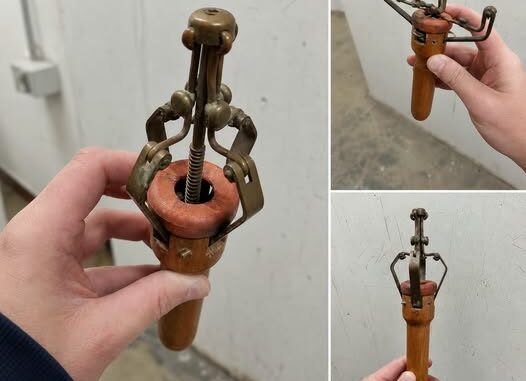
I found a small, unusual tool in my grandmother’s basement, and at first, I had no idea what it was used for.
It turned out to be a teat cup liner expander, sometimes referred to by the French name “Écarteur de tétine de trayeuse.” Its purpose was connected to the early days of mechanical dairy farming.
Before modern manufacturing techniques made perfectly shaped rubber liners common, milking-machine liners were relatively simple rubber tubes. Getting them properly fitted inside the metal milking cups could be surprisingly difficult.
The edges needed to be carefully positioned and shaped so they would sit smoothly against the animal rather than creating uncomfortable or potentially irritating pressure.
That’s where this little tool came in.
It featured a wooden handle and metal jaws designed to expand and shape the edge of the rubber liner. Instead of relying entirely on a farmer’s fingers to manipulate the thick material, the tool made the job quicker and more consistent.
After milking, the liners could be removed, cleaned, and sanitized before being used again.
It was a small tool, but it played an important role in an era when farmers depended heavily on mechanical milking equipment while still having to handle many of its components by hand.
Eventually, manufacturing technology improved.
After World War II, advances in rubber molding made it possible to produce milking-machine liners in much more precise shapes. The edges could be formed during manufacturing, eliminating much of the manual work that had previously been necessary.
And just like that, the little expander became obsolete.
Tools like this are fascinating because they represent the transitional period between traditional farming and modern agricultural technology. They weren’t glamorous inventions, but they solved very specific problems that farmers encountered every day.
Most were eventually discarded when newer equipment replaced them.
That’s why finding one today can be so interesting.
What looks like a strange piece of wood and metal sitting forgotten in an old basement may actually be a small piece of agricultural history—a reminder of how many clever tools were once essential before manufacturing technology made their jobs unnecessary.
Leave a Reply