
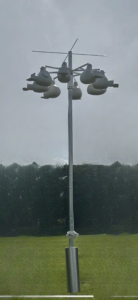
Have you ever noticed tall poles topped with clusters of white, gourd-shaped objects in a park or open field and wondered what they were?
At first glance, they might look like security cameras, weather-monitoring equipment, or some type of modern technology. In reality, they’re something much simpler—and much more beneficial for local wildlife.
These structures are purple martin houses, specially designed nesting sites that help support one of North America’s most recognizable migratory birds.
What Are Purple Martins?
Purple martins are the largest members of the swallow family in North America. They’re well known for their graceful flight, glossy blue-black feathers, and ability to catch flying insects while in the air.
Adult birds measure about 7 to 8 inches (18–20 cm) in length and have a wingspan of approximately 15 to 16 inches (38–41 cm). During the warmer months, they can often be seen soaring over fields, lakes, and parks searching for food.
Purple martins migrate thousands of miles every year, spending the winter in South America before returning to North America during the spring breeding season.
Why Do They Need Human-Made Nesting Houses?
Unlike many bird species that build nests in trees or shrubs, purple martins naturally prefer nesting inside cavities.
Historically, they used hollow spaces in dead trees. However, as forests were cleared and natural habitats changed over time, suitable nesting sites became much harder to find in many areas.
Today, especially in the eastern United States, purple martins rely heavily on artificial nesting houses provided by people.
Bird enthusiasts, conservation organizations, and park managers install these nesting structures to help support healthy breeding populations.
Why Are the Houses Shaped Like Gourds?
The distinctive gourd shape isn’t just decorative.
The design has been used for centuries and was originally inspired by dried gourds that Native American communities and early settlers hung to attract purple martins.
Modern versions continue using this shape because it offers several practical advantages.
Protection
The rounded design provides a sheltered nesting space while helping reduce access for some predators.
Many houses are also mounted on tall poles, adding another layer of protection.
Comfortable Nesting Space
Each gourd serves as an individual nesting chamber where purple martins can build nests, lay eggs, and raise their chicks.
Because these birds prefer living in colonies, several gourds are usually grouped together on the same pole.
Ventilation
Most modern martin houses include ventilation openings and drainage holes that help regulate temperature and reduce moisture inside the nest.
These features create a healthier environment during the breeding season.
Why Are These Houses Installed in Parks?
Purple martin houses are part of ongoing wildlife conservation efforts.
Their main purpose is to provide safe nesting locations where natural cavities may no longer be available.
By supporting successful breeding, parks and conservation groups help maintain healthy populations of these migratory birds.
Do Purple Martins Help Control Insects?
Purple martins primarily feed on flying insects such as:
- Dragonflies
- Beetles
- Flying ants
- Moths
- Wasps
- Other aerial insects
Although they’re often associated with mosquito control, research suggests mosquitoes make up only a small portion of their overall diet. Even so, purple martins play an important role in local ecosystems by helping maintain balanced insect populations.
What You Might Notice in the Park
If you look closely at one of these structures, you’ll probably see several interesting features.
Multiple Nesting Chambers
Instead of a single birdhouse, each pole usually supports many individual gourds arranged together. This matches the purple martin’s natural preference for nesting in colonies.
Adjustable Poles
Many systems include pulleys or telescoping poles that allow caretakers to safely lower the nesting houses for cleaning, maintenance, and monitoring after the breeding season.
Predator Guards
Some poles include smooth metal guards near the base. These are designed to discourage climbing predators from reaching the nests.
Why Purple Martin Conservation Matters
Like many migratory bird species, purple martins face ongoing challenges, including habitat loss and changes to their environment.
Providing safe nesting sites helps improve breeding success and supports local wildlife conservation efforts.
Many communities across North America continue installing and maintaining martin houses as part of larger conservation programs that encourage biodiversity in parks, wetlands, and open spaces.
Final Thoughts
The next time you notice tall poles with white, gourd-shaped structures in a park, you’ll know they’re not surveillance cameras or weather instruments.
They’re carefully designed homes built for purple martins—migratory birds that have developed a unique relationship with people over generations.
These simple structures provide safe nesting spaces, support conservation efforts, and give visitors an opportunity to observe one of North America’s most fascinating bird species while enjoying the outdoors.
Leave a Reply