

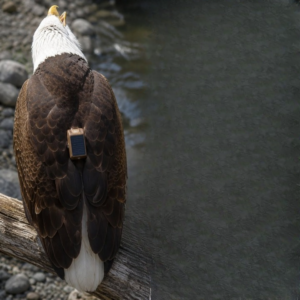
For years, scientists have used GPS technology to better understand how animals move across landscapes, migrate between regions, and respond to changing environments. In one particularly remarkable long-term tracking project, researchers followed the movements of a single eagle for nearly two decades, collecting an enormous amount of data about its journeys across mountains, valleys, coastlines, and open terrain.
What initially appeared to be a series of unpredictable flight paths eventually revealed something far more fascinating: a powerful example of adaptation, environmental awareness, and the remarkable survival strategies found throughout the natural world.
A Journey That Seemed Random at First
When researchers first reviewed the eagle’s tracking data, the routes appeared irregular and difficult to interpret.
The bird frequently changed direction, altered its migration paths, and made unexpected stops along the way. From a purely visual perspective, the GPS map looked more like a tangled web of lines than a predictable migration route.
However, as scientists compared the bird’s movements with weather records, seasonal patterns, and environmental conditions, a clearer picture began to emerge.
What looked random at first was often closely connected to changing conditions in the surrounding environment.
Following Nature’s Invisible Highways
Large birds of prey rely heavily on air currents to travel efficiently.
Warm rising air columns, known as thermals, allow eagles to gain altitude while using minimal energy. By circling within these natural lifts, birds can soar for long distances without constant wing flapping.
Researchers discovered that many of the eagle’s unexpected turns corresponded with favorable thermal activity and shifting wind patterns.
Rather than following the shortest route, the bird often appeared to choose the most energy-efficient one.
This behavior highlighted an important lesson: successful navigation is not always about traveling in a straight line.
Sometimes it is about adapting to conditions as they change.
Flexibility as a Survival Strategy
One of the most interesting discoveries involved the eagle’s ability to adjust its behavior from year to year.
Although the bird often returned to familiar resting areas and migration regions, it rarely followed exactly the same route twice.
Changes in weather, food availability, seasonal conditions, and environmental obstacles all appeared to influence its decisions.
Researchers observed that:
- Some detours aligned with favorable wind corridors
- Certain stops occurred near seasonal feeding areas
- Route changes often helped avoid difficult weather conditions
- Flight patterns shifted in response to environmental changes
Rather than relying on rigid routines, the eagle demonstrated a highly flexible approach to survival.
What Scientists Learned About Animal Intelligence
The long-term study challenged some traditional assumptions about animal behavior.
For many years, scientists often relied on models that emphasized predictable movement patterns and straightforward migration routes.
The eagle’s behavior suggested a more complex reality.
Its movements reflected constant decision-making based on changing circumstances, available resources, and environmental conditions.
Researchers increasingly recognized that successful survival requires animals to process large amounts of information from their surroundings and adjust accordingly.
This type of adaptability is now considered an important aspect of animal intelligence.
Adapting to an Ever-Changing Environment
Over the course of two decades, the eagle encountered countless environmental challenges.
Storms, shifting weather systems, seasonal changes, and habitat variations all influenced its journey.
Yet the bird consistently adapted.
When conditions became unfavorable, it changed course.
When opportunities appeared, it took advantage of them.
This ability to respond to changing circumstances helped researchers better understand how wildlife survives in dynamic environments.
The study also reinforced the importance of protecting migration corridors and habitats that many species depend upon throughout their lives.
Lessons Beyond Biology
While the project focused on wildlife research, it also offered broader insights about the natural world.
Scientists involved in the study noted how much they learned about interconnected ecosystems by observing a single animal.
The eagle’s movements reflected relationships between:
- Weather systems
- Geography
- Seasonal cycles
- Food availability
- Habitat conditions
The bird’s journey served as a reminder that ecosystems function as complex networks rather than isolated components.
Even a single species can reveal important information about how environmental systems work together.
The Value of Long-Term Research
One reason the project proved so valuable was its duration.
Many scientific studies last only a few years, making it difficult to observe long-term patterns.
By following the same eagle for nearly twenty years, researchers gained a rare opportunity to study behavioral consistency, environmental adaptation, and lifetime movement patterns.
The project highlighted how patience and long-term observation can uncover details that shorter studies might miss.
A New Appreciation for Wildlife Navigation
Today, advances in GPS technology continue helping scientists better understand animal migration and behavior.
Studies involving eagles, hawks, storks, sea turtles, whales, and many other species are revealing increasingly sophisticated survival strategies.
What once seemed like simple instinct often involves a remarkable combination of environmental awareness, experience, and adaptation.
The eagle in this study became a powerful example of how wildlife interacts with the world in ways that humans are only beginning to fully appreciate.
Final Thoughts
The story of one eagle tracked across two decades offers a fascinating glimpse into the complexity of life in the natural world.
What initially appeared to be random movement eventually revealed patterns shaped by weather, geography, food resources, and environmental conditions. The bird’s ability to adapt, conserve energy, and respond to changing circumstances demonstrated the importance of flexibility in survival.
More importantly, the study reminded researchers that nature often operates through systems far more intricate than they first appear.
Sometimes, the greatest discoveries come not from finding something new, but from looking more carefully at what has been there all along.
And in the case of this remarkable eagle, twenty years of observation transformed a collection of GPS points into a deeper understanding of resilience, adaptation, and the extraordinary capabilities of wildlife.
Leave a Reply