
Some objects carry memories far beyond their physical value.
For some people, it might be a watch, an old photograph, or a piece of furniture passed down through generations. For me, it was a motorcycle that had been part of my life for more than five decades.
One ordinary morning, I walked into my workshop and immediately sensed that something was wrong.
The familiar corner where my father’s motorcycle had always sat was empty.
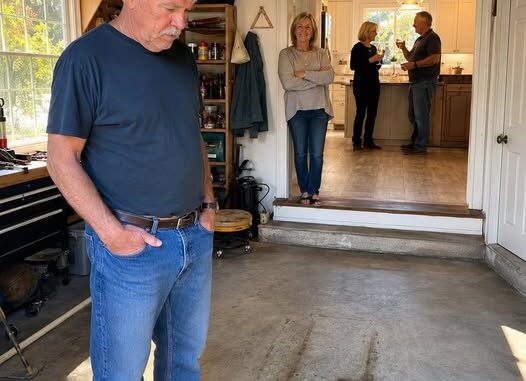
For a moment, I simply stood there, confused. The outline of the tires remained visible on the concrete floor, and a faint mark beneath where the engine usually rested seemed like a ghost of its presence.
But the motorcycle itself was gone.
I looked around the room, hoping there was some simple explanation.
There wasn’t.
A few moments later, my wife Margaret appeared in the doorway.
She seemed cheerful.
“I have a surprise for you,” she said with a smile.
I had a feeling I wasn’t going to like it.
“What happened to the motorcycle?” I asked.
“Oh, that?” she replied casually. “I sold it this morning.”
At first, I thought she was joking.
When I realized she wasn’t, I felt my stomach drop.
Margaret explained that a buyer had contacted her after seeing photos online. According to her, it seemed like a great opportunity.
She proudly told me how much money she had received and immediately began talking about vacations, home improvements, and all the things we could finally afford.
But I wasn’t listening.
All I could think about was the motorcycle.
To Margaret, it was an old machine taking up space in the workshop.
To me, it represented something entirely different.
The motorcycle had belonged to my father.
He purchased it decades before I was born and cared for it meticulously throughout his life. Some of my earliest childhood memories involved standing beside him in the garage while he explained how engines worked.
He wasn’t just maintaining a motorcycle.
He was preserving a piece of family history.
When I turned twenty-one, he handed me the keys.
I still remember that day.
He didn’t give a long speech or make a dramatic presentation. He simply told me that he trusted me to take care of it.
Along with the motorcycle came boxes of photographs, maintenance records, handwritten notes, and stories connected to every stage of its life.
For years, I honored that trust.
Every Sunday morning became a tradition. I would spend a few hours cleaning, polishing, and maintaining the bike, just as my father had done.
The ritual wasn’t really about the motorcycle.
It was about remembering him.
That’s why seeing that empty space felt so unsettling.
Later that afternoon, while I sat quietly trying to process everything, the phone rang.
Margaret answered.
Within seconds, her expression changed.
The excitement disappeared from her face.
She handed me the phone.
The buyer was calling.
He had been researching the motorcycle and had quickly discovered something important: it was far more significant than anyone initially realized.
Collectors and enthusiasts had recognized the model almost immediately. Its history, condition, and documentation made it exceptionally rare.
The buyer wasn’t angry.
In fact, he sounded concerned.
He wanted clarification regarding ownership and background information before proceeding any further.
As we talked, it became clear that the motorcycle’s value extended far beyond what Margaret had believed.
For years, I had occasionally received inquiries from collectors and enthusiasts interested in learning more about it. Professional evaluations had consistently highlighted its historical importance.
Yet I had never seriously considered selling it.
Not because of money.
Because some things simply can’t be replaced.
When I hung up the phone, the room was silent.
Margaret finally realized the situation was much more complicated than she had assumed.
For the first time, she asked me a question that surprised me.
“Why didn’t you ever tell me how much it meant to you?”
The answer came quickly.
“I thought you already knew.”
But the truth was more complicated.
Over the years, we had shared a life together. We talked about work, finances, family plans, and daily responsibilities.
Yet somehow, we had never truly talked about the motorcycle.
Not once had she asked why I spent so much time caring for it.
Not once had she asked about my father’s connection to it.
Not once had she shown curiosity about the stories behind the photographs and documents I kept carefully stored away.
To her, it had always been just an old motorcycle.
To me, it was one of the last tangible connections to my father.
The experience forced both of us to confront something uncomfortable.
The problem wasn’t really about the motorcycle.
It was about understanding.
Or rather, the lack of it.
Over the following weeks, the situation was resolved. The buyer, after learning the full story, agreed to reverse the transaction. He understood the emotional significance attached to the motorcycle and appreciated the history behind it.
When the bike finally returned to my workshop, I felt a sense of peace I hadn’t realized I was missing.
The familiar shape once again occupied its place in the corner.
The room felt complete.
But the experience continued to stay with me.
It made me think about relationships and what it means to truly know another person.
We often assume that because we share our lives with someone, we automatically understand what matters most to them.
Yet that isn’t always true.
Understanding requires curiosity.
It requires asking questions.
It requires listening to stories that may seem unimportant at first glance.
Sometimes the things people treasure most are not obvious.
A worn-out book.
An old photograph.
A family recipe.
A collection of letters.
Or a motorcycle sitting quietly in a garage.
Months later, I attended a gathering of vintage motorcycle enthusiasts.
As people admired the bike, many asked about its history.
They wanted to know who owned it first.
Where it had traveled.
What memories were attached to it.
For hours, I shared stories about my father, our weekends together, and the lessons he taught me.
What struck me most wasn’t their interest in the motorcycle itself.
It was their interest in the person behind it.
They understood that objects often become meaningful because of the people connected to them.
That realization stayed with me.
Today, the motorcycle still sits in my workshop.
Every Sunday morning, I continue the tradition my father started many years ago.
I polish the chrome, inspect the engine, and spend a little time reflecting.
The bike remains beautiful, but its true value has never been measured in dollars.
Its value comes from the memories it carries.
The lessons it represents.
And the promise attached to it decades ago.
Whenever I start the engine, I don’t just hear machinery coming to life.
I hear echoes of conversations from long ago.
I remember a father sharing knowledge with his son.
I remember trust being passed from one generation to the next.
Most importantly, I’m reminded that the things we treasure aren’t always valuable because of what they are.
Sometimes they’re valuable because of who they help us remember.
And those memories are worth preserving for as long as we can.
Leave a Reply