
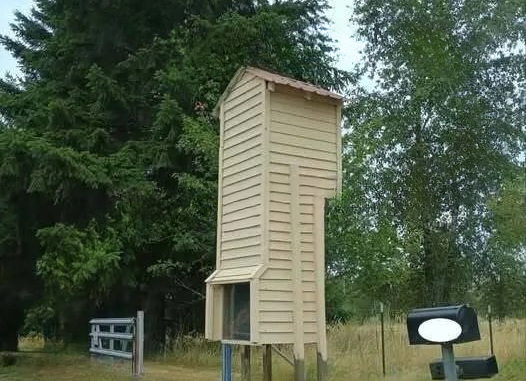
At first glance, a tall wooden structure standing beside a quiet road might seem unusual. Without flashing lights, warning signs, or obvious machinery, it could easily be mistaken for a decorative feature or an unfinished construction project. Yet, in certain locations, structures like these serve a surprisingly practical purpose: helping drivers see approaching traffic when their view of the road is blocked.
Imagine approaching a narrow driveway that meets a busy road at a sharp bend. Thick vegetation, a wall, or the shape of the surrounding landscape prevents you from seeing vehicles coming from either direction. Pulling out too quickly could be dangerous, but moving forward far enough to check the road might put your vehicle in harm’s way.
This is where a simple visibility aid can make a meaningful difference.
Some property owners and communities use specially positioned mirrors to improve sightlines around blind corners and difficult entrances. Depending on the location and design, a raised structure may support reflective surfaces that allow drivers to see portions of the road that would otherwise remain hidden.
Although such a device may look unusual, the principle behind it is straightforward. By redirecting light, mirrors can provide an additional view of an obstructed area and help people make more informed decisions before moving into traffic.
The idea highlights an important lesson about everyday safety: sometimes, a practical solution does not need to be complicated to be useful.
The Unusual Roadside Structure That Makes People Look Twice
Roadside features often blend into the background. Drivers become accustomed to seeing fences, utility poles, signposts, and roadside barriers without giving them much thought.
A tall, narrow wooden tower, however, is likely to attract attention, particularly when it stands beside a residential driveway or near a bend in the road.
Its unusual appearance naturally raises questions. Why would someone build such a structure? Is it intended for decoration, observation, or some other purpose?
In locations where visibility is limited, the answer may be connected to road safety.
A driveway positioned near a blind bend can create a difficult situation for residents. They may have to contend with approaching vehicles, changing traffic conditions, and restricted views caused by the terrain or nearby buildings.
Even experienced drivers can struggle when they cannot see far enough along the road to judge whether it is safe to enter.
A properly positioned visibility aid can help address part of this problem by allowing drivers to observe traffic approaching from an otherwise hidden direction.
However, not every unusual roadside tower has the same function. Without information about a particular structure, its precise purpose cannot be confirmed simply from its appearance.
How a Roadside Mirror Can Improve Visibility
<AsyncImageGroup query={[“convex traffic safety mirror at blind driveway rural road”,”road safety mirror mounted on pole at sharp bend”,”rural driveway with limited visibility entering main road”]} aspectRatio=”5:4″ layout=”bento” size=”lg”/>
The principle behind a traffic mirror is based on the reflection of light.
Ordinary mirrors reflect light in a way that allows people to see objects positioned in front of them. Convex mirrors, which curve outward, can show a wider area than flat mirrors, although the objects reflected in them generally appear smaller.
This wider field of view can be useful at certain driveways, intersections, parking facilities, and narrow access roads.
For example, imagine a driver preparing to leave a property bordered by a tall hedge. The hedge blocks the driver’s view of traffic approaching from the left.
A suitably placed traffic mirror may reflect part of the hidden roadway, allowing the driver to check for approaching vehicles before proceeding.
The same principle can help pedestrians and cyclists assess certain blind spots, depending on the location and installation.
A raised structure could potentially support a mirror at a useful height when a conventional mounting position is unsuitable. Its design would depend on the surrounding terrain, the angle of the road, and the sightlines that need to be improved.
The important detail is that the mirror must be positioned correctly. A poorly placed or unsuitable mirror may provide a distorted, incomplete, or misleading view.
Why Blind Corners Can Be Dangerous
Limited visibility is a common challenge on rural roads and in residential areas.
Some driveways connect directly to roads where vehicles travel at relatively high speeds. Others are positioned near sharp bends, steep slopes, dense vegetation, or buildings that obstruct the view.
These conditions can make it difficult to judge the speed and distance of approaching traffic.
A driver may believe the road is clear simply because no vehicle is visible from their position. In reality, a car or motorcycle could be approaching from beyond the obstruction.
This is why visibility plays such an important role in safe driving.
Drivers need enough information to judge when to stop, when to wait, and when it is appropriate to enter a road. Improving the view of surrounding traffic can help reduce uncertainty, but it cannot eliminate every hazard.
Weather conditions can also make matters more complicated. Rain, fog, darkness, and glare may affect what drivers can see, while dirty or damaged mirrors can reduce their usefulness.
For these reasons, visibility aids should be treated as an additional source of information rather than a replacement for careful observation.
The Value of Simple, Practical Design
Modern road safety increasingly involves advanced technologies, including vehicle sensors, cameras, warning systems, and automated assistance features.
These technologies can provide valuable support, but simpler solutions also have an important place in the right circumstances.
A traffic mirror, for example, does not necessarily require an internet connection, a software update, or a complex electronic system. Its basic function depends on reflection and appropriate positioning.
That simplicity can make mirrors a practical option for certain locations where sightlines are restricted.
Nevertheless, low-tech does not automatically mean maintenance-free or suitable for every situation. Mirrors can become dirty, damaged, misaligned, or difficult to see in poor weather. Their effectiveness depends on local conditions and proper installation.
A thoughtful design begins by identifying the actual problem. If a driveway has poor visibility, the most appropriate solution might involve trimming vegetation, repositioning an entrance, installing an approved mirror, or making other changes recommended by a road safety professional.
The goal is not to add equipment merely because it looks useful. It is to find a measure that addresses the specific hazard.
How Better Visibility Can Help Drivers Make Decisions
One of the greatest challenges of entering a road from a driveway is deciding when there is a safe opportunity to move.
When the view is obstructed, drivers may need to wait longer, reposition their vehicles, or approach the entrance carefully to gather more information.
A visibility aid may help reveal traffic that would otherwise remain hidden. This can make it easier to recognize approaching vehicles and decide whether to remain stopped.
However, even a well-positioned mirror has limitations.
Objects can appear smaller or farther away than they really are, particularly in convex mirrors. A vehicle may also be hidden temporarily by another road user or fall outside the mirror’s field of view.
Drivers should therefore check the actual roadway whenever it is safe and possible to do so. They should never assume that a mirror showing no traffic guarantees that the road is clear.
The safest approach combines useful visibility aids with cautious driving, appropriate stopping positions, and careful observation in both directions.
Could a Structure Like This Encourage Safer Driving?
An unusual roadside feature may also attract the attention of passing motorists.
When drivers notice something unexpected near a bend or driveway, they may naturally become more alert to their surroundings. In some circumstances, this extra awareness can encourage them to pay closer attention to the road.
However, the presence of a structure alone does not guarantee that drivers will slow down or behave more cautiously.
Clear road markings, suitable warning signs, appropriate speed limits, and well-maintained road surfaces may be necessary to address specific risks.
Where a roadside structure is intended to improve visibility, its design should support safe behavior rather than distract drivers or create another obstacle near the roadway.
This is especially important on narrow roads, where roadside installations may need to comply with local regulations and clearance requirements.
Maintenance Matters More Than You Might Expect
Even a relatively simple visibility aid requires occasional inspection.
A mirror covered in dust, mud, or water spots may provide a less useful image. Strong winds, accidental impacts, and gradual movement of the supporting structure can also affect its position.
Routine maintenance may include cleaning the reflective surface, checking the mounting hardware, and making sure vegetation has not grown into the viewing area.
The supporting structure should remain stable and should not create an unnecessary hazard for vehicles or pedestrians.
In areas exposed to severe weather, materials and mounting methods need to be appropriate for local conditions.
Property owners should also confirm whether permission is required before installing a mirror or tall structure near a public road. Depending on the location, visibility aids may need to meet specific requirements established by road authorities.
These considerations help ensure that an intended safety improvement does not introduce new problems.
A Small Idea With Lessons Beyond the Road
The concept behind a roadside visibility aid extends beyond driving.
Many everyday problems become easier to manage when people recognize a hidden obstacle and find a practical way to address it.
At home, improved lighting can make a dark staircase safer. In a workplace, clearer signs can help people navigate unfamiliar areas. In public spaces, removing an obstruction from a walkway can reduce the likelihood of trips and falls.
These changes may not appear especially dramatic, but their value can be significant when they address a genuine need.
The process begins with observation. Instead of accepting a recurring problem as unavoidable, someone asks whether the surrounding environment can be improved.
The solution may involve new technology, but it may also be as straightforward as adjusting an existing feature or changing the way a space is arranged.
This kind of practical thinking is particularly valuable when safety is involved. Identifying hazards early and choosing appropriate measures can help prevent avoidable incidents.
Final Thoughts: Sometimes, the Simplest Ideas Deserve a Closer Look
A tall, unusual structure beside a driveway may initially seem like little more than a roadside curiosity. In certain settings, however, structures that support traffic mirrors can help drivers see around blind corners and assess approaching traffic.
The underlying principle is simple: better visibility can provide useful information when the surrounding landscape blocks a driver’s view.
Still, no mirror or roadside installation can guarantee safety. Correct positioning, regular maintenance, local regulations, and careful driving all matter.
The broader lesson is that effective problem-solving begins with understanding the challenge. Whether the issue is a difficult driveway, an obstructed intersection, or another everyday hazard, the best solution is one that responds to the actual conditions and helps people make safer decisions.
Sometimes, innovation arrives in the form of advanced technology. Other times, it comes from a practical idea that makes an ordinary situation a little safer.
And that is what makes simple design worth appreciating: when it is carefully planned and appropriately used, even a modest improvement can make a meaningful difference in everyday life.
Leave a Reply