
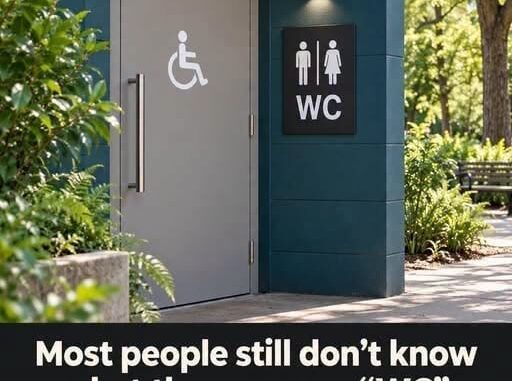
If you’ve ever traveled through Europe or stayed in an international hotel, you may have noticed two simple letters on a restroom sign: WC.
For many people, the meaning isn’t immediately obvious. Unlike words such as “bathroom” or “restroom,” WC doesn’t directly describe the room in modern everyday English.
So what does it actually stand for?
WC is short for “water closet,” an older term that was once commonly used to describe a room containing a toilet.
Although the expression sounds unusual today, it has a long history connected to the development of indoor plumbing and the modern toilet.
Where Did “Water Closet” Come From?
The term “water closet” originally referred to a private room or small space containing a toilet that used water for flushing.
The word “closet” historically didn’t necessarily mean a storage space. It could also describe a small private room or enclosed area.
As plumbing technology developed, the phrase became associated with toilets that used water to remove waste.
Over time, “water closet” became a familiar expression in Britain and other parts of Europe.
Early Flush Toilet Designs
The concept of using water to improve sanitation is much older than the modern bathroom.
In the late 16th century, English inventor and writer Sir John Harington described an early flushing toilet. His design used water to help carry waste away, although it was very different from the toilets found in homes today.
Harington’s work was an important part of the long history of toilet development, but the technology still had significant limitations.
It would take many more years of experimentation before flushing toilets became practical and widely adopted.
Alexander Cumming’s Contribution
Another important development came in the 18th century.
In 1775, Scottish inventor Alexander Cumming received a patent for an improved flushing toilet design.
One of the important features of his design was an S-shaped water trap.
This feature helped prevent unpleasant sewer gases from traveling back through the plumbing and into a building.
The basic principle became an important part of modern toilet plumbing.
Although today’s bathroom technology is much more advanced, the underlying idea of using a water-filled trap to create a barrier remains familiar.
Why Did “WC” Become Common?
As indoor plumbing became increasingly common during the 19th century, the term “water closet” became more widely associated with indoor toilet facilities.
Eventually, the phrase was shortened to the initials WC.
The abbreviation was especially useful on signs because it was short, easy to recognize, and could be understood across different languages.
That helped WC remain in use even as everyday vocabulary changed.
Today, you can still find WC signs in many European countries, hotels, transportation facilities, restaurants, and other public locations.
Why Americans Usually Say “Bathroom”
Language developed differently in different regions.
In the United States, terms such as “bathroom” and “restroom” became much more common in everyday conversation.
As a result, many Americans rarely use the phrase “water closet” and may encounter the abbreviation WC mainly when traveling internationally.
The difference is mostly linguistic and cultural.
The facility itself hasn’t changed simply because people use a different word for it.
WC Doesn’t Necessarily Mean There Is a Bath
One interesting detail is that “water closet” originally referred specifically to a toilet facility rather than a room containing a bathtub or shower.
This is one reason the term can seem confusing to modern English speakers.
Today, Americans commonly use “bathroom” to describe a room that may contain a toilet, sink, bathtub, or shower.
The older expression “water closet” was much more specifically connected with the toilet.
A Small Sign With a Long History
The next time you see WC on a restroom door, you’re looking at more than just two letters.
The abbreviation is a small reminder of how language and technology have changed together.
From early experiments with flushing systems to the development of plumbing traps and indoor sanitation, the modern bathroom evolved gradually over centuries.
The terminology evolved too.
Words that once sounded completely ordinary can eventually become unfamiliar, while abbreviations can survive long after their original expressions have faded from everyday speech.
Why WC Is Still Used Today
There are practical reasons for keeping the abbreviation around.
A short two-letter sign takes up very little space and can be useful in places visited by people from many countries.
Hotels, airports, train stations, restaurants, and other international locations often need signage that is simple and easy to recognize.
WC provides a compact label without requiring a longer phrase in a particular language.
That makes the abbreviation particularly useful in international settings.
The Next Time You See “WC”
So, if you ever wondered what those two letters mean, the answer is surprisingly simple:
WC stands for “water closet,” an old term for a toilet room or toilet facility.
The phrase dates back to an era when indoor plumbing was still developing, and the abbreviation eventually became a convenient label used in many parts of the world.
In the United States, you’re more likely to see “bathroom” or “restroom.”
But when traveling abroad, don’t be surprised if a simple WC sign points you toward the facilities.
It’s a small piece of everyday language with a surprisingly long history.
Leave a Reply