
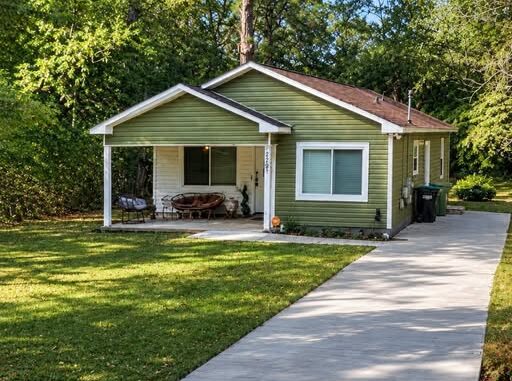
At first glance, the property listing looks almost too good to be true.
Three bedrooms.
Two bathrooms.
A price of just $20,000.
For anyone searching for an affordable place to live, those numbers immediately grab attention. In a housing market where prices can make homeownership feel completely out of reach, an advertised three-bedroom property at such a low price can look like the opportunity someone has been waiting for.
But there is an important detail that changes the picture entirely.
The property isn’t a conventional single-family house.
It’s a mobile home.
And that distinction matters.
A buyer scrolling quickly through a listing could easily focus on the number of bedrooms, bathrooms, and the unusually low asking price without immediately realizing what type of property is actually being offered.
That can create a very different impression from the reality.
A traditional three-bedroom home selling for around $20,000 would naturally attract enormous attention. Someone struggling with rent might immediately begin imagining a future in which monthly housing costs are replaced by homeownership.
A young family might picture children growing up in their own rooms.
A first-time buyer might see an opportunity that seems almost impossible in today’s market.
But property listings require more than attractive numbers.
They need context.
The type of property is one of the most important pieces of information a prospective buyer needs to understand before getting emotionally invested in a listing.
A mobile home can offer legitimate housing and, depending on the circumstances, may be an affordable alternative to traditional homeownership. However, purchasing one can involve considerations that are different from buying a conventional house.
For example, the buyer may need to determine whether the land is included in the purchase.
If the mobile home sits on leased land, there may be ongoing lot rent.
There can also be community rules, maintenance costs, financing considerations, insurance requirements, and other expenses that aren’t immediately obvious from the headline price.
That means the $20,000 figure alone doesn’t tell the complete financial story.
The same principle applies to almost any property advertised at an unusually low price.
The headline number is only the beginning.
Buyers need to ask what exactly they’re purchasing.
Is the land included?
Are there monthly lot fees?
What condition is the structure in?
How old is it?
What repairs are required?
Are utilities connected?
Are there restrictions on where the property can remain?
What financing options are available?
And perhaps most importantly, does the buyer actually own the land beneath the home?
These questions can completely change the economics of an apparently inexpensive property.
That’s why the wording of a listing matters so much.
A headline can create excitement in seconds.
The details determine whether that excitement is justified.
When a listing emphasizes attractive features such as three bedrooms, two bathrooms, and an exceptionally low price while giving less prominence to the fact that the property is a mobile home, a prospective buyer may initially form an inaccurate impression.
That doesn’t automatically prove that the seller intended to mislead anyone.
However, it does demonstrate why buyers should read the entire listing carefully rather than relying solely on the headline.
Real estate purchases are too significant to make based on a few appealing numbers.
The dream of affordable homeownership can be powerful.
For many families, housing costs represent one of the largest financial pressures they face. When someone sees a property advertised for a fraction of the price of nearby houses, it is completely understandable that they might become excited.
But excitement should be followed by questions.
A low price isn’t necessarily a hidden treasure.
Sometimes there’s a reason a property costs substantially less than comparable homes.
That reason could be the property’s condition.
It could be the location.
It could involve land ownership.
It could involve financing.
Or, as in this case, it could simply be that the property is a different type of housing than a reader initially assumed.
The distinction between a mobile home and a conventional site-built house isn’t merely a technical detail.
It can affect ownership, financing, resale, insurance, maintenance, and long-term costs.
For someone shopping on a limited budget, those factors can be especially important.
A bargain that looks affordable at first may become considerably more expensive once all of the associated costs are understood.
This is why prospective buyers should resist the temptation to make assumptions based on a low advertised price.
Instead, they should investigate the property thoroughly before making an offer or signing anything.
Ask for the full property description.
Confirm what is included in the sale.
Check whether the land is part of the transaction.
Review any community or lot agreements.
Investigate taxes and recurring fees.
Have the property professionally inspected where appropriate.
And make sure the purchase terms are fully understood before committing.
The $20,000 figure may still represent a legitimate opportunity for the right buyer.
A mobile home isn’t inherently a bad investment or an undesirable place to live.
For some people, manufactured or mobile housing can provide an affordable path to housing that would otherwise be difficult to achieve.
The problem is not necessarily the type of home.
The problem is when the most important details aren’t immediately clear.
A buyer deserves to know what they’re actually considering.
A beautiful photograph can make almost any property look appealing.
A catchy headline can make the price feel irresistible.
But neither tells the complete story.
The real value of a property depends on everything surrounding that initial number.
And that is perhaps the biggest lesson behind this unusual listing.
When something looks dramatically cheaper than everything else on the market, don’t assume you’ve discovered a miracle.
Slow down.
Read the fine print.
Ask questions.
Find out what is included—and what isn’t.
Because sometimes the difference between a dream home and a disappointing purchase is just one missing detail.
In this case, that detail was two simple words:
Mobile home.
Those words don’t automatically make the property a bad choice.
But they completely change what a potential buyer should investigate before deciding whether the $20,000 price tag is truly the bargain it appears to be.
Leave a Reply