
There’s something almost magical about watching birds gather in the evening sky.
As the sun begins to disappear and the light turns golden, birds seem to dance above the treetops. They swoop, circle, chirp, and chatter, sometimes moving so quickly that they appear to be little sparks flying through the air.
For many people, those evening sights and sounds are inseparable from summer.
Open windows.
Warm evenings.
Crickets in the grass.
And somewhere overhead, the unmistakable calls of Chimney Swifts.
If you’ve ever watched a flock of swifts swirling through the sky at dusk, you may understand why these small birds inspire such fascination. They are fast, energetic, and almost always in motion. Unlike many familiar backyard birds, Chimney Swifts spend much of their lives in the air.
But there is something unusual you might spot in a backyard, park, schoolyard, or nature center that has been designed specifically for them.
It looks almost too simple to be important.
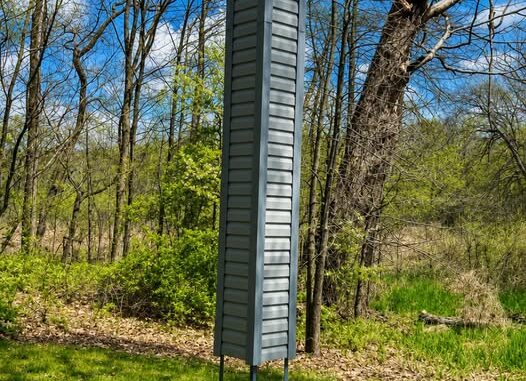
A tall, narrow tower.
It may resemble a miniature chimney standing by itself in the yard. There may be no decorative features, feeders, perches, or colorful birdhouse attached to it.
At first glance, you might wonder:
Why would anyone put that there?
The answer is fascinating.
That odd-looking tower has a secret mission: to provide Chimney Swifts with a safe place to roost and nest.
And as natural nesting locations become harder for these birds to find, structures like these can become surprisingly valuable.
Why Chimney Swifts Need Our Help
To understand why a skinny tower can matter so much, it helps to look at the history of Chimney Swifts.
Long before towns and cities filled the landscape, these birds used natural vertical structures for nesting and roosting.
They could make use of hollow trees, caves, cliffs, and other sheltered spaces that provided the dark, vertical surfaces they needed.
Then humans began changing the landscape.
As settlements expanded, forests were cleared and buildings became more common. Chimney Swifts discovered something that worked remarkably well for them:
brick chimneys.
Traditional masonry chimneys had many of the characteristics that swifts were already adapted to using. They were tall, dark, sheltered, and had rough interior surfaces that allowed the birds to cling to the walls.
For generations, chimneys became an important substitute for the natural cavities Chimney Swifts had once used.
In some communities, it was common for swifts to live in chimneys during the warmer months.
But architecture changed.
Modern homes often use different heating systems. Many newer structures no longer have traditional masonry chimneys. Older chimneys have also been demolished, capped, lined, screened, or modified.
From a human perspective, these changes may make perfect sense.
From the perspective of a Chimney Swift, however, they can mean fewer places to nest and roost.
That is where the backyard tower comes in.
The Backyard Tower That Looks Like a Chimney
A Chimney Swift tower is essentially an artificial structure designed to provide the kind of vertical, enclosed habitat these birds need.
From the outside, it can look surprisingly plain.
Tall.
Narrow.
Simple.
Almost like someone planted a skinny chimney in the middle of the lawn.
But the real purpose is hidden inside.
The interior creates a dark, sheltered shaft where swifts can cling to the walls, rest, and potentially build their nests.
Unlike many familiar backyard birds, Chimney Swifts aren’t looking for a little wooden box with a round entrance.
They have very different requirements.
And that’s what makes the tower so interesting.
It isn’t simply a birdhouse.
It’s an attempt to recreate a piece of habitat that modern landscapes have gradually removed.
Chimney Swifts Don’t Perch Like Robins
One of the most interesting things about Chimney Swifts is the way they interact with their environment.
If you watch a robin, sparrow, cardinal, or blue jay, you’ll frequently see the bird sitting on a branch.
Chimney Swifts are different.
Their feet are adapted for clinging to vertical surfaces rather than comfortably gripping horizontal branches.
They spend an enormous amount of time flying.
In fact, their entire lifestyle is closely connected to the air.
They feed on flying insects while airborne and can spend much of the day moving through the sky.
When they need somewhere to rest, they need a vertical surface they can hold onto.
That’s why an ordinary birdhouse doesn’t necessarily work for them.
A Chimney Swift tower gives them something much closer to what their feet and behavior are designed to use.
How Chimney Swifts Build Their Nests
The way Chimney Swifts build their nests is another remarkable part of their story.
The birds gather small twigs, often while flying.
They then use their saliva to help attach those twigs to the vertical interior surface of their nesting site.
One small twig becomes part of a larger structure.
Over time, the pieces form a nest where the birds can raise their young.
This is another reason the interior surface of a chimney or tower matters.
The birds aren’t looking for a comfortable shelf or a traditional nest box.
They need a structure that allows them to cling to the wall and attach their nest.
A properly designed swift tower essentially gives them an artificial version of the vertical habitat they have historically used.
The Nostalgic Sound of Summer
For people who grew up around older homes and traditional masonry chimneys, Chimney Swifts can bring back powerful memories.
Long before smartphones and social media, families spent summer evenings listening to the sounds coming from their homes and neighborhoods.
And sometimes, those sounds came from above.
A soft chattering or fluttering sound might be heard inside a chimney.
For some homeowners, it was simply part of summer.
The birds would arrive, raise their young, and eventually leave when the seasons changed.
Then the cycle would begin again the following year.
Not everyone understood what was happening, though.
Hearing scratching, fluttering, or movement inside a chimney can understandably make a homeowner nervous.
People might wonder whether something has become trapped.
But Chimney Swifts were often simply using the chimney as a nesting or roosting site.
And they weren’t there to cause trouble.
In fact, they provide a valuable ecological service by eating flying insects.
A Helpful Neighbor in the Sky
Chimney Swifts are insect-eating birds.
They spend much of their time catching insects while flying, which makes them fascinating to watch and valuable members of the ecosystem.
Their presence is also a reminder that wildlife doesn’t always live in places we expect.
A bird doesn’t necessarily need a forest preserve or a remote wilderness area to survive.
Sometimes, it can adapt to living alongside people.
Chimney Swifts are a remarkable example of this adaptability.
They essentially discovered that human-built chimneys could serve a purpose similar to natural nesting structures.
But now that human architecture is changing again, the birds need another opportunity to adapt.
This time, people can help.
Why a Tower Can Be Better Than a House Chimney
There’s something particularly appealing about a dedicated Chimney Swift tower.
Instead of having birds enter a home’s fireplace chimney, the birds get their own structure.
The arrangement can benefit both people and wildlife.
Homeowners don’t have to worry about birds occupying a chimney used for heating or ventilation, while the birds receive a protected location designed specifically for their needs.
It’s a fascinating example of coexistence.
Humans changed the landscape.
Birds adapted to those changes.
Then humans changed the landscape again.
Now, people can deliberately create new habitat to help the birds adapt once more.
The tower becomes a bridge between two worlds.
The Magic of a Large Flock at Dusk
Perhaps the most spectacular thing about Chimney Swifts isn’t a single bird.
It’s a flock.
During migration and at communal roosting sites, large numbers of swifts may gather together.
As evening approaches, you might see them swirling above a chimney or other suitable structure.
At first, the flock may look like a distant cloud.
Then it grows.
More birds appear.
The entire group circles and twists through the air, creating a living spiral above the landscape.
And then, almost as quickly as they appeared, they disappear.
One by one—or seemingly all at once—the birds drop toward their roost.
From a distance, the scene can almost resemble smoke being pulled into a chimney.
It’s an unforgettable sight.
A backyard tower probably won’t attract thousands of birds by itself.
But that’s not really the point.
Even a single nesting pair can contribute to the future population and give people an opportunity to witness these remarkable birds up close.
Why the Location of a Tower Matters
A Chimney Swift tower doesn’t need an elaborate garden surrounding it.
In fact, the birds have very different requirements from many backyard species.
They need open airspace because they spend so much time flying and feeding.
A tower surrounded by some open lawn and nearby trees can provide the birds with access to the sky while still giving them a sheltered place to rest.
The goal isn’t to create a fancy bird resort.
It’s to provide a functional structure in a suitable environment.
The tower itself may be simple, but the habitat surrounding it still matters.
A safe location away from excessive disturbance can make the structure more useful to the birds.
A Tower Can Teach an Entire Neighborhood
One of the unexpected benefits of a Chimney Swift tower is that it can become an educational tool.
Imagine a child walking past one.
They see the strange, skinny structure standing in a yard.
Naturally, they ask:
“What is that?”
And suddenly, there’s an opportunity to tell a story.
You can explain that the tower is for birds.
Then you can explain why the birds need it.
That leads to a conversation about old chimneys.
Then hollow trees.
Then migration.
Then insect-eating birds.
Then habitat loss.
Then conservation.
A simple structure becomes a doorway into a much bigger lesson about the natural world.
That’s one of the most beautiful things about conservation.
It doesn’t always begin with something enormous.
Sometimes it begins with something small enough to fit in someone’s backyard.
Conservation Doesn’t Always Have to Be Complicated
When people hear the word “conservation,” they may imagine huge protected forests, scientific research projects, government programs, or massive restoration efforts.
Those things can be important.
But conservation can also be surprisingly simple.
A tower in a backyard.
A nesting box.
A native plant.
A clean water source.
A protected patch of habitat.
One small action can become part of a much larger network.
A single Chimney Swift tower won’t solve every problem facing these birds.
But it doesn’t have to.
If enough communities provide suitable nesting and roosting structures, those individual efforts can add up.
One tower becomes two.
Two become ten.
Ten become hundreds.
And suddenly, a collection of simple structures is providing habitat across an entire region.
Bringing Back the Sounds of Summer
There’s something especially meaningful about helping Chimney Swifts because their presence is tied so strongly to the changing seasons.
Their arrival can become a signal that summer has returned.
Their calls can become part of the evening soundtrack.
Their silhouettes can become familiar against the sunset.
And their departure can remind us that the seasons are changing again.
A backyard tower gives people an opportunity to participate in that cycle.
Instead of simply watching wildlife disappear as habitats change, we can sometimes make small changes that give wildlife another option.
That’s what makes these towers so special.
They aren’t flashy.
They aren’t expensive-looking monuments.
They don’t dominate the landscape.
They simply stand quietly and do their job.
An Odd Tower With an Important Purpose
The next time you see a tall, narrow tower standing in someone’s backyard, don’t assume it’s an unusual decoration or an abandoned structure.
It might have a secret mission.
It could be a home for Chimney Swifts.
Inside that simple column, birds may be able to rest, build nests, raise young, and continue a relationship with the landscape that has lasted for generations.
The tower represents something bigger than a single nesting site.
It represents adaptation.
It represents coexistence.
And it represents the idea that humans can make room for wildlife even as the world around us continues to change.
For generations, Chimney Swifts adapted to the chimneys that people built.
Now, as those chimneys disappear or become unsuitable, we have an opportunity to adapt alongside them.
A single tower may seem small.
But for a pair of birds searching for a safe place to nest, it can mean everything.
And if you’re lucky enough to sit outside one summer evening and see Chimney Swifts circling overhead, listen carefully.
You may hear their calls echoing across the neighborhood.
You may watch them twist through the fading light.
And you may realize that the strange little tower in the yard isn’t strange at all.
It’s a promise that there is still room for wildlife in our changing world.
A promise that old summer sounds don’t necessarily have to disappear.
And perhaps most importantly, it’s a reminder that sometimes conservation begins with something as simple as building a safe place to call home.
Leave a Reply