
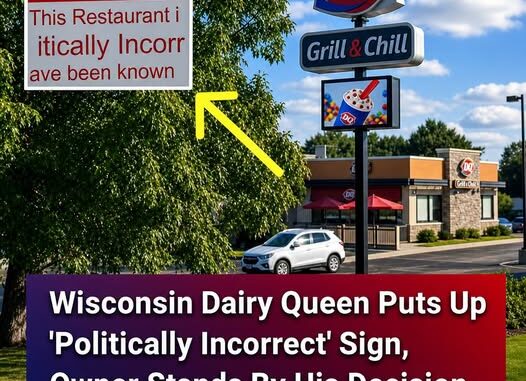
A simple sign displayed at a Dairy Queen restaurant in Kewaskum, Wisconsin, attracted attention after its message described some of the values the local franchise owner wanted his restaurant to represent. What began as a statement at a small-town business soon became part of a much wider online conversation about community traditions, personal expression, and how businesses communicate their identity.
The franchise owner, Kevin Scheunemann, explained that the sign was intended to give customers an idea of the atmosphere and values associated with his location. Among the references were Christian music, the use of the phrase “Merry Christmas,” expressions such as “God Bless America,” and visible support for veterans. For supporters, the message represented familiar traditions and values that they felt were an important part of the local community.
At the same time, the sign prompted a different perspective from some people who wondered whether messages connected to religion or patriotism could make certain customers feel less comfortable. This raised a broader question that many businesses face: how can a locally owned establishment express the personality and traditions of its owners while making people from different backgrounds feel welcome?
Supporters of the restaurant emphasized that the sign was intended as an expression of values rather than a statement that particular customers were unwelcome. They pointed to the distinction between expressing personal beliefs and treating customers differently. From this perspective, a business owner can share the traditions that are meaningful to the community while continuing to provide courteous service to everyone who walks through the door.
To understand the full scope of this discussion, it helps to look closer at the intersection of local culture and commercial enterprise in small towns across America. In many rural and suburban municipalities, a local diner, ice cream shop, or franchise location serves as much more than a mere commercial transaction point. It functions as a de facto town square where neighbors congregate, news is exchanged, and local identity is forged and reinforced over decades. When a business owner decides to publicly post their personal convictions, they are often tapping into this deep-seated sense of community fellowship, assuming that their neighbors share a common cultural baseline. Yet, as communities grow more diverse and interconnected through digital platforms, what plays well as a cozy, localized gesture can quickly take on an entirely different weight once it crosses virtual boundaries and enters the hyper-critical ecosystem of the internet.
The discussion also highlighted the unique position of franchise businesses. A local restaurant may be operated by an individual franchise owner while still being part of a larger national brand. Because of that relationship, statements made by an individual franchise location can sometimes attract attention beyond the local community and lead people to question how much the message represents the wider company.
This tension between corporate umbrella policies and individual operator autonomy is a classic challenge in modern franchising. National brands spend millions of dollars meticulously crafting an inclusive, universally appealing corporate identity designed to welcome every potential consumer, regardless of background, politics, or creed. They rely on consistency, predictability, and a neutral corporate posture to protect their bottom line and brand equity on a national scale. On the other hand, individual franchisees invest their life savings, sweat equity, and personal reputations into their specific brick-and-mortar locations. They live in the community, attend local churches, support local high school sports teams, and naturally view their business as an extension of their own personal worldview. When these two philosophies collide—the hyper-localized expression of the operator versus the macro-brand protectionism of the parent corporation—friction is almost inevitable.
Dairy Queen’s corporate organization sought to distinguish the local franchise owner’s personal messaging from the broader brand while emphasizing the importance of treating guests with respect. The clarification helped demonstrate why it is useful to distinguish between the views of an individual business operator and the policies or positions of a national company.
Furthermore, this episode underscores the profound power of social media to amplify localized disputes into national cultural flashpoints. A photograph taken on a smartphone by a passing patron can be uploaded, shared, debated, and weaponized across various online platforms within a matter of hours. Algorithms that favor emotional engagement often strip away nuance, turning a quiet local dialogue about signage into a polarized battleground where individuals feel compelled to take hardline stances. In this digital environment, moderation and context are frequently lost, leaving business owners and corporate entities alike scrambling to manage public relations fallout from incidents that, twenty years ago, would have remained confined to local word-of-mouth or a brief letter to the editor of the town newspaper.
Ultimately, the Wisconsin restaurant sign became an example of how quickly a simple local message can generate a much larger discussion. Rather than being only about a sign outside a restaurant, the conversation touched on community traditions, freedom of expression, customer experience, and the challenges businesses face when communicating personal or local values.
As society continues to grapple with questions of inclusivity, pluralism, and free speech, the boundary lines of where public commerce meets private expression will undoubtedly continue to shift. Business owners find themselves navigating a delicate tightrope. On one side is the desire for authentic self-expression and the comfort of traditional community norms; on the other is the commercial necessity of fostering a broad, hospitable environment where all patrons feel valued and respected. There is no simple playbook or universal formula that can resolve these competing priorities neatly, which is precisely why stories like the one in Kewaskum resonate so deeply with the public. They hold up a mirror to our current cultural climate, forcing us to examine how we coexist in shared spaces despite our differences.
For many small businesses, creating a welcoming environment means balancing authenticity with consideration for a diverse customer base. The conversation surrounding the Kewaskum Dairy Queen illustrates how even a few words displayed in a restaurant window can encourage people to think about that balance. It also shows how local businesses can become part of national conversations when photographs or statements spread online.
Leave a Reply