
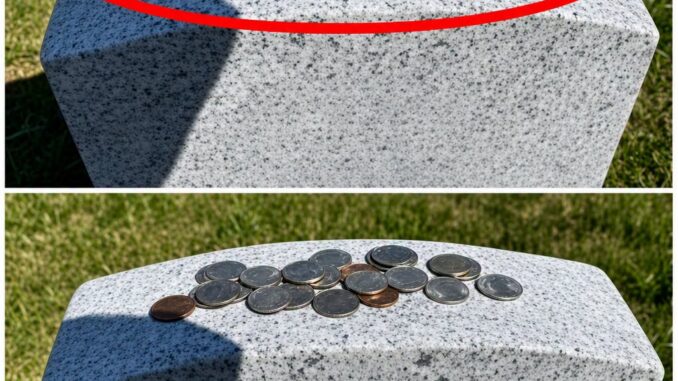
If you’ve ever walked through a cemetery—especially a military cemetery—you may have noticed small coins resting on gravestones. At first, they might seem like forgotten change. But in some traditions, these coins are deliberate symbols of remembrance, respect, and connection.
Each coin can carry a message, particularly when left on the grave of a fallen service member. Though the custom is often associated with military cemeteries in the United States, its meaning can vary depending on the person, place, and tradition.
What Different Coins Can Represent
One commonly shared interpretation assigns a different meaning to each denomination. These meanings are not universal rules, but they offer a way to understand the gesture.
A Penny: “I Remember You”
A penny is often understood as a simple sign that someone visited the grave. It can mean, “I was here,” or “You have not been forgotten.”
For families, discovering a coin may offer a quiet reminder that someone took time to honor their loved one. Even when the visitor was a stranger, the gesture can communicate respect and remembrance.
A Nickel: A Connection Through Service
In the military tradition, a nickel is sometimes said to represent having trained alongside the deceased. It may symbolize a shared period of service, from basic training to other experiences that helped form a lasting bond.
The coin becomes a small acknowledgment of the time and hardships two people experienced together.
A Dime: A Bond Forged in Combat
A dime is commonly associated with serving alongside the deceased during combat. It can represent a connection shaped by danger, shared responsibility, and experiences that are difficult to explain to anyone who was not there.
For those who use this interpretation, the coin is a personal tribute to a fellow service member and the bond they shared.
A Quarter: Remembering a Final Moment
A quarter is sometimes described as a symbol that the visitor was present when the service member died. It may represent being there during a person’s final moments or sharing the grief surrounding their loss.
Because this interpretation is particularly personal, it is best understood as one version of the tradition rather than a meaning that applies to every quarter found on a grave.
Why the Gesture Matters
The value of the coin is not the point. Its significance comes from the intention behind leaving it.
For families who have lost someone, a coin may serve as a small sign that their loved one is still remembered. For veterans and fellow service members, it can express a connection that does not end with death.
The gesture is quiet, requiring no speech or ceremony. Yet it can carry a message of gratitude, grief, and respect.
A Tradition With Older Roots
Leaving coins with the dead has historical precedents. In ancient Greek and Roman traditions, coins were sometimes placed with the deceased in connection with beliefs about the afterlife. One well-known story involved Charon, the mythological ferryman who carried souls across the River Styx.
Modern coins left on gravestones are not necessarily a direct continuation of those ancient practices. Similar gestures can emerge in different cultures for different reasons, and the symbolism depends on the community observing it.
In military cemeteries, the coin tradition is especially associated with honoring fallen service members. The penny, nickel, dime, and quarter interpretations are often shared as a way to communicate different levels of connection, from remembering someone to having served beside them.
What Happens to the Coins?
In some cemeteries, coins may be collected by staff or volunteers. Certain locations or organizations may use collected coins for charitable purposes, including support for veterans.
However, practices vary. Not every cemetery collects coins, and visitors should not assume that coins left on a gravestone will be donated or used in a particular way.
If a cemetery has posted rules about items placed on graves, those guidelines should be followed.
How to Respond When You See a Coin
If you encounter a coin on a gravestone, it is generally best to leave it where it is unless cemetery staff instruct otherwise. The coin may have been placed as a personal tribute, and removing it could disturb someone’s act of remembrance.
It is also worth remembering that not every coin has a specific military meaning. Some may be personal tokens, accidental drops, or gestures whose significance is known only to the person who left them.
A Small Object With a Lasting Message
A coin resting on a gravestone may look insignificant, but it can represent a meaningful connection between the living and the dead.
Whether it is a penny left to say “I remember,” or another coin marking a personal bond, the gesture offers a quiet way to honor someone’s life.
The next time you notice a coin on a gravestone, consider that it may be more than loose change. It may be someone’s small, private way of saying: You mattered. You are remembered.
Leave a Reply