
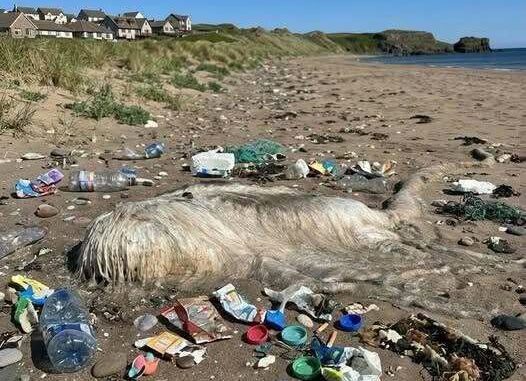
It was an ordinary afternoon at the beach until I noticed something unusual lying near the water.
At first glance, I couldn’t figure out what I was looking at. The strange shape almost seemed too unusual to belong on the shoreline. My dog, Charlie, was curious too and started moving toward it.
I stayed nearby, but something about the creature made me hesitate. Rather than touching it or trying to move it, I decided to take a photograph and ask someone who knew more about marine life.
Later that afternoon, I contacted a local marine biologist. She identified the animal as a roughtail stingray, a species found along parts of the Atlantic coast.
What surprised me most was learning that a stingray can still present a hazard even when it appears lifeless.
Stingrays have defensive spines near their tails, and these can cause serious injuries if someone accidentally steps on or handles the animal. For that reason, an unfamiliar marine animal should never be picked up simply because it appears to be dead or inactive.
The biologist explained that stingray injuries can be extremely painful and may involve swelling and other complications. Serious injuries require prompt medical attention.
Her advice was simple: keep your distance.
That conversation made me think about how close we had come. Charlie had been investigating the animal, while I had been standing nearby without realizing that its tail could potentially cause an injury.
Nothing happened, thankfully. But the encounter could have turned out differently if either of us had touched the animal.
It was a useful reminder that beaches can contain wildlife that isn’t always easy to identify. Many sea creatures are fascinating to observe, but some have natural defenses that can hurt people or pets.
Don’t Touch Unfamiliar Marine Animals
Stingrays aren’t the only animals that deserve caution.
Depending on where you live, beaches and coastal waters may be home to jellyfish, Portuguese man o’ war, sea urchins, cone snails, sea snakes, and other animals with defensive or venomous features.
You don’t need to be afraid of these creatures. You simply need to give them appropriate space.
If you discover an unfamiliar animal on the beach, avoid touching, kicking, picking up, or moving it. Keep children and pets away and observe it from a safe distance.
If the animal appears to be causing a hazard or is in an area where people are likely to step on it, contact local beach authorities or wildlife professionals for guidance.
Taking a photograph from a safe distance can also be useful if you want help identifying what you’ve seen.
Why Dead Animals Can Still Be Dangerous
One of the biggest lessons from my experience was that an animal doesn’t necessarily become harmless when it stops moving.
A dead or injured marine animal can still have physical structures capable of causing injury. Spines, shells, teeth, stingers, or other defensive features may remain hazardous.
That’s why it’s best not to rely on appearance alone.
If you don’t know what an animal is, assume that it should not be handled.
This is especially important when children or curious pets are nearby. Dogs may investigate unfamiliar objects with their noses or mouths, while young children may instinctively reach toward something unusual.
Keeping them at a safe distance is much easier than dealing with an avoidable injury.
A New Way of Looking at the Beach
I still enjoy walking along the beach with Charlie. The difference is that I’m now a little more observant.
I keep him close when we’re near unfamiliar objects, particularly around shallow water and the shoreline. If something looks unusual, we simply walk around it.
That doesn’t make the beach less enjoyable. If anything, it has made me appreciate the environment more.
The ocean contains an incredible variety of life, much of which we rarely notice. Some creatures are beautiful, some are strange, and some have surprisingly effective ways of protecting themselves.
That afternoon, I initially thought I had discovered something that looked like it belonged in another world.
Instead, I discovered a small reminder of how much there is to learn about the world we already share.
The experience left me with one simple rule that I now follow whenever I’m near the water:
Look, appreciate, and learn—but don’t touch unfamiliar sea life.
A little caution allows us to enjoy the beach while giving wild animals the space they need.
Leave a Reply