
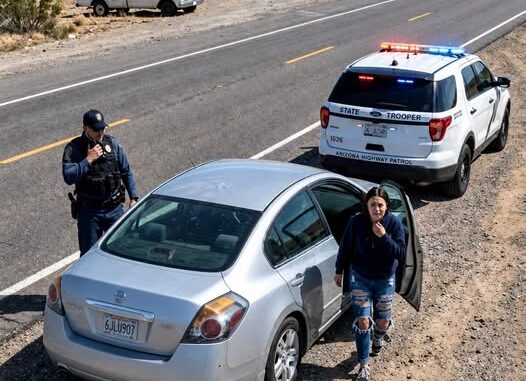
A routine traffic stop on a quiet Texas highway was about to become something much bigger.
Delaney Voss had been driving through East Texas when a local officer pulled her over. At first, the encounter appeared ordinary. But Delaney had a reason for being in the area, and the small camera mounted inside her vehicle was recording everything.
What happened during the next several minutes would eventually raise serious questions about the officer’s conduct—and help uncover a much larger investigation.
Why Delaney Was There
Three days earlier, Delaney had received a distressed phone call from her younger brother, Ronan.
The 19-year-old college student had been traveling toward his university when a local officer stopped him. Ronan told his sister that the officer had questioned him about several thousand dollars he was carrying for his tuition.
According to Ronan, the money was taken during the encounter, but he was not given documentation explaining why it had been seized.
For Ronan, the incident was devastating. He had spent years working to save for college, and suddenly the money intended for his education was gone.
Delaney decided to look into the matter.
She wasn’t interested in creating a confrontation. She wanted answers.
At the time, she was on administrative leave from her federal position while another matter was being reviewed. Her professional experience had taught her something important: when allegations are serious, documentation matters.
So she arranged to travel through the area and kept her vehicle’s recording equipment running.
The Traffic Stop
Delaney was driving below the posted speed limit when she noticed a patrol vehicle following closely behind her.
A short time later, the emergency lights came on.
She safely moved onto the shoulder, turned off the engine, and kept her hands visible on the steering wheel.
The officer approached the vehicle.
According to the story, he accused Delaney of driving dangerously despite her belief that she had been following the traffic rules. The conversation quickly became tense.
The officer then instructed her to step outside the vehicle.
Delaney remained calm and followed the instruction.
She understood that arguing on the roadside would accomplish little. Instead, she focused on documenting the encounter and keeping the situation under control.
A Question About the Vehicle
Once outside the SUV, the officer began asking questions about what was inside the vehicle.
He also claimed that he suspected illegal substances were present.
Delaney knew there was nothing in the vehicle that justified such an accusation.
When the officer asked about her credentials, she decided it was time to identify herself.
She explained that she worked as a federal special agent.
The revelation immediately changed the tone of the encounter.
The officer initially appeared skeptical.
Then Delaney carefully reached toward the vehicle to retrieve her identification.
The officer reacted by drawing his firearm and ordering her to stop moving.
The situation had suddenly become far more serious.
The Camera Kept Recording
What the officer apparently didn’t realize was that the entire interaction had been captured by the vehicle’s recording system.
The footage documented the conversation, the instructions given during the stop, and the officer’s actions.
For Delaney, the recording could provide something more valuable than an argument: evidence.
Within moments, another vehicle arrived.
It was an unmarked SUV carrying several federal agents.
Their arrival suggested that Delaney’s presence in the area had never been accidental.
She had been gathering information as part of a broader inquiry into allegations involving local law enforcement.
The Investigation Expands
A senior federal agent identified himself and instructed the officer to remain calm.
The officer began explaining his actions, claiming that he had reasonable grounds for the traffic stop and subsequent search.
But the federal team had already been examining information connected to the department.
The traffic stop had become another piece of evidence.
Delaney then explained why she had been there.
Her brother’s missing tuition money was not an isolated concern. Investigators had been examining allegations that some motorists had been subjected to questionable stops and property seizures.
The investigation was now moving in a much broader direction.
Evidence From the Patrol Vehicle
After the officer was taken into custody, investigators searched the patrol vehicle as part of their investigation.
According to the story, they discovered records and cash that investigators believed could be connected to previous encounters with motorists.
Among the recovered items was reportedly an envelope containing the money belonging to Ronan.
For Delaney, that discovery provided the confirmation she had been searching for.
The money hadn’t simply disappeared.
It had allegedly been placed among other property being examined by investigators.
Ronan Gets His Money Back
Later that day, Delaney returned to Austin.
When she arrived at her brother’s apartment, Ronan was still struggling to process everything that had happened.
Without saying much, Delaney handed him the envelope containing his tuition money.
Ronan immediately recognized it.
The relief on his face said more than words could.
The money represented more than tuition. It represented years of work, sacrifices, and his plans for the future.
Delaney reminded him that the situation wasn’t his fault.
He had simply been in the wrong place at the wrong time.
A Larger Lesson
The story illustrates why documentation can be important when disputes arise during roadside encounters.
A dashcam cannot settle every disagreement, but recorded footage can sometimes provide an objective record of what happened.
It can help establish the sequence of events, preserve conversations, and give investigators information that might otherwise depend entirely on conflicting accounts.
The story also highlights another important principle: authority comes with responsibility.
Law-enforcement officers are entrusted with significant powers, but those powers are expected to be exercised according to the law and established procedures.
When allegations of misconduct arise, proper investigations and evidence are essential.
What Happened Next?
According to the fictional account, the investigation continued after the officer’s arrest, with authorities reviewing additional records and encouraging people who believed they had experienced similar treatment to come forward.
For Delaney, however, the most important moment came later that evening.
She wasn’t celebrating.
She simply sat quietly, knowing that her brother had his money back and that the evidence she had helped preserve could now be examined properly.
The traffic stop had started as an encounter on an ordinary stretch of highway.
But because the interaction was recorded, it became part of a much larger story.
Sometimes, the smallest piece of evidence can change the direction of an entire investigation.
And in this case, a camera that was quietly recording from inside an SUV may have captured the information investigators needed to uncover the truth.
Leave a Reply