
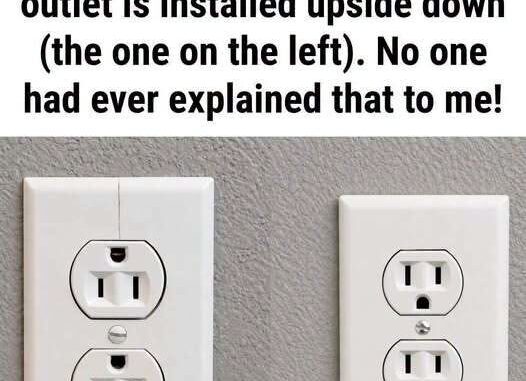
Have you ever noticed a wall outlet with the grounding hole on top instead of at the bottom? At first, it can look like the electrician installed it incorrectly. But an upside-down receptacle is not necessarily a mistake.
In many homes, the orientation can reflect a practical choice, the way the outlet is wired, or simply the preference of the electrician who installed it.
A Possible Clue for Switched Outlets
One reason you may encounter an upside-down outlet is that it can sometimes be used as a visual indicator for a switched receptacle.
This arrangement was especially common in older homes, where ceiling lighting wasn’t always the standard. Instead, a wall switch could control a lamp plugged into an outlet.
A duplex receptacle may be wired so that one half is controlled by a wall switch while the other remains powered continuously. This gives homeowners flexibility. A lamp can be connected to the switched portion, while something such as a clock, charger, or other appliance can remain plugged into the constantly powered portion.
Some electricians have used an inverted orientation to make a switched receptacle easier to recognize.
However, there is an important distinction: an upside-down outlet does not automatically mean it is switched.
There Isn’t One Universal Orientation
Electrical receptacles don’t have to be installed in one particular direction under the National Electrical Code. As a result, you’ll see different orientations from home to home.
Some electricians install receptacles with the grounding opening facing upward. Others place it downward. Still others may install them horizontally depending on the particular application.
The choice can be influenced by local practices, the builder, the electrician, or the specific installation.
That means you shouldn’t assume that an outlet is wired differently simply because it looks different.
Why Might an Electrician Prefer the Ground Hole on Top?
There are also practical arguments for installing a receptacle with the grounding slot facing upward.
For example, if a plug is partially pulled from an outlet and something heavy falls against it, some electricians prefer the grounding pin to be positioned so that it may make contact first, depending on the circumstances.
This is one reason you may see upside-down receptacles in commercial, industrial, or residential settings. However, the safety benefits can depend on the particular plug, receptacle, installation, and circumstances.
In other cases, the orientation is simply a matter of installation preference.
How Can You Tell What an Outlet Actually Does?
The orientation alone isn’t enough to determine how a receptacle is wired.
If you’re curious whether an outlet is controlled by a wall switch, you can test it with an ordinary lamp or another suitable device. Plug it in and operate the nearby switches to see whether the power changes.
Some duplex outlets may have one receptacle controlled by a switch while the other remains continuously energized.
If you notice anything unusual—such as loose wiring, damaged receptacles, scorching, buzzing, or signs of overheating—don’t attempt to diagnose or repair the wiring yourself. Turn off the appropriate circuit if you can do so safely and have a qualified electrician inspect it.
Upside Down Doesn’t Mean Wrong
An outlet with the ground opening on top may look strange if you’re accustomed to seeing the opposite arrangement, but orientation by itself isn’t evidence of an installation error.
It may indicate a switched receptacle, reflect an electrician’s preferred convention, or simply be the way that particular home was wired.
So the next time you spot an upside-down outlet, don’t assume someone made a mistake. The unusual orientation may have a practical explanation—or it may simply be a choice made during installation.
Leave a Reply