
I was standing in the feminine hygiene aisle of our local grocery store, holding a package of pads and trying to remember which brand my daughter Maya preferred.
Our youngest, June, had started her period that morning.
I had been through this twice before with Maya and Ellie, so I knew the routine: pads, chocolate, ibuprofen, a heating pad, and—most importantly—a calm attitude that told her there was nothing embarrassing about what was happening.
As I placed everything on the checkout counter, the cashier smiled and suggested a heating pad and some gummies for cramps.
“Good idea,” I said.
She had no way of knowing why I was doing the shopping myself.
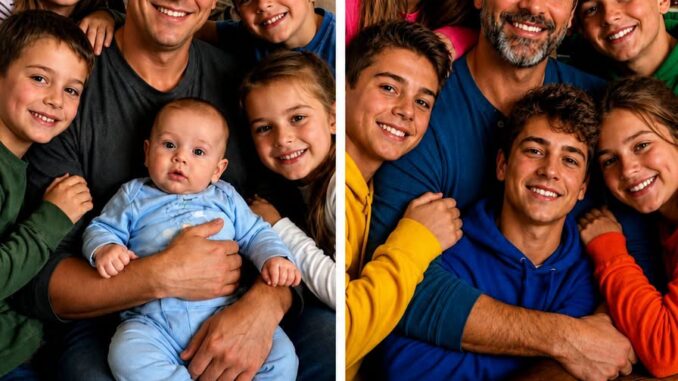
She didn’t know I was a single father raising five children.
And she certainly didn’t know how that happened.
Ten years earlier, my wife, Natalie, had kissed our six-month-old daughter Rosie on the forehead and said she was stepping out for fifteen minutes.
She never came back.
Fifteen minutes became thirty.
Thirty became an hour.
My calls went unanswered.
When I finally checked the bedroom, I knew something was wrong.
Her clothes were gone.
Several suitcases were missing.
So was the emergency cash we’d kept in the house.
She had left deliberately.
I remember sitting on the edge of the bed, trying to process what had happened while the children played in the next room.
I didn’t want them to see me fall apart.
I had no idea where Natalie had gone.
Over the following years, I heard rumors.
She was living in another city.
She had met wealthy people.
She was traveling.
She was living a life that looked nothing like ours.
Eventually, I stopped asking.
There were five children who needed me.
Bills needed paying.
Meals needed cooking.
Homework needed checking.
Someone had to be there.
My mother moved in a few days after Natalie disappeared and helped us keep everything together.
I worked whenever I could—warehouse shifts, deliveries, bookkeeping late at night.
Some days I was so exhausted that I could barely remember what day it was.
But the children kept growing.
Maya became incredibly responsible.
Owen learned to help without being asked.
Ellie could make Rosie laugh even when everyone else was exhausted.
And June had a talent for turning ordinary moments into something funny.
Then, two years ago, my mother died.
Losing her felt like losing the last piece of the foundation beneath us.
But we kept going.
Somehow, the five of us became a family that worked.
It wasn’t perfect.
It wasn’t easy.
But it was ours.
That Saturday evening, after I returned from the grocery store, the children were waiting for me.
Dinner was loud and chaotic.
June announced that periods were “a corporate scam.”
Ellie reminded her that during her first period, she had cried over a baked potato.
Everyone laughed.
I sat there listening to them and realized something.
We had survived.
Not because life had been kind to us.
Because we had been kind to one another.
The next morning was Mother’s Day.
We visited my mother’s grave.
The children brought flowers, and we stood together quietly for a few minutes.
Then we went home.
That’s when the doorbell rang.
I opened the door.
And froze.
Natalie was standing there.
She looked exactly like the person I remembered from before she left—expensive coat, perfect hair, polished shoes.
For a moment, neither of us spoke.
Then she walked inside.
The children went silent.
Rosie, now ten, moved behind Owen.
Owen instinctively stepped in front of her.
Natalie looked around the room with tears in her eyes.
“I never wanted to leave,” she said.
I stared at her.
She continued, telling us that she had felt trapped, that I hadn’t been able to provide the life she wanted, that leaving had been the hardest sacrifice she had ever made.
She spoke as though the past ten years had been a misunderstanding.
As though she had somehow been the victim.
Then she looked at Rosie.
“My baby.”
Rosie didn’t move.
Natalie reached toward her.
Rosie stepped farther behind Owen.
That was when Maya stood up.
She didn’t yell.
She didn’t cry.
She simply walked into the kitchen.
A moment later, she returned carrying a small package wrapped in old paper.
Natalie smiled.
For the first time since she arrived, she looked hopeful.
Maybe she thought Maya had prepared a Mother’s Day gift.
She took the package.
Slowly, she opened it.
Her expression changed.
On top was a card.
Maya had written four words:
GO AWAY. WE DON’T NEED YOU.
Beneath it were old cards and photographs.
Mother’s Day cards the children had made years ago.
Some had crooked handwriting.
Some had drawings.
One had a child’s simple message asking when Mom was coming home.
Another said, “I miss you.”
Another simply said, “Please come back.”
Natalie stared at them.
“You kept these?”
Maya nodded.
“We kept everything.”
One by one, the children began talking.
Not shouting.
Not screaming.
Just telling the truth.
Owen reminded Natalie that there had been birthdays she missed.
Ellie talked about school events she never attended.
June told her about the nights she used to ask why other children had mothers who came to pick them up.
Natalie kept saying she hadn’t known.
She hadn’t realized.
She hadn’t understood.
Owen finally looked at her.
“That was the problem.”
The room went quiet.
“You didn’t know because you weren’t here.”
Natalie looked toward me.
“You told them I abandoned them.”
I shook my head.
“I didn’t have to.”
She stared at me.
“The children remember what happened.”
June stepped forward.
“You said Dad couldn’t give us a decent life.”
Her voice was small, but steady.
“He gave us everything.”
I felt my eyes fill with tears.
Rosie suddenly ran toward me and wrapped both arms around my waist.
“Dad is my family,” she said.
That was the moment something inside me broke.
Not from sadness.
From relief.
For years, some part of me had worried that the children would eventually resent me for what they had lost.
Instead, they had built something together.
Something stronger than I ever imagined.
Maya picked up the package.
“You can take these,” she said.
Natalie looked confused.
“Why?”
“Because they’re yours.”
Maya paused.
“But we’re not waiting anymore.”
Natalie began crying.
She said she had come back because her life had fallen apart. The relationships she had relied on were gone. The life she had imagined hadn’t worked out.
I listened quietly.
Then I told her the only thing I knew to say.
“Being a parent isn’t something you return to when the rest of your life stops working.”
She looked at me.
“You don’t get to disappear for ten years and come back expecting everyone to pretend nothing happened.”
She didn’t answer.
Eventually, she walked toward the door.
Before she left, she turned around.
“I am their mother.”
Maya looked at her.
“You were.”
Natalie stood there for a long moment.
Then she left.
The door closed.
Nobody moved.
Then Owen looked toward the kitchen.
“Dinner’s getting cold.”
Ellie laughed.
June started arguing about dessert.
Rosie was still holding onto me.
And somehow, the house felt warm again.
That night, I thought about the woman who had left ten years earlier.
I thought about all the birthdays she missed.
The first days of school.
The illnesses.
The late-night conversations.
The countless ordinary moments that never make it into photographs but somehow become the foundation of a childhood.
I realized something I had never allowed myself to admit.
My children had stopped waiting for Natalie long before I did.
They had mourned her absence.
Then they had learned how to live without her.
And somewhere along the way, we had become enough for one another.
I can’t say what will happen next.
Maybe Natalie will eventually take responsibility for what she did.
Maybe she won’t.
Maybe the children will forgive her someday.
Maybe they won’t.
That choice belongs to them.
But I know this much:
Love isn’t measured by who gives the biggest gifts or says the most convincing words.
It’s measured by who stays.
Who gets up at 3 AM when a child is sick.
Who sits through school plays.
Who learns which brand of pads their daughter prefers.
Who makes dinner when they’re exhausted.
Who shows up on the ordinary days when nobody is watching.
That was the lesson Mother’s Day gave me.
The children didn’t need a perfect family.
They needed someone who would stay.
And for ten years, I did.
Maybe I couldn’t give them everything.
But I gave them what mattered most.
I was there.
Leave a Reply