
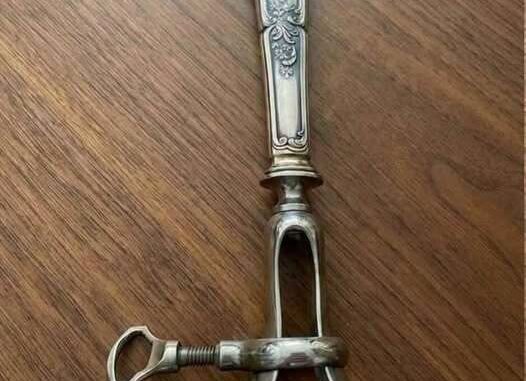
Three days after my grandmother’s funeral, we found something in the back of her dresser that none of us could identify.
It was small enough to fit in my palm.
Dark, worn, and oddly shaped, it looked like some kind of old household tool. One end was rounded, while the other had a narrow opening through the center.
I turned it over several times.
“What on earth is this?”
My mother glanced over from the clothes she was sorting.
“I’ve never seen it before.”
My uncle picked it up next.
“Maybe it’s something from the kitchen?”
I laughed.
“Grandma had stranger things in her drawers.”
That was true.
She had lived in the same house for nearly sixty years, and she had never been particularly interested in throwing things away.
Her drawers were little time capsules.
There were old buttons, coins, photographs, handwritten notes, safety pins, receipts, keys nobody recognized, and tiny household objects that probably hadn’t been used in decades.
So finding one more mysterious item shouldn’t have surprised us.
But this one was different.
It was clearly worn.
The surface had become smooth in certain places, and tiny scratches covered the edges.
Someone had used it repeatedly.
Maybe for years.
My mother stared at it.
“I wonder how long she had this.”
That question stayed with us.
Everyone Had a Theory
We placed the object on the kitchen table and continued sorting through Grandma’s belongings.
Every few minutes, somebody picked it up again.
My uncle thought it might be a tool.
My mother guessed it could have something to do with sewing.
My cousin suggested it might have belonged to one of Grandma’s parents.
I jokingly said maybe we’d discovered a family treasure.
Nobody took the joke very seriously.
We were still grieving.
Going through Grandma’s possessions felt different from ordinary cleaning.
Every drawer contained something connected to her.
There was a handkerchief she had carried for years.
A faded birthday card.
An old photograph of my mother as a teenager.
A perfume bottle that still carried the faintest trace of her familiar scent.
The mystery object suddenly didn’t feel like an ordinary piece of junk.
It had belonged to Grandma.
That meant something.
My mother eventually said, “Let’s ask someone who knew her.”
The First Clue
We showed it to one of Grandma’s neighbors.
She studied it for several seconds.
“I’ve seen something like that before.”
We immediately became interested.
“Where?”
“My mother’s house,” she replied.
Unfortunately, she couldn’t remember what it was used for.
Still, that was our first clue.
The object wasn’t unique.
It belonged to an older generation of household items that had largely disappeared.
That evening, my cousin photographed it and shared the pictures with our relatives.
The family theories multiplied.
One person thought it might be connected to sewing.
Another believed it could have been used with shoes.
Someone else suggested it was an old-fashioned clothing accessory.
Nobody agreed.
Finally, my cousin said something obvious.
“Why don’t we show it to someone who specializes in antiques?”
The next morning, we took the object to a local antique dealer.
He examined the photographs first and then asked to see the actual item.
Under a bright lamp, he carefully turned it over.
He examined the opening.
Then the worn surface.
Finally, he smiled.
“I’ve seen these before.”
We all leaned closer.
A Piece of Everyday History
He explained that the object was an old-fashioned buttonhook, a small clothing tool once used to help fasten buttons, particularly on shoes and garments with difficult-to-reach fasteners.
It wasn’t valuable.
It wasn’t rare enough to make us rich.
And it certainly wasn’t the mysterious treasure we’d joked about.
But somehow, knowing its purpose made the object more interesting.
The dealer explained that older generations often owned small tools designed for repairing, maintaining, and caring for clothing.
People were much more accustomed to fixing things instead of replacing them.
A loose button was repaired.
A torn seam was stitched.
Shoes were maintained.
Clothes were expected to last.
The object suddenly fit perfectly into Grandma’s world.
She had grown up during a time when even small household tools had a purpose.
But then my mother remembered something.
“Wait.”
She had been looking through one of Grandma’s old photograph albums earlier.
She hurried to get it.
A few minutes later, she opened the album to a photograph of Grandma as a young woman.
She was sitting beside a sewing basket.
Several small tools were arranged on the table.
My mother pointed at one.
“Look at that.”
We stared at the photograph.
The object beside the young Grandma looked remarkably similar to the one sitting on our kitchen table.
We couldn’t prove with absolute certainty that it was the exact same piece.
But the shape was almost identical.
And suddenly, the little object felt completely different.
It wasn’t just an old tool.
It might have been something Grandma had held when she was young.
Something that had remained with her through decades of life.
We Put It Back
That afternoon, we returned the buttonhook to Grandma’s dresser.
We could have placed it in a box.
We could have thrown it away.
Instead, my mother put it back in the same drawer where we’d discovered it.
Nobody argued.
The object wasn’t worth much money.
But it had become part of the family story.
And something unexpected happened while we were trying to understand it.
We started talking about Grandma.
Not about her funeral.
Not about the paperwork.
Not about sorting out her belongings.
We remembered her cooking.
Her habits.
Her favorite sayings.
The way she saved spare buttons.
The way she repaired things instead of replacing them.
The stories she told so often that we could almost recite them ourselves.
For several hours, the kitchen felt less like a place where we were dividing up someone’s belongings and more like a place where we were remembering her.
That’s when I realized something.
Sometimes the value of an old object has nothing to do with its price.
A photograph can be priceless because of who’s in it.
A handwritten recipe can matter because of whose handwriting is on the page.
And a tiny old tool can become special because it survived long enough to remind you of the person who used it.
We never discovered every detail about Grandma’s little buttonhook.
We don’t know exactly how old it was.
We don’t know how many times she used it.
We don’t know whether she kept it for practical reasons or simply because she couldn’t bring herself to throw away something that still worked.
But perhaps we don’t need to know.
Finding that object gave us something more important than an answer.
It gave us a reason to remember.
And maybe that’s what old family belongings are really for.
They don’t always preserve the entire story.
Sometimes they preserve just enough of it to make us start talking.
So the next time you find a strange object in an old family drawer, don’t dismiss it immediately.
Take a closer look.
Ask questions.
Search for its history.
Because the object itself might be ordinary.
But the memories connected to it may be something you can never replace.
Leave a Reply