
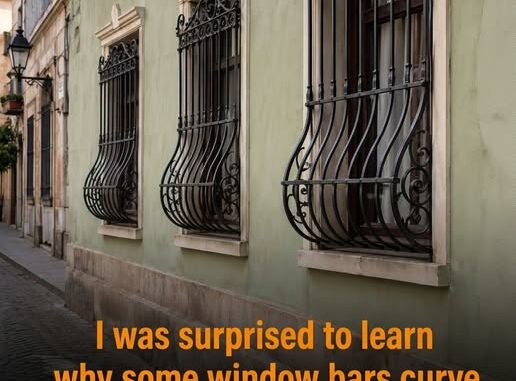
Have you ever noticed window grilles that don’t sit completely flat against a building?
Some have a noticeable outward curve near the middle or lower section, creating a shape that almost resembles a small rounded belly.
At first glance, it may look like nothing more than an old-fashioned decorative feature.
But there’s often a practical reason for the design.
Known by some as a “potbelly” window grille, this style adds useful space between the window and the protective bars. That extra room can make the grille more versatile while still serving its primary purpose.
What Is a Potbelly Window Grille?
A potbelly grille is essentially a window security grille with an outward projection.
Instead of following the flat surface of the window, part of the metal framework extends away from the wall.
The amount of projection varies considerably. Some designs have only a modest curve, while others create enough space for practical uses beyond security.
The basic idea is simple:
Create additional space without completely changing the window’s protective barrier.
That small adjustment can make a surprising difference.
A Practical Design, Not Just Decoration
Window grilles are primarily installed to provide a physical barrier around windows.
Over time, however, designers and homeowners found that the area around a window could serve other purposes as well.
The outward curve created an opportunity to combine security with everyday functionality.
Rather than having a flat metal grille that occupies the same plane as the window, the projected section can provide room for certain accessories or installations.
This is one reason these designs can be seen on older residential buildings, apartments, and other structures where space efficiency is important.
One Common Use: Flower Boxes
Perhaps the most recognizable purpose of the outward curve is to accommodate plants.
A suitable window box or planter can sometimes rest against or be supported by the projecting section of the grille.
This turns an otherwise utilitarian feature into part of the building’s exterior decoration.
Imagine a simple metal grille against a plain wall.
Now add a row of colorful flowers.
The entire appearance of the window changes.
The plants introduce color and texture, while the metal framework provides structure.
For homes with limited yard or balcony space, this can be an appealing way to add greenery without constructing a separate garden feature.
Of course, any planter attached to or supported by a grille should be properly secured and should not exceed the grille’s structural capacity.
Making Room for Window Air Conditioners
Another possible reason for the curved design is the use of window-mounted air-conditioning units.
Older buildings and homes sometimes rely on window AC systems because installing a central system may not be practical.
A flat security grille can interfere with the space needed for an air-conditioning unit.
A projecting grille can provide additional clearance.
That doesn’t mean every potbelly grille was specifically designed for an AC unit. Designs vary, and the actual purpose depends on the building and the grille’s construction.
But the extra space can make certain window installations easier to accommodate.
Why Not Simply Remove the Grille?
This is where the design becomes particularly useful.
A homeowner may want the protection of window bars while also needing to use the window for another purpose.
Instead of choosing between security and functionality, a projecting design can provide some additional flexibility.
The grille remains in place while creating clearance around part of the window.
It’s a simple example of practical design solving more than one problem.
The Design Can Also Add Character
Function isn’t the only reason these grilles attract attention.
Their curved shape can give a building a distinctive appearance.
Straight metal bars can look very utilitarian.
Adding curves, decorative elements, or geometric patterns can make the grille feel more integrated with the architecture.
On older buildings, ornate metalwork can contribute to the overall character of the façade.
On simpler homes, a modest curve can provide visual interest without making the window look overly decorative.
This combination of utility and appearance is one reason traditional grille designs continue to attract interest.
Materials Matter
Window grilles can be made from different types of metal.
Steel is commonly used because it can provide strength and durability when properly manufactured and protected against corrosion.
Wrought-iron designs can also be found, particularly on older or more decorative buildings.
The quality of the material, construction, finish, mounting hardware, and installation all affect how well a grille performs.
A decorative appearance doesn’t automatically mean a grille provides strong security.
The construction and installation are far more important than appearance alone.
Installation Is Extremely Important
A window grille only works as intended when it is properly installed.
The mounting points need to be appropriate for the building structure, and the hardware should be suitable for the loads and conditions involved.
Poor installation can make even a heavy-looking grille less effective.
There’s another consideration that is even more important: emergency escape.
Fixed security bars can create serious problems if they block a window that occupants might need to use during an emergency.
For bedrooms and other areas where emergency escape may be necessary, local building and fire-safety requirements should be checked before installing or modifying window bars.
In some locations, approved quick-release or removable designs may be required.
Security Bars Are Only One Part of Home Safety
Window grilles can provide an additional physical barrier, but they shouldn’t be viewed as a complete security system.
Other measures can also make a difference, including:
- Strong and properly secured exterior doors
- Reliable window locks
- Adequate exterior lighting
- Working smoke and carbon-monoxide alarms
- Appropriate security or monitoring systems
- Clear emergency escape routes
A secure home should also remain safe for the people living inside it.
That means security features shouldn’t create unnecessary obstacles during an emergency.
Why the Curved Shape Makes Sense
The interesting thing about the potbelly design is that the curve itself is quite simple.
It doesn’t require a complicated mechanism.
Instead, the shape creates additional usable space.
That space can potentially accommodate plants, decorative elements, or certain window installations, depending on the design.
At the same time, the grille can continue to serve as a barrier around the window.
It’s a good example of how architectural details often develop from practical needs rather than appearance alone.
A Small Feature With Several Functions
When you see a curved window grille, it’s easy to assume the shape was chosen simply because someone liked the way it looked.
Sometimes that may be true.
But in many cases, the outward projection can serve a practical purpose.
It can create room for a planter.
It can provide clearance around a window-mounted appliance.
It can add visual character.
And it can allow a security feature to perform more than one role.
The exact purpose depends on the building, the design, and how the grille is being used.
The Next Time You See One
The next time you pass a building with outward-curving window bars, take a closer look.
You may notice a flower box sitting in the projection.
You might see an air-conditioning unit occupying the extra space.
Or perhaps the curve is simply part of an older decorative style.
Whatever the reason, the design is a reminder that practical architecture often hides useful ideas in plain sight.
That small outward curve isn’t necessarily there by accident.
It can represent a thoughtful compromise between security, space, function, and appearance.
And sometimes, the most interesting architectural details are the ones we walk past every day without ever stopping to ask why they’re there.
Leave a Reply