
I stepped outside early one morning with a cup of coffee in one hand and my phone in the other, expecting another quiet start to the day.
Instead, I stopped almost immediately.
Something about the yard looked completely different.
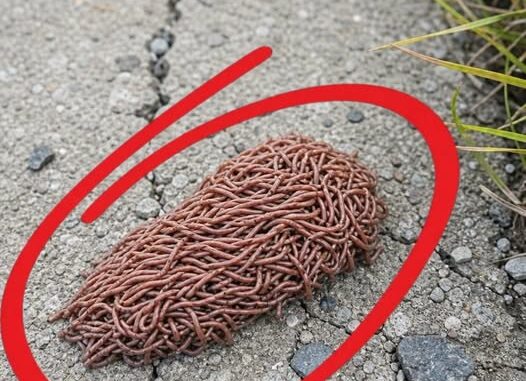
Across the damp grass were dozens of earthworms, their bodies glistening in the morning light. Some were scattered across the lawn, while others had gathered into tangled groups.
For a few seconds, I couldn’t figure out what I was seeing.
It was an unsettling sight.
The yard was familiar. I’d walked across it countless times without giving the ground much thought. Yet that morning, it suddenly seemed as though an entirely different world had appeared beneath my feet.
Then I remembered the rain.
Why Were So Many Earthworms on the Surface?
After periods of heavy rainfall, it’s common to see earthworms above the soil.
Earthworms normally spend most of their lives underground, where they move through soil and feed on organic material. When the ground becomes saturated with water, however, their usual environment changes.
The extra moisture can fill the spaces between soil particles, affecting the conditions in which worms live and move.
As a result, earthworms may emerge onto the surface.
Scientists have proposed several reasons for this behavior, and the exact response can vary depending on the species and environmental conditions.
One explanation is that extremely wet soil can make movement underground more difficult. Another is that emerging onto the surface allows worms to move across the ground more easily.
Whatever the precise reason, seeing earthworms after a substantial rainfall isn’t necessarily a sign that something is wrong with your yard.
In many cases, it’s simply a natural response to changing conditions.
Why Do They Sometimes Gather Together?
The clusters can be particularly surprising.
Rather than remaining evenly distributed across the lawn, earthworms may sometimes appear concentrated in certain areas.
This can happen because of differences in moisture, soil conditions, shade, temperature, or other environmental factors.
What looks like a strange mass from a distance may simply be many individual worms responding to the same conditions.
The sight can certainly be unpleasant for someone who isn’t comfortable around worms, but it doesn’t automatically indicate an infestation or a dangerous problem.
The Rain Changes More Than We Realize
One thing that surprised me most was how quickly a familiar yard could look completely different after heavy rain.
We tend to think of soil as something still and lifeless.
It isn’t.
Beneath the surface is a constantly changing ecosystem containing earthworms, insects, microorganisms, plant roots, fungi, and countless other forms of life.
Most of it remains invisible.
A few hours of unusual weather can temporarily bring some of that hidden activity into view.
That’s why a morning walk after rainfall can reveal things you wouldn’t normally notice.
You might see worms crossing sidewalks, insects moving through wet leaves, or other small creatures taking advantage of the changed conditions.
Earthworms Are Important for Healthy Soil
Although finding a large number of worms on your lawn may be surprising, earthworms generally play an important role in soil ecosystems.
As they move through the soil, they create channels that can help improve soil structure and movement of air and water.
Their activity also contributes to the breakdown and recycling of organic material.
Earthworm castings—the material they leave behind after digestion—contain nutrients and can contribute to soil fertility.
For gardeners and homeowners, their presence is often considered one indication of biological activity in the soil.
Of course, seeing worms on the surface doesn’t tell you everything about the overall health of your lawn.
But these small creatures are an important part of many soil environments.
Should You Be Worried?
Usually, there is no reason to panic simply because earthworms appear after rain.
If you suddenly notice many of them in your yard, observe what is happening before assuming there’s a problem.
Heavy rainfall is one of the most straightforward explanations.
If the worms disappear as the ground dries, there’s generally little reason to be concerned.
However, if you notice unusual changes in your lawn along with persistent drainage problems, soil erosion, standing water, or other concerns, it may be worth investigating the condition of the yard itself.
The worms may simply be responding to an environmental change rather than causing it.
A Strange Sight With a Simple Explanation
Standing there that morning, I initially felt uneasy.
The sight of so many earthworms moving across the grass was completely unexpected.
But once I understood what was happening, the scene became less frightening and much more interesting.
Nothing mysterious had invaded the yard.
There was no unusual creature lurking beneath the grass.
It was simply nature responding to rain.
That experience also changed how I look at the ground around my home.
A yard can appear perfectly still, but beneath that surface, an entire ecosystem is constantly active.
Earthworms are moving through the soil. Roots are growing. Microorganisms are breaking down organic material. Insects are moving through tiny spaces that we rarely notice.
Most of this activity happens without us ever seeing it.
Then, every once in a while, the right combination of weather and conditions brings a small part of that hidden world into view.
For me, that happened after a rainy morning.
What first looked strange turned out to be a simple reminder that there’s far more happening beneath our feet than we usually realize.
And the next time I step outside after a heavy rain, I know I’ll be looking a little more carefully.
Leave a Reply